Picture the logistics of NEET-UG 2024. A record 24 lakh registrations, roughly 23.3 lakh candidates who actually appeared, all sitting on the same day, watched by human invigilators in halls across the country. Now picture a paper leak reaching the darknet anyway, and UGC-NET being cancelled on 19 June 2024, a day after it ran, on inputs from the Indian Cyber Crime Coordination Centre. Human eyes in a room did not prevent either.
That is the uncomfortable question every Indian EdTech institution is now facing. Do you trust human invigilators, AI proctoring software, or some mix of the two? The honest answer is not "AI wins" or "humans win." It depends on your exam, your volume, and what you can defend when a result is challenged.
This is a straight comparison. Where each approach genuinely wins, where each fails, and why a blended model beats a purist stance for most institutions.
The Data Behind the Debate
Before you pick a side, look at what the adoption numbers and the 2024 exam record actually say.
- India holds roughly USD 0.88 billion of the online proctoring market with about a 35.7% regional share.
- More than 900 Indian universities have moved to online examination models, with 30%+ of higher-ed institutions using online proctoring by 2021.
- Human invigilation did not stop NEET-UG leaks or the UGC-NET cancellation in 2024, proof that neither approach is a silver bullet alone.
See all the data:
| Metric | Figure | Source |
| India share of online proctoring market | ~USD 0.88B (35.7% regional share) | Industry market reports |
| India market CAGR (2024-25) | ~18.3% | Industry market reports |
| Asia-Pacific proctoring adoption rise | ~42% | Industry market reports |
| Indian universities on online exam models | 900+ | Industry market reports |
| Indian HEIs using online proctoring by 2021 | 30%+ | Industry market reports |
| NEET-UG 2024 registrations / appeared | ~24 lakh / ~23.3 lakh | NTA |
| UGC-NET June 2024 | Cancelled 19 Jun 2024 (darknet leak) | Ministry of Education |
The two approaches, defined plainly
Traditional invigilation is a human in the room, or watching a live feed, making judgment calls in real time. It has run exams for over a century and people trust it, partly out of habit.
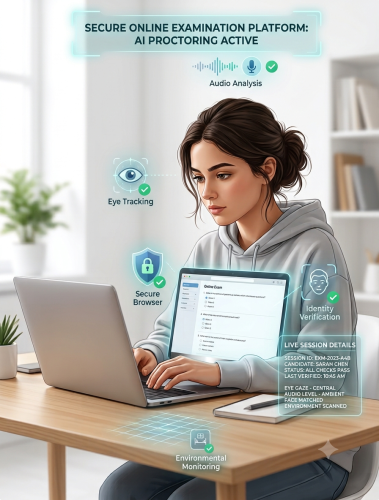
AI proctoring is software that monitors the candidate through their webcam and screen, flags anomalies like a second face, a missing candidate, or tab-switching, and either reviews them automatically or hands them to a human. Proctor360's AI auto-proctoring is the non-disruptive version: it runs in the background, records, flags, and lets a reviewer look at the flags afterward instead of watching every candidate live.
The market has already picked a direction. According to industry market reports for 2024 to 2025, India held roughly USD 0.88 billion of the online exam proctoring market with about a 35.7% regional share, and Asia-Pacific saw a 42% rise in adoption led by India, China, and Southeast Asia. Those same reports show more than 900 Indian universities transitioning to online examination models, with an estimated 30% or more of higher-ed institutions using online proctoring by 2021. Institutions are adopting. The question is how, not whether.
Worth saying plainly before the comparison: this is not a debate about whether machines can replace people. It is about which job each does best, and how a testing team assigns those jobs so an exam stays both fair and cheat-resistant.
Head to head
Here is the comparison stripped to what actually matters for an exam team.
| Factor | AI Proctoring | Traditional Invigilation |
| Cost per candidate | Low and flat as volume rises | High; more candidates need more staff |
| Scale | Handles thousands in parallel | Capped by seats and staff |
| Coverage | Continuous, records everything | Depends on where the invigilator is looking |
| Human judgment | Weak on context and intent | Strong; reads the room |
| False flags | Higher; software over-flags | Lower on ambiguous behaviour |
| Candidate anxiety | Can feel surveilled | Familiar, but presence adds pressure too |
| Evidence trail | Timestamped recording by default | Often just the invigilator's report |
Read that table and the pattern is obvious. Neither column is all green. They are strong in different places, and that is the whole point.
Where AI proctoring clearly wins
Scale and cost, first. One invigilator can watch a handful of candidates well and a full hall poorly. Software watches ten thousand candidates at the same standard, at a cost that barely moves as numbers climb. For a mock-test platform running lakhs of attempts, or a university replacing physical centres, that is decisive.
Coverage is the second win. A human looks away, takes a break, misses the corner of the room. AI records the whole session, every candidate, start to finish, and never blinks. When a result is disputed weeks later, you have the footage, not a memory.
And the evidence trail comes for free. Timestamped flags and a full recording are just how the system works, which matters more than institutions realise until the first serious challenge lands. Think back to the 2024 exam scandals. When results are contested at scale, the institutions that survive the scrutiny are the ones that can produce a record, not the ones relying on an invigilator's recollection of a hall full of strangers.
Where human invigilation still wins
Judgment. A candidate looks up and to the left. Are they cheating, thinking, or just tired? A human reads context, body language, the whole situation. Software sees "gaze off screen" and raises a flag, and a lot of those flags are nothing.
That is the false-positive problem, and it is real. Over-flagging punishes honest candidates, generates review work, and erodes trust in the system. A nervous student who fidgets is not a cheater, but tell that to a raw AI score. Humans are better at the ambiguous middle, which is exactly where fairness lives.
There is also the human-response side. Someone's connection drops, or they panic, or a genuine emergency happens mid-exam. A person can adapt in the moment in a way pure software cannot.
And it matters more in India than the global averages suggest. Candidates sit in vastly different conditions: a shared room in a small town, a patchy connection, an older laptop, a household that does not go quiet on command. A rigid AI rule that reads "second face detected" the instant a family member walks past will flag thousands of honest candidates in exactly the environments Indian online exams are meant to reach. A human reviewer understands that a mother crossing the frame is not a proxy test-taker. That context is not a nice-to-have here. It is the difference between an exam that works across the country and one that only works for candidates who happen to own a quiet private study.
The case for a blended model
Here is where most institutions get the framing wrong. They treat this as a choice, AI or humans, and pick a side. The better setup uses AI for coverage and humans for judgment.
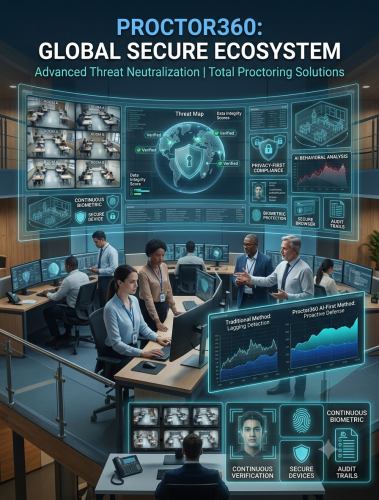
In practice that looks like AI monitoring every candidate continuously and flagging anomalies, with trained human reviewers making the actual integrity decisions on the flags that matter. The software does the watching no human could do at scale. The human does the judging no software should do alone. You get AI's coverage without handing a career-defining verdict to an algorithm, and you get human judgment without asking one person to watch ten thousand exams.
For high-stakes exams, layer in live human proctoring and a second camera angle for the sessions that justify it, and keep lighter AI-only monitoring for high-volume, low-stakes tests. Proctor360's five service levels exist precisely so an institution can blend this way rather than committing to one mode for everything. Its higher-ed remote testing solution is built around matching the level of scrutiny to the exam.
What a serious vendor should give an EdTech institution
If you are blending AI and human proctoring, the vendor has to support both well, not bolt one onto the other. That means genuine AI flagging, real live-proctoring options, modes that scale from light to strict, and a compliance posture that survives a data-protection review under India's DPDP Act.
Proctor360, founded in 2018 and based in Chantilly, Virginia, was built for this range. It offers AI auto-proctoring, single and multi-camera live proctoring, and the patent-pending 360° Total View headset for the exams that need the whole room in view, no competitor offers that hardware. It holds SOC2, GDPR, and FERPA compliance, runs on AWS GovCloud for regulated content, and carries a Gartner Peer Insights rating of 5.0 out of 5 across 3 ratings, ranked number one for service and support. For an institution that wants a blended model rather than a religious war between humans and machines, that breadth is the point.
How to Build Your Proctoring Mix
A blended model is a set of decisions, not a switch. Work through these three.
How high are the stakes of this specific exam?
Stakes set the mix. Low-stakes, high-volume tests can run on non-disruptive AI alone. A final or licensing exam earns live human proctoring and a second camera angle. Decide per exam, not per institution.
Who makes the final integrity call, a human or the software?
A raw AI flag should never void a score. Assign a trained reviewer to judge the flags that matter, and write down how a candidate can respond. The software watches; the human decides.
Can your setup scale to lakh-level cohorts without losing fairness?
India's cohorts are enormous and its testing conditions vary wildly. Confirm your AI can absorb the volume while human review catches the false flags that rigid rules generate in noisy, shared home environments.
Frequently Asked Questions
Is AI proctoring better than human invigilation?
Neither is universally better. AI wins on cost, scale, coverage, and the evidence trail. Humans win on judgment, reading context, and lower false-flag rates. For most institutions a blended model, AI for continuous coverage and humans for the integrity decisions, beats picking one side.
Does AI proctoring produce false accusations of cheating?
It can. Software over-flags ambiguous behaviour like looking away or fidgeting, which is why a raw AI score should never be the final verdict. A trained human reviewer looking at the flagged moments cuts false accusations sharply, which is the core reason to keep humans in the loop.
Can AI proctoring handle exams at NEET or UGC-NET scale?
AI handles massive parallel volume in a way human invigilation cannot, which is its main advantage for exams drawing lakhs of candidates. But scale alone did not stop the 2024 leaks, so volume handling has to sit alongside secure delivery, identity checks, and human review of flags.
Is AI proctoring legal for Indian institutions?
Yes, under the DPDP Act, 2023, which requires free, specific, informed, unambiguous, and withdrawable consent and limits use to the stated purpose. Institutions assessing EU-based candidates must also meet GDPR. Legality depends on doing consent, retention, and transparency correctly, not on the technology itself.
What is a blended proctoring model?
It pairs AI monitoring, which watches every candidate continuously and flags anomalies, with human reviewers who make the actual integrity decisions. The software provides coverage at scale; the human provides judgment and fairness. Layer in live proctoring for high-stakes exams and lighter AI-only monitoring for low-stakes ones.
Choosing the mix that fits your exams
The AI-versus-invigilation debate has a boring but correct answer: use both, and match the mix to the exam. Let software do the watching at scale, let people make the calls that decide someone's future, and turn up the scrutiny only where the stakes justify it.
If your institution is designing that blend, or rethinking a pure-AI or pure-human setup, book a demo with Proctor360 and map the right level of proctoring to each exam in your program.
Schedule a Demo & Subscribe to Our Blog
Designing a blended proctoring model for your institution? Schedule a demo with the Proctor360 team and we will map the right security level to each exam in your program.
Want more guides like this one? Subscribe to the Proctor360 blog for new posts on exam integrity, data privacy, and online proctoring.
References
Online exam proctoring market analyses, India and Asia-Pacific (2024 to 2025). Industry market reports.
Online Exam Proctoring Market Report 2025: global market to nearly triple by 2029. The Business Research Company. globenewswire.com
The 2024 NEET controversy. (2024). Wikipedia. en.wikipedia.org/wiki/2024_NEET_controversy
NEET-UG 2024-25: Record 24 lakh applications received from candidates. (2024). Business Standard. business-standard.com
The Digital Personal Data Protection Act, 2023. Ministry of Electronics and Information Technology, Government of India. meity.gov.in