Key takeaways
- Students have real rights over their proctoring data, including what's collected and how long it's kept.
- Knowing those rights, and how to exercise access or deletion, puts students back in control.
- A trustworthy provider states plainly that data isn't sold or used to train models without consent.
Student Data Privacy in Online Proctoring: Your Rights
Are you sitting an online exam and wondering what happens to your personal information once the session ends? You are not alone. As remote testing becomes the norm across universities and certification programs worldwide, understanding student data privacy in online proctoring is no longer optional, it is essential.
This guide covers what data is collected during a proctored exam, the key risks to be aware of, the legal protections available to you, and practical steps you can take before, during, and after your test.
Why Student Data Privacy in Online Proctoring Matters
Remote testing is a multi-billion dollar industry built to protect exam integrity and ensure fair outcomes. But when monitoring moves into a student's home, it raises valid privacy questions that deserve clear answers. Most students report concern about digital surveillance and how securely their data is stored. As education continues shifting online, knowing your rights around student data privacy in online proctoring helps you stay informed and in control.
What Data Do Online Proctoring Systems Collect?
The amount of data collected depends on your institution's policies and the proctoring vendor they use. Common data points include:
- Webcam and audio recording, The camera captures your face and surrounding environment to detect unauthorized materials, while the microphone records background audio to flag forbidden communication. Recordings are stored securely for human or AI-assisted review.
- Screen activity and browser monitoring, Proctoring software tracks open applications, visited websites, and mouse behavior in real time. A secure browser or lockdown extension blocks new tabs, copy-paste commands, and unapproved programs.
- Biometric identity verification, Advanced systems use facial matching at check-in to confirm you are the registered student and prevent proxy testing. How this data is stored and protected is a critical element of student data privacy in online proctoring.
Key Privacy Risks Students Should Know
- Surveillance in personal spaces, Being recorded at home can feel intrusive and heighten test-day anxiety, particularly when the camera captures more than your immediate workspace.
- Third-party data exposure, Institutions contract with external vendors to deliver proctoring. If a vendor lacks strong cybersecurity controls, your data could be at risk.
- Data retention timelines, The longer your video, audio, and screen recordings are stored, the greater the chance of accidental exposure or misuse.
- Algorithmic bias, Automated facial recognition can produce false flags, especially under poor lighting or for students with darker skin tones. A human review layer is an important safeguard.
Understanding Your Legal Rights
Several global regulations govern how institutions and proctoring vendors must handle your data.
FERPA and US State Laws
Curious how Proctor360 fits your exam program?
See AI, live, multi-cam, and 360° Total View™ proctoring in a quick 30-minute demo.
In the United States, the Family Educational Rights and Privacy Act (FERPA) protects student educational records. Proctoring vendors working with US institutions are bound by FERPA and cannot share your personally identifiable information without cause. Violations can cost institutions federal funding and expose them to civil liability. The California Consumer Privacy Act (CCPA) gives students the right to view captured data and request its deletion. Canada provides similar protections under the Personal Information Protection and Electronic Documents Act (PIPEDA).
GDPR in the European Union
The General Data Protection Regulation (GDPR) requires that student data be collected transparently and only for clearly defined testing purposes. You have the right to access your data, restrict how it is processed, and request deletion under the right to be forgotten. Biometric data falls under Article 9 as a special category, requiring explicit consent and formal Data Protection Impact Assessments (DPIAs).
Other Global Frameworks
Brazil's Lei Geral de Proteção de Dados (LGPD) and India's Digital Personal Data Protection Act both regulate cross-border data transfers and require strong encryption. Illinois enforces strict biometric protections through the Biometric Information Privacy Act (BIPA), mandating opt-in consent and defined data destruction timelines.
Practical Steps to Protect Your Privacy
Before the exam:
- Read the vendor's privacy policy, focusing on how long recordings are stored and who can access them
- Only install proctoring software from links provided by your institution
- Ask your instructor about alternative assessment options if you have specific privacy concerns
During the exam:
- Set up in a quiet, well-lit room with a clear desk and no sensitive documents in the camera's view
- Close all non-essential applications and browser tabs before launching your session
- On a shared device, create a separate user profile exclusively for the exam
After the exam:
- Uninstall the browser extension or application immediately once your exam is submitted
- Contact your institution's privacy officer to formally request deletion of your session recordings and logs as permitted by local law
How Proctor360 Protects Student Data Privacy in Online Proctoring
At Proctor360, student data privacy in online proctoring is built into the platform from the ground up. Here is what that looks like in practice:
- Identity verification at check-in compares your webcam snapshot against your photo ID only, no permanent biometric profiles of your facial geometry are built or stored
- Student session recordings are never used to train AI or machine learning models
- Data collection is limited strictly to what the exam requires, and recordings are automatically purged once the institutional review window closes
- For higher-security multi-camera sessions, simply position your workspace to capture your active desk area while keeping the rest of your living space out of view
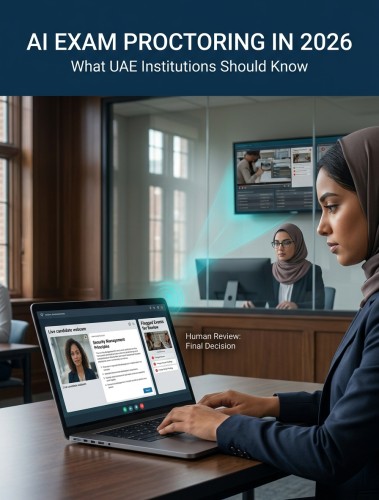
- When AI flags a potential incident, a trained human reviewer evaluates it before any action is taken, this human-in-the-loop model reduces false accusations and protects every student
- If a technical issue occurs mid-exam, Proctor360's 24/7 support team is available to help you resume securely without data loss
What data does Proctor360 collect from students during an exam? Proctor360 collects webcam video, microphone audio, screen activity, and browser process logs during the exam session. A full disclosure of what is collected is provided in the candidate consent notice before every session. What rights do students have over their proctoring data under FERPA? Under FERPA, students have the right to inspect their education records, request correction of inaccuracies, and consent to disclosure of their records to third parties. Proctoring session data constitutes an education record when maintained by the institution. Can students request deletion of their exam recordings? Students can request deletion through their institution, which then directs Proctor360 to delete the associated recordings. Proctor360 processes verified deletion requests within 30 days. What are students' rights under CCPA for proctoring data? California students have the right to know what personal data is collected, to opt out of sale (Proctor360 never sells student data), to request deletion, and to non-discrimination for exercising these rights. Does online proctoring data get used to train AI models? No. Proctor360 does not use student exam recordings or session data to train AI models without explicit, documented institutional consent. Student data is used solely for the purpose of exam integrity monitoring. Ready to see Proctor360 in action? Get a 30-minute demo tailored to your exam type, whether that is AI, live, multi-cam, or 360° Total View™. Kranthi Bathula is the Co-Founder and CTO of Proctor360 and an online proctoring and assessment-security expert with extensive experience in EdTech, exam integrity, and AI-enabled test monitoring. He writes about remote proctoring, test security, AI in assessments, live and automated proctoring, and best practices for secure online testing. Through his engineering-driven insights, Kranthi helps educational institutions, certification bodies, and employers make informed decisions to protect the integrity of their exams.Frequently Asked Questions (FAQs)