Key takeaways
- AI proctoring helps close the gaps that make Indian entrance exams a target for organized cheating.
- Continuous identity checks and environment monitoring counter impersonation and outside help.
- At entrance-exam scale, the technology has to stay fair and accessible, not just strict.
How AI Proctoring is Transforming Entrance Exam Security in India
Twenty-four lakh students registered for NEET-UG 2024. Roughly 23.3 lakh sat down to write it. Then came the allegations that the question paper had leaked, that some candidates had paid between 30 and 50 lakh rupees for it, and that a network of middlemen had monetized the most watched exam in the country. Bihar police arrested 13 people. The NTA Director General was dismissed. The CBI took over.
That is what a broken chain of custody looks like at national scale. And it was not an isolated failure. The same month, UGC-NET June 2024 was cancelled after the paper surfaced on the darknet.
For anyone running entrance exams in India, the lesson landed hard. Paper-based and center-based delivery moves a physical document through dozens of hands, and every hand is a point of failure. AI proctoring changes the geometry of the problem. It moves the exam into a controlled digital session where the paper never exists as a leakable object in the first place.
The Cracks in Center-Based Entrance Exams
India's entrance exam ecosystem is enormous. NEET-UG alone pulled around 24 lakh registrations in 2024. CUET-UG added another 13 to 14 lakh. Multiply that by JEE, state CETs, and hundreds of university-level tests, and you have tens of millions of high-pressure sittings a year.
Physical delivery struggles at that volume. Papers are printed, transported, stored, and distributed. Each step assumes trust. When trust breaks, as it did in 2024, the fallout is national.
The economics of the leak market make this predictable. When a single medical seat can change a family's trajectory, and a leaked paper is worth 30 to 50 lakh rupees to the right buyer, someone will always try to intercept the document. You cannot moralize that incentive away. You can only remove the object being sold. That is the core structural argument for moving high-stakes exams into a delivery model where no static master paper exists to be stolen in the first place.
Center-based exams also carry human problems that no invigilator can fully catch. Impersonation. Coordinated seating. Bluetooth devices. A single stressed invigilator cannot watch 200 candidates with the attention a camera gives to one. That gap is exactly where AI proctoring earns its place.
Scale makes the math brutal. When more than 900 Indian universities moved to online examination models and, by 2021, an estimated 30% or more of higher-ed institutions had begun using online proctoring, they were not chasing a trend. They were responding to volume that manual invigilation could no longer police fairly. A camera that watches one candidate at full attention, replicated across tens of thousands of sessions, is a genuinely different kind of oversight than a hall monitor.
How AI Proctoring Closes the Gaps
AI proctoring is not one technique. It is a stack of them, layered so the weaknesses of any single method get covered by another.
The Paper Never Leaks Because It Never Sits Still
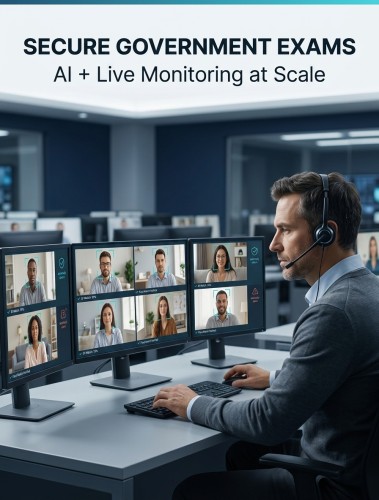
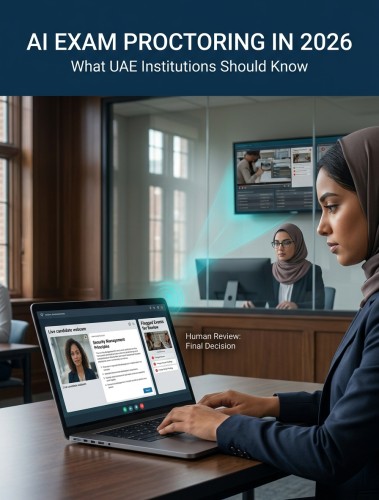
In a properly run online entrance exam, questions are served from a secure engine, often randomized per candidate, and rendered inside a locked session. There is no printed master to steal weeks in advance. The AI auto-proctoring layer then watches the session itself: face presence, gaze direction, multiple faces, unexpected audio, tab-switching. It flags anomalies without a human needing to stare at every feed.
That does not eliminate every risk. But it removes the specific failure that gutted NEET-UG and UGC-NET, the advance leak of a static paper.
There is a second benefit that gets overlooked. Because each session is recorded and time-stamped, the exam body has an evidence trail. When a result is challenged, and at this scale results are always challenged, you can point to the session footage rather than an invigilator's memory. Disputes get resolved on evidence instead of allegation.
Layered Modes Match the Threat
Here is where the smart programs pull ahead. They do not apply one blunt setting to every exam. They stack modes.
AI auto-proctoring runs quietly in the background for scale. Live proctoring adds a human who can intervene in real time. Multi-cam proctoring uses the candidate's phone as a second camera, so the examiner sees both the screen and the wider desk. And for the highest-stakes sittings, 360° Total View™ uses a headset that captures the candidate's entire environment. A proxy sitting off to the side, a hidden phone, a second screen, all of it comes into frame. No competitor offers that hardware.
Curious how Proctor360 fits your exam program?
See AI, live, multi-cam, and 360° Total View™ proctoring in a quick 30-minute demo.
Think of it as a dial. A qualifying test needs less. A medical entrance exam needs the whole stack.
The stacking matters because attackers adapt. Block the second screen and they try an earpiece. Block the earpiece and they try a proxy in the room. A single detection method invites a single workaround. Layered modes force a cheater to defeat several independent systems at once, which is far harder and far more likely to trip a flag. That is the design principle behind matching intensity to stakes rather than trusting one clever feature to do everything.
Identity Verification Before the First Question
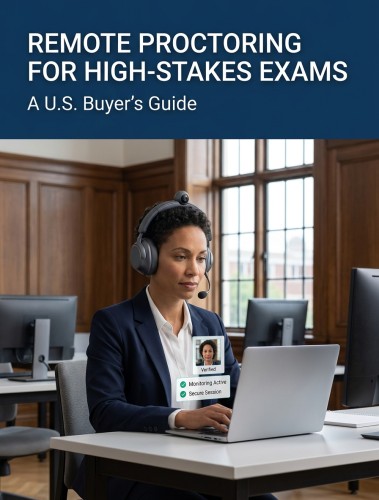
Proxy candidates have plagued Indian entrance exams for decades. AI proctoring front-loads the defense. ID capture, face-presence confirmation, and a room scan happen before the exam unlocks. The person who registered has to be the person in the chair, and the room has to be clear, before a single question appears.
At a center-based exam, verification is a glance at an admit card and a photo, done in seconds by an invigilator watching hundreds of faces. A digital ID gate is more thorough and more consistent. It does not get tired at hour three, and it does not wave through a familiar face.
The Regulatory Backdrop Now Rewards Doing This Properly
The 2024 scandals produced law, not just outrage. The Public Examinations (Prevention of Unfair Means) Act, 2024 was implemented on 21 June 2024, giving India a national anti-cheating framework with real teeth for organized exam fraud.
Data law tightened in parallel. The Digital Personal Data Protection Act, 2023 governs how you handle candidate footage and biometric checks. It is consent-first, purpose-limited, and carries penalties up to 250 crore. For minors, it demands verifiable parental consent and bans behavioral monitoring of children. So the modern entrance exam has to be both harder to cheat and cleaner on privacy. Those two goals used to feel opposed. Done right, they are not.
The market reflects the shift. According to industry market reports, India held around USD 0.88 billion of the online proctoring market with an 18.3% CAGR across 2024 to 2025, and Asia-Pacific adoption rose roughly 42%, led by India. Institutions are voting with their budgets.
Read the two laws together and a picture emerges. The Prevention of Unfair Means Act raises the penalty for organized cheating. The DPDP Act raises the penalty for careless data handling. An exam body now sits between them. Under-invest in integrity and you risk a leak scandal. Over-collect or mishandle candidate footage and you risk a data penalty. The only comfortable position is a proctoring setup that is genuinely secure and genuinely privacy-clean at the same time. That is a higher bar than most legacy systems were built to clear.
What a Serious Proctoring Vendor Should Provide for Entrance Exams
An entrance exam is a public trust. The vendor behind it needs infrastructure built for sensitive content, layered proctoring that scales, and compliance a regulator will accept.
Proctor360 covers that ground. It runs five service levels, so a program can match security to the specific exam rather than over- or under-proctoring everything. It holds SOC2, GDPR, and FERPA. For the most sensitive, regulated content, it hosts on AWS GovCloud, an environment very few proctoring vendors operate in, and it serves federal clients with strict data-residency and security requirements. On Gartner Peer Insights it holds a 5.0 out of 5 and ranks first for service and support among remote proctoring vendors.
For an exam body deciding how to protect the next NEET-scale cohort, that combination of hardware, tiered modes, and regulated hosting is the point. The technology exists to prevent 2024 from repeating. The question is whether programs adopt it before the next paper leaks.
Worth saying plainly: no proctoring system is a magic shield, and any vendor claiming zero risk is overselling. What good AI proctoring does is shift the odds hard against the cheater and give you defensible evidence when a result is contested. For exams that decide medical seats, teaching eligibility, and university admission, shifting those odds is not a nice-to-have. It is the job.
Frequently Asked Questions
Can AI proctoring stop question paper leaks like NEET-UG 2024?
It removes the main cause. Leaks like NEET-UG and UGC-NET involved a static physical paper that could be stolen in advance. A secure online exam serves randomized questions from an engine inside a locked session, so there is no master document to leak weeks ahead. AI monitoring then guards the live session itself.
How does AI proctoring detect a proxy or impersonator?
It layers checks. ID capture and face-presence confirmation verify the registered candidate is the one testing. A pre-exam room scan clears the space. For the highest stakes, a 360° Total View™ headset captures the whole room, so a second person feeding answers off-camera has nowhere to hide.
Is AI proctoring legal under Indian exam and data laws?
Yes, within the rules. The Public Examinations (Prevention of Unfair Means) Act, 2024 supports stronger integrity measures, and the DPDP Act, 2023 governs candidate data. You must obtain valid consent, limit data to the stated purpose, and secure verifiable parental consent for candidates under 18.
What is the difference between AI auto-proctoring and live proctoring?
AI auto-proctoring runs automatically in the background, flagging anomalies like multiple faces or tab-switching without a human watching each feed, which makes it ideal for scale. Live proctoring adds a human who can intervene in real time. High-stakes entrance exams often combine both.
Do students need special hardware for AI proctoring?
Usually not for standard modes, which run on a webcam and browser. Multi-cam proctoring uses the candidate's own phone as a second camera. The 360° Total View™ headset is specialized hardware reserved for the most sensitive exams where full room capture is required.
The Bottom Line
India's 2024 entrance exam scandals were not a technology failure. They were a chain-of-custody failure that technology is built to fix. AI proctoring, layered with live and 360-degree monitoring, closes the gaps that plagued paper-based delivery, and the new legal framework rewards programs that adopt it responsibly.
If you run entrance or admission exams and want to see how tiered AI proctoring holds up at scale, book a demo with Proctor360 and map the right security level to each exam in your calendar.
Ready to see Proctor360 in action?
Get a 30-minute demo tailored to your exam type, whether that is AI, live, multi-cam, or 360° Total View™.
Kranthi Bathula is the Co-Founder and CTO of Proctor360 and an online proctoring and assessment-security expert with extensive experience in EdTech, exam integrity, and AI-enabled test monitoring. He writes about remote proctoring, test security, AI in assessments, live and automated proctoring, and best practices for secure online testing. Through his engineering-driven insights, Kranthi helps educational institutions, certification bodies, and employers make informed decisions to protect the integrity of their exams.