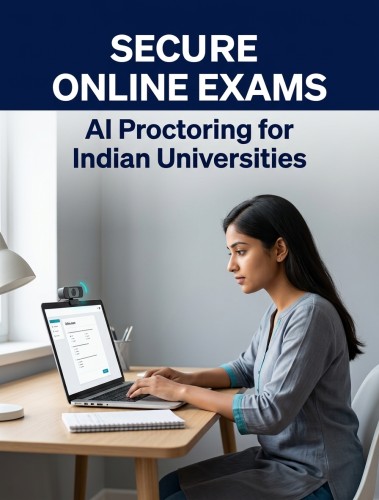
Why Indian Universities Are Adopting AI-Based Remote Proctoring
A state university in central India admits 900 students to an online MBA. The programme is approved, the curriculum is fine, the fee structure works. Then the examination controller sits down to plan end-semester assessment and finds the constraint nobody costed: the regulation requires proctored examinations, the students are spread across eleven states, and the university has three examination halls.
That arithmetic is why AI proctoring in India has moved from an experiment to a line item. Not because universities are enthusiastic about surveillance technology. Because the alternative is either capping online enrolment at whatever the physical infrastructure supports, or running an assessment process that will not survive scrutiny.
This article looks at what is actually driving adoption in Indian higher education, what the regulator requires, and what a university should insist on before signing.
The regulator made proctoring a condition, not a choice
The University Grants Commission's Distance Education Bureau requires examinations for online programmes to be conducted in proctored mode, in line with any norms the Commission stipulates for such examinations.
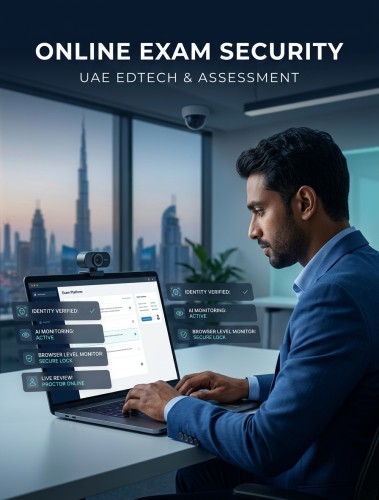
Under the UGC (Open and Distance Learning Programmes and Online Programmes) Regulations, 2020, a proctored examination is one run under the supervision of an approved person, or through technology-enabled proctoring, that safeguards both the identity of the test taker and the integrity of the test-taking environment, whether the exam is pen-and-paper, computer-based or fully online.
Read the definition carefully. It puts identity and environment on equal footing. A system that verifies who the candidate is but cannot see what is in the room satisfies half of it.
The scale argument is the one that actually moves budgets
India's higher education system is not comparable to any other in size, and the growth is recent enough that infrastructure has not caught up.
The Ministry of Education's All India Survey on Higher Education for 2023-24 records total enrolment at 4.50 crore, up from 3.42 crore in 2014-15, a 31.5 percent increase across the decade. Gross Enrolment Ratio reached 30 in 2023-24, against 23.7 in 2014-15. The survey covered 59,533 participating institutions out of 64,756 registered.
Consider what a decade of that growth does to examination logistics. Enrolment expands faster than examination halls get built, and the students added at the margin are disproportionately the ones for whom travelling to a centre is hardest.
The national testing bodies already operate at a scale that makes the point. The National Testing Agency scheduled NEET (UG) 2025 for over 22.7 lakh registered candidates across more than five thousand centres in India and 13 cities abroad. Individual universities do not operate at that volume, but they compete for the same physical centre capacity during the same examination windows.
Accessibility across states is a genuine equity argument
Here is where the debate in India gets framed wrongly. Remote proctoring is usually discussed as a cost saving, and it is one. But the more defensible argument is about who gets to sit the exam at all.
A working student in a district town, a woman whose family will not sanction two days of travel, a candidate with a mobility impairment, a serving defence personnel posted somewhere without a nearby centre. Every one of them is a candidate the centre-based model quietly filters out.
AISHE data shows female enrolment rising from 1.57 crore in 2014-15 to 2.24 crore in 2023-24, with the Gender Parity Index at 1.08 in 2023-24 and above 1.0 for seven consecutive years. Sustaining that requires assessment infrastructure that reaches people where they are.
Cost matters too, and it is not marginal. Centre-based examination for a distributed cohort means hall hire, invigilator payments, question paper transport and secure storage, per city, per session. Remote proctoring converts that fixed and lumpy cost into a per-session variable cost. For a university with 900 students spread across eleven states, remote proctoring is likely to be the cheaper option, and the comparison is worth pricing out.
Exam integrity is now a statutory matter
Adoption is also being pushed by a hardening legal environment around examination malpractice.
The Public Examinations (Prevention of Unfair Means) Act, 2024 covers recruitment examinations run by bodies including the Union Public Service Commission and the Staff Selection Commission, as well as entrance tests including NEET, JEE and CUET. It makes question paper leakage, tampering with answer sheets and computer systems, manipulation of examination processes, and organised facilitation of unfair means criminal offences.
The Act does not apply directly to a university's internal end-semester examinations. What it does is set the public expectation. Once national examinations are governed by criminal statute, a university that cannot demonstrate basic controls over its own assessments looks negligent by comparison, particularly when a degree is challenged.
Data protection is the part universities underestimate
The Digital Personal Data Protection Act, 2023 changes the compliance picture for any institution recording candidates.
Under the DPDP Act, a university acting as a data fiduciary has obligations around notice, consent, purpose limitation and security safeguards for the personal data it processes. Examination session recordings, identity documents and facial images sit squarely inside that.
Three questions a university should settle before procurement:
- Where is session data stored and processed, and does the contract state it?
- What is the retention period for each data type, and who confirms deletion?
- Can recordings be used for anything other than the stated examination purpose, including model training?
If the vendor cannot answer in writing, that is your answer.
Matching the monitoring tier to the examination
Universities that deploy one monitoring level across every assessment either overspend or underprotect. Usually both, in different places.
Weekly quizzes and formative assessments need identity assurance and a deterrent, not a live human. Automated check-in, automated ID verification, screen and camera recording with incident flagging covers that band well and scales to whatever enrolment throws at it.
End-semester examinations that determine degree classification are a different risk. A live proctor who can intervene mid-session, combined with secure exam password entry, changes what is possible for a candidate to attempt.
For professional programmes where a compromised result carries downstream consequences, and for any assessment still delivered on paper, the camera frame itself becomes the limitation. That is the gap a second camera angle or hardware-level 360-degree monitoring exists to close.
What a serious proctoring vendor should provide
State the requirements independently of any supplier.
Multiple security tiers, so examination risk drives cost. Automated check-in and ID verification, because live check-in does not scale to a large distributed cohort. Tolerance for low-bandwidth and mid-range devices, which is not optional for a student population spread across districts. Clear data residency and retention terms compatible with the DPDP Act. Compliance attestations that hold up under institutional review. Integration with the LMS the university already runs. Support that covers the full examination window, including weekends. Regular internal and external penetration and load testing, with separate accounts per institution.
Proctor360 operates in India through an international partner, alongside partners in the UK, Brazil, Singapore and Spain. The platform holds SOC 2 Type I, GDPR and FERPA compliance, keeps each organisation's data in a segregated storage account, performs background checks on staff, and runs regular internal and external security penetration and load tests. Its higher education remote testing offering is built around university examination workflows, and 11 named LMS and test-engine integrations are published rather than described generically.
Proctor360 offers five service tiers: AI Auto-Proctoring, AI Auto-Proctoring with Intervention, Single Webcam Live, Multi-Cam Live, and Institutional SaaS Remote Proctoring. They map onto the risk bands above. AI auto-proctoring handles automated check-in, automated ID verification, screen, camera and audio recording, and 24/7 incident flagging. Single-webcam live adds a proctor who can intervene during the session. Multi-cam live proctoring uses the candidate's own phone as a second camera, which matters in a market where most students already carry the required hardware, and each camera is recorded as its own view that a reviewer can play back individually. Institutional SaaS Remote Proctoring lets a university use its own staff as proctors. Default retention is six months. For professional programmes and paper-based assessments, 360° Total View™, a patent-pending headset with a 360-degree camera, microphone and speaker, delivers test-centre-grade capture of the entire room and supports paper examinations as well as online ones. G2 rates the platform 4.9 out of 5 across 14 reviews, and Gartner Peer Insights shows 5.0 out of 5 from 3 ratings.
Frequently Asked Questions
Is AI proctoring allowed for Indian university examinations?
Yes. The UGC's regulations for open, distance learning and online programmes require examinations to be conducted in proctored mode, and the definition of a proctored examination explicitly includes technology-enabled proctoring that safeguards the identity of the test taker and the integrity of the test-taking environment. Universities should confirm their specific programme approval conditions with the Distance Education Bureau.
What does UGC mean by proctored mode?
Under the UGC (Open and Distance Learning Programmes and Online Programmes) Regulations, 2020, a proctored examination is one run under the supervision of an approved person or through technology-enabled proctoring, covering pen-and-paper, computer-based and fully online modes. The definition requires both identity verification and integrity of the testing environment, which means a system that only checks identity does not fully satisfy it.
Does remote proctoring work for students with limited internet bandwidth?
It depends on the tier and the platform's engineering. Ask any vendor for its minimum bandwidth and device specification, and how it handles a dropped connection. Proctor360's platform attempts an automatic reconnect if a student's connection drops, and a pre-exam system check tests bandwidth, camera, microphone, browser extension and operating system before the session starts. It runs in the browser on a desktop or laptop. Run a pilot with students on actual district-level connections and mid-range devices before committing, since vendor performance claims are usually measured under better conditions than your cohort will have.
How does the DPDP Act apply to examination recordings?
A university processing candidate personal data acts as a data fiduciary under the Digital Personal Data Protection Act, 2023, with obligations covering notice, consent, purpose limitation and security safeguards. Session video, audio and identity documents fall within scope. Write storage location, retention period and deletion confirmation into the vendor contract rather than relying on a privacy policy.
Is remote proctoring cheaper than centre-based examination?
For a geographically distributed cohort, generally yes, because it replaces per-city hall hire, invigilator payments and secure question paper logistics with a per-session cost. The saving narrows for cohorts concentrated in one city. Compare against your actual student distribution rather than a national average, and price each security tier separately.
Can AI proctoring detect a second person in the room?
Audio analysis and camera monitoring catch some cases, but a single webcam covers a narrow frame and a second person can sit outside it. A second camera angle, typically the candidate's own phone, or hardware-level 360-degree capture closes that gap. Choose the tier based on what a compromised result would actually cost the institution.
Start from the examination, not from the software
Indian universities adopting remote proctoring successfully tend to do the same thing first. They sort their assessments by consequence, decide what evidence they would need if a result were challenged, and only then look at platforms.
Universities that start from a product demo usually end up with one monitoring tier applied to everything, which is the most expensive way to be under-protected.
To work through tiering against your own examination calendar, schedule a demo and talk to the team about your exam program.
Sources
- Online Learning: UGC regulations and proctored examination requirement, Distance Education Bureau, University Grants Commission
- Union Ministry for Education Releases Reports of the All India Survey on Higher Education (AISHE): 2022-23 & 2023-24, Press Information Bureau, Ministry of Education
- National Testing Agency to conduct NEET UG 2025 examination in India and abroad, Akashvani News, Prasar Bharati
- Public Examinations (Prevention of Unfair Means) Act, 2024, India Code, Government of India
- The Digital Personal Data Protection Act, 2023 (Act No. 22 of 2023), India Code, Government of India
- Higher Ed Remote Testing, Proctor360
- AI Auto-Proctoring, Proctor360
- Multi-cam Live Proctoring, Proctor360
- 360° Total View™, Proctor360
- Book a Demo, Proctor360
Kranthi Bathula is the Co-Founder and CTO of Proctor360 and an online proctoring and assessment-security expert with extensive experience in EdTech, exam integrity, and AI-enabled test monitoring. He writes about remote proctoring, test security, AI in assessments, live and automated proctoring, and best practices for secure online testing. Through his engineering-driven insights, Kranthi helps educational institutions, certification bodies, and employers make informed decisions to protect the integrity of their exams.