AI and Live Monitoring for High-Volume Government Examinations
When a national recruitment exam is cancelled, the cost is not measured in refunded fees. It is measured in a hiring cycle lost, a court case filed, and a few million candidates who now believe the process is rigged.
Government examinations sit at an awkward intersection. They have to run at a scale no commercial testing program approaches, under public scrutiny no commercial program faces, on a budget set by an appropriations process. And the security requirements often exceed what a standard education-sector proctoring contract covers, because the content is sensitive, the candidate data is protected, and the hosting environment has to satisfy federal rules.
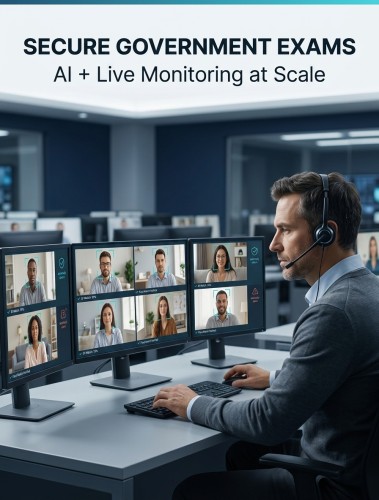
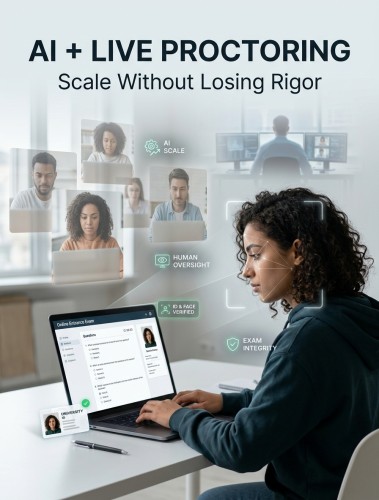
This article looks at what breaks when proctoring for large scale government exams is designed as an afterthought, and how AI monitoring paired with live human proctors handles concurrency, auditability, and secure delivery at once.
The Scale Is Not an Abstraction
India's National Testing Agency scheduled NEET (UG) 2025 for over 22.7 lakh registered candidates, across more than five thousand centres in India and 13 cities abroad, in a single three-hour window. That is roughly 2.27 million registered candidates, all due to write the same paper at the same moment.
Numbers like that change the engineering problem. A system that handles 5,000 concurrent sessions comfortably will not necessarily handle 50,000, and the failure modes are not proportional. Check-in queues bunch at the start. Video upload bandwidth saturates. A proctor-to-candidate ratio that works on a Tuesday afternoon collapses when every session opens within the same ten minutes.
Governments have responded on the legal side as well as the technical one. India enacted the Public Examinations (Prevention of Unfair Means) Act, 2024, which covers recruitment examinations run by bodies including the Union Public Service Commission and the Staff Selection Commission, as well as entrance tests such as NEET, JEE and CUET. The Act makes paper leakage, tampering with answer sheets and computer systems, and organised facilitation of unfair means criminal offences, while candidates themselves remain under the existing unfair-means policy of the conducting authority.
Legislation deters. It does not detect. Detection is still a delivery problem.
Four Things That Fail at Volume
Check-in throughput
Identity verification is the single biggest bottleneck in a high-volume remote exam. If every candidate needs a live proctor to eyeball an ID card, your staffing requirement scales linearly with registration, and it becomes the cost driver for the entire program.
Automated ID verification and automated check-in change that ratio. The system handles the standard case at machine speed and escalates only the exceptions to a human. That is the difference between a proctor workforce sized for peak and one sized for exceptions.
Concurrency without degradation
Ask any vendor a specific question: what load testing have you actually run, and what happened at the ceiling? A platform that has never been pushed past its normal operating band will find its limit during your exam. Regular internal and external load testing should be a contract requirement, not a nice-to-have.
The audit trail
Government exams get challenged. Results get contested in tribunals, in the press, and sometimes in court. Every flag your system raises has to be reconstructible months later: synchronised video, audio, screen capture, timestamped incident records, and a clear chain showing who reviewed what and when.
An unreviewable flag is a liability. It gives a challenger something to point at without giving the awarding body anything to defend with.
Where the data lives
This is the requirement that disqualifies most vendors, and it usually surfaces late in procurement.
Secure Cloud Delivery Is a Hard Requirement, Not a Feature
If your examination touches federal information, the hosting question comes with a defined answer.
FedRAMP was established in 2011 and codified by the FedRAMP Authorization Act in the FY23 National Defense Authorization Act as the authoritative standardised approach to security assessment and authorization for cloud products and services that process unclassified federal information. It leans on NIST standards, FISMA, and OMB Circular A-130.
Where an exam involves Controlled Unclassified Information, the NIST SP 800-171 suite sets out recommended security requirements for protecting the confidentiality of CUI in nonfederal systems and organizations. SP 800-171A adds assessment procedures, and SP 800-172 adds enhanced requirements for content associated with critical programs or high value assets.
Two practical questions follow from that. Where is session data physically stored and processed? And who has access to it, including the humans doing the proctoring?
For export-controlled or otherwise regulated content, the second question matters as much as the first. A US-based cloud region staffed by proctors outside the country does not satisfy the requirement. Neither does a compliant cloud with an offshore support desk that can pull recordings.
Matching Security Tier to Exam Risk
Not every government examination needs the same treatment, and pretending otherwise wastes budget that should go to the exams that matter.
A large open-eligibility screening test with a rotating item bank can run on AI auto-proctoring, with automated check-in, automated ID verification, full screen, camera and audio recording, and incident flagging reviewed after the fact. Volume is high, individual stakes are moderate, item exposure is managed by bank size.
A licensing or security-clearance-adjacent exam is a different animal. Live proctoring with session intervention, secure exam password entry through the browser extension, and proctor chat with phone escalation gives you a human who can stop a session in progress rather than discovering the problem in a post-hoc review. Single webcam live proctoring covers that band.
For the exams where a leaked item bank ends the program, the frame of a single webcam is not enough. A second camera angle closes the off-camera gap, either through multi-cam live proctoring, which uses the candidate's phone, or through 360° Total View™, the patent-pending headset that lets a live proctor see and hear the entire testing space, captured at hardware level rather than software level. The headset also works for paper-based exams, which still make up a large share of government testing and which most remote proctoring platforms simply cannot support.
What a Serious Proctoring Vendor Should Provide
For a high-volume government program, the requirements list is short and unforgiving:
- Multiple security tiers, so exam risk drives cost rather than a single blanket setting.
- Automated check-in and ID verification, because human-only check-in does not scale to six figures.
- Demonstrated load and penetration testing, internal and external, on a regular cycle.
- Complete synchronised recording with a defensible audit trail.
- Compliance attestations that match the sector, meaning SOC 2 at minimum plus FERPA where student records are involved.
- A hosting environment that satisfies federal requirements for the content class in question.
- Personnel controls covering background checks and, for regulated content, citizenship.
- Support available across the exam window rather than during business hours in one time zone.
Proctor360 was built to that shape. Its GovCloud remote proctoring for regulated content runs on AWS GovCloud for regulated and CUI material, staffed by US-citizen proctors trained in data security, with the option for a client's own staff to proctor through its Institutional SaaS Remote Proctoring tier instead. The company runs regular internal and external security penetration and load tests, performs background checks on staff, and keeps each organization's data in a segregated storage account. Select clients in the nuclear energy and specialty risk sectors use this offering, and the wider platform serves federal agencies with strict data-residency requirements.
Proctor360 offers five service tiers: AI Auto-Proctoring, AI Auto-Proctoring with Intervention, Single Webcam Live, Multi-Cam Live using the candidate's phone as a second camera, and Institutional SaaS Remote Proctoring. For the highest-stakes exams, the patent-pending 360° Total View™ headset, with a 360-degree camera, microphone and speaker, adds full-room capture and supports online and paper exams. In multi-cam sessions each camera is recorded as its own view that a reviewer can play back individually, and default retention is six months. Compliance covers SOC 2 Type I, GDPR and FERPA. Gartner Peer Insights rates the platform 5.0 out of 5 from 3 ratings, ranked first for service and support among remote proctoring vendors, with G2 at 4.9 out of 5 across 14 reviews.
Frequently Asked Questions
What is proctoring for large scale government exams?
It is remote or hybrid supervision of public examinations run by government agencies, licensing boards, and national testing bodies, typically involving tens of thousands to millions of candidates in a compressed window. It combines automated identity verification and AI incident detection with live human proctors, and it carries additional requirements around data residency, personnel screening, and audit evidence that commercial testing programs usually do not face.
How many candidates can be proctored at once?
That depends entirely on the platform's tested ceiling and the security tier selected, so ask for load test evidence rather than a marketing figure. AI auto-proctoring scales far higher than live proctoring because it does not consume human capacity per session. Programs that mix tiers, using AI for the bulk and live proctors for flagged or high-risk sessions, generally reach the highest workable concurrency for a given budget.
Does remote proctoring meet federal data security requirements?
It can, provided the platform is hosted in an environment appropriate to the content class. For unclassified federal information, FedRAMP defines the standardized authorization approach. For Controlled Unclassified Information in nonfederal systems, the NIST SP 800-171 suite sets the security requirements. Confirm hosting region, data residency, and proctor citizenship in writing before procurement closes.
Can remote proctoring handle paper-based government exams?
Most platforms cannot, because they monitor the screen rather than the room. Hardware-based 360-degree capture is the exception, since it records the candidate's entire physical space and works whether the exam is delivered on screen or on paper. That matters for government programs where a significant share of testing remains paper-based.
What audit evidence should we require after the exam?
Synchronised video, audio and screen recording for every session, timestamped incident logs tied to specific moments, records of which proctor reviewed which flag, and retention long enough to cover your appeals and litigation window. If a vendor cannot reconstruct a contested session end to end, the flags it produces will not survive challenge.
How do we keep costs down at national scale?
Tier by consequence. Run the highest-volume, lowest-individual-stakes assessments on automated proctoring, reserve live intervention for exams where a compromised result is unrecoverable, and use automated check-in to keep proctor staffing sized to exceptions rather than to peak registration.
Build the Security Tier Around the Exam, Not the Other Way Round
High-volume government testing fails in predictable places: check-in throughput, concurrency ceilings, thin audit trails, and hosting that does not match the content class. Each of those is solvable, and each of them is much cheaper to solve before the exam than after a cancellation.
Map your examination portfolio by consequence and by content sensitivity first. The tier decisions follow from that map almost automatically.
To pressure-test your setup against a real delivery plan, schedule a demo and talk to the team about your exam program.
Sources
- National Testing Agency to conduct NEET UG 2025 examination in India and abroad, Akashvani News, Prasar Bharati
- Public Examinations (Prevention of Unfair Means) Act, 2024, India Code, Government of India
- FedRAMP Program Basics, FedRAMP, US General Services Administration
- Protecting Controlled Unclassified Information (NIST SP 800-171 suite), National Institute of Standards and Technology
- GovCloud Remote Proctoring, Proctor360
- Single Webcam Live Proctoring, Proctor360
- Multi-cam Live Proctoring, Proctor360
- 360° Total View™, Proctor360
- Book a Demo, Proctor360

Kranthi Bathula is the Co-Founder and CTO of Proctor360 and an online proctoring and assessment-security expert with extensive experience in EdTech, exam integrity, and AI-enabled test monitoring. He writes about remote proctoring, test security, AI in assessments, live and automated proctoring, and best practices for secure online testing. Through his engineering-driven insights, Kranthi helps educational institutions, certification bodies, and employers make informed decisions to protect the integrity of their exams.