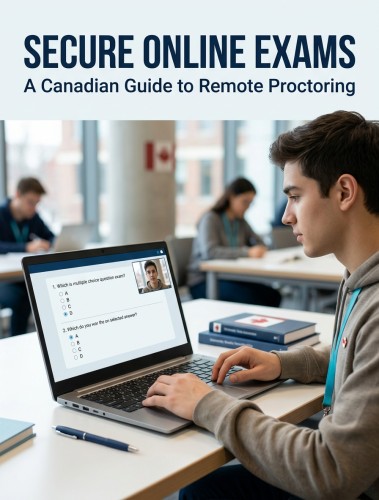
Secure Online Exams in Canada: A Guide to Remote Proctoring Solutions
Picture a registrar's office in Ontario that gets a formal complaint two weeks after finals. A student is asking where her exam recording is stored, who watched it, how long it will be kept, and whether it left Canada. She has copied the provincial privacy commissioner. Nobody in the room can answer question three from memory, and the vendor contract turns out to say "industry standard retention."
That is how remote proctoring goes wrong in Canada. Rarely through a dramatic breach. Usually through a records request that exposes how little the institution actually knows about its own monitoring stack.
Remote proctoring for Canadian universities sits at an awkward intersection: federal privacy law, a patchwork of provincial statutes, bilingual service obligations, accessibility duties, and exams whose results decide professional licensure. This guide covers what to get right and what to put in the contract.
The volume behind the question
Canadian postsecondary education is bigger and more international than it was five years ago, and both facts push assessment online.
According to Statistics Canada, enrolments in public colleges and universities reached 2.3 million students in 2023/2024, up 5.8 percent from 2.2 million the previous year. International student enrolments accounted for most of the growth, rising by 103,953 (22.2 percent), and for the first time in a decade international enrolments in public colleges (288,801) surpassed those in universities (284,160).
Students spread across time zones, countries, and continents cannot all sit in a proctored hall on the same Tuesday morning. That is the practical driver. The compliance work is what follows.
PIPEDA is the floor, not the ceiling
The federal starting point is the Personal Information Protection and Electronic Documents Act. The Office of the Privacy Commissioner of Canada sets out ten fair information principles that govern how personal information is collected, used, disclosed and accessed, and any collection, use or disclosure must be for purposes a reasonable person would consider appropriate in the circumstances.
Three of those principles do most of the work in a proctoring context.
Limiting collection. Collect only what the identified purpose requires. Continuous audio capture of a student's home for a 45-minute multiple-choice quiz is very hard to defend as necessary.
Limiting use, disclosure and retention. The OPC's guidance on limiting use, disclosure and retention requires that personal information be kept only as long as necessary to fulfil the stated purpose. "We keep recordings indefinitely in case we need them" is not a retention policy.
Openness. Students should not have to decode legal language to understand what is happening to their data. If your proctoring notice runs eleven paragraphs of vendor boilerplate, you have failed this principle regardless of what the paragraphs say.
Here is where institutions get tripped up: PIPEDA is not the only law that applies to you, and in many cases it is not the one that applies at all.
Provincial variation is the part people underestimate
Canada does not have a single privacy regime for education. Public universities and colleges are generally governed by provincial public-sector access and privacy legislation, and several provinces have their own private-sector statutes as well. The OPC maintains a summary of provincial and territorial privacy laws and oversight, which is the right place to start rather than assuming your federal analysis carries over.
Quebec deserves its own paragraph. Under Quebec's regime, an organisation that creates a database of biometric characteristics or measurements must declare it to the Commission d'accès à l'information at least 60 days before it is brought into service, and the CAI publishes guidance on biometrics for organisations. Facial matching at exam check-in can fall squarely inside that. If you operate in Quebec and your proctoring vendor performs biometric identity verification, that declaration is a scheduling dependency, not a formality you handle later.
Where the data lives, and who is accountable for it
Data residency questions come up in every Canadian procurement, usually phrased as "does it stay in Canada."
The legal answer is more nuanced than the political one. The OPC's guidelines for processing personal data across borders set out that PIPEDA does not prohibit organisations from transferring personal information to a service provider in another jurisdiction for processing. What it does is keep the transferring organisation accountable for that information, primarily through contract, along with transparency to individuals about the practice.
So the useful procurement questions are not only "where are the servers." They are:
- ● Which entity is the processor, and which subprocessors touch session recordings?
- ● What contractual protections and audit rights do you actually hold?
- ● What are you telling students, in plain language, before they consent?
- ● What happens to the data if you terminate the contract?
Institutions handling sensitive or regulated content should also ask about hardened hosting environments. Proctor360 hosts regulated and Controlled Unclassified Information workloads on AWS GovCloud, keeps each organisation's data in a segregated storage account, runs regular internal and external security penetration and load tests, and background-checks staff. Not every exam needs that tier. Knowing it exists helps you decide which ones do.
Bilingual delivery and accessibility are exam-integrity issues
A student who cannot understand the check-in instructions will fail check-in. That is not an integrity signal. That is a service defect that produces a false flag and, eventually, an appeal.
For Canadian institutions this means candidate-facing support in English and French, not just a translated interface. Support hours have to cover the exam window, including sessions running from Halifax to Victoria and from students sitting abroad.
Accessibility follows the same logic. Proctoring systems that flag atypical eye movement, involuntary motion, or the presence of a support person will generate disproportionate incidents for students with disabilities. The fix is procedural as much as technical: agreed accommodations recorded before the session, human review of every flag rather than automated adjudication, and a documented appeal route. Never let an algorithm be the final word on academic misconduct. That position is not controversial among registrars, but it is surprisingly often absent from the vendor configuration.
What a serious proctoring vendor should provide
Judge vendors against requirements, not features.
A security tier matched to exam risk. A weekly quiz and a professional licensing exam should not receive identical treatment. Proctor360 offers five service tiers: AI Auto-Proctoring, AI Auto-Proctoring with Intervention, Single Webcam Live, Multi-Cam Live, and Institutional SaaS Remote Proctoring, which lets institutions use their own staff to proctor their own candidates. The 360° Total View™ headset covers the highest-stakes exams, as described below.
Recognised compliance posture. Proctor360 holds SOC 2 Type I, GDPR and FERPA compliance, which gives your privacy office something concrete to assess. Each camera in a multi-cam session is recorded as its own view, and default retention is six months.
Hardware-level monitoring where stakes justify it. For high-stakes licensure, the patent-pending 360° Total View™ headset with a camera, microphone and speaker captures the entire room rather than a webcam cone, and it works for paper exams as well as online ones.
Human oversight built into the workflow. Live proctors who can intervene, speak to a candidate, and resolve an ambiguous situation before it becomes an integrity case.
Responsive support across your exam window. Proctor360 is rated 4.9 out of 5 on G2 across 14 reviews and 5.0 out of 5 on Gartner Peer Insights across 3 ratings, ranked first for service and support among remote proctoring vendors.
Clean integration. Eleven named LMS and test-engine integrations, plus support for most common platforms and third-party test publishers, so students never leave the environment they were trained on.
Frequently Asked Questions
Is remote proctoring legal for Canadian universities?
Yes, provided the collection is proportionate to the purpose, students are clearly informed, and the institution complies with the privacy statute that governs it. For most public universities and colleges that is provincial public-sector legislation rather than PIPEDA, so confirm which law applies before designing the notice.
Does exam recording data have to stay in Canada?
Not as a general rule under federal law. The OPC's cross-border guidance permits transferring personal information abroad for processing while holding the transferring organisation accountable for protecting it, chiefly through contract and transparency. Individual provinces and individual institutional policies may impose stricter residency requirements, so check yours.
What are the rules for facial recognition at exam check-in in Quebec?
Quebec requires organisations to declare the creation of a biometric database to the Commission d'accès à l'information at least 60 days in advance, alongside consent and necessity requirements. Budget for that timeline before your exam calendar is locked.
How long should we keep proctoring recordings?
Only as long as needed for the stated purpose, which usually means the appeal and academic-integrity window for that exam, then deletion. PIPEDA's limiting retention principle expects a defined, documented period rather than open-ended storage.
Do we need to offer proctoring in both English and French?
If your institution has bilingual service obligations or serves francophone students, then yes, and it should extend to live support during the exam window rather than only the interface. A student who cannot complete check-in in their own language will generate a false integrity flag.
How do we handle students with accommodations?
Record approved accommodations before the session, configure the proctoring tier accordingly, and require human review of every flagged incident. Automated systems disproportionately flag atypical movement and assistive setups, so the human review step is what keeps the process defensible.
Decide the tier, then write the contract
Canadian institutions rarely lose on proctoring technology. They lose on documentation: unclear notices, undefined retention, and contracts that do not say who holds the data or for how long. Get those three right and most of the compliance risk disappears.
If you are reviewing options for the next exam cycle, schedule a demo and talk to the team about your programme, your governing privacy legislation, and the tier your highest-stakes exams actually need.
Sources
- ● Canadian postsecondary enrolments and graduates, 2023/2024, Statistics Canada
- ● PIPEDA fair information principles, Office of the Privacy Commissioner of Canada
- ● PIPEDA Fair Information Principle 5: Limiting Use, Disclosure, and Retention, Office of the Privacy Commissioner of Canada
- ● Guidelines for processing personal data across borders, Office of the Privacy Commissioner of Canada
- ● Provincial and territorial privacy laws and oversight, Office of the Privacy Commissioner of Canada
- ● Biométrie, Commission d'accès à l'information du Québec
- ● GovCloud Remote Proctoring, Proctor360
- ● AI Auto-Proctoring, Proctor360
- ● Integrations, Proctor360
- ● Book a Demo, Proctor360

Kranthi Bathula is the Co-Founder and CTO of Proctor360 and an online proctoring and assessment-security expert with extensive experience in EdTech, exam integrity, and AI-enabled test monitoring. He writes about remote proctoring, test security, AI in assessments, live and automated proctoring, and best practices for secure online testing. Through his engineering-driven insights, Kranthi helps educational institutions, certification bodies, and employers make informed decisions to protect the integrity of their exams.