AI Proctoring in India: Transforming Secure Online Exams at Scale
Picture a state recruitment board that cancels a paper three hours after it opens. Screenshots of the question set are already circulating on Telegram. Six lakh candidates who travelled to test centres are told to come back in eleven weeks, the board absorbs the cost of a full re-run, and every subsequent notification it publishes gets read with suspicion.
That is the failure mode Indian exam administrators actually plan around. Not one candidate glancing at a phone. A structural breach that voids an entire cycle and lands in the newspapers.
AI proctoring in India has to be understood against that backdrop. The question is not whether a webcam can spot a wandering eye. It is whether a monitoring system can hold up across two million candidates, thirteen languages, five thousand venues, and a legal regime that now criminalises organised exam fraud and separately regulates every byte of candidate data you collect. This article walks through what that actually demands.
The scale problem is not an exaggeration
Look at one exam. According to the National Testing Agency's press release on the NEET (UG) 2026 result, close to 20 lakh candidates appeared at 5,440 centres across 551 cities in India and 14 cities abroad, in 13 languages, with 11.21 lakh qualifying.
That is a single entrance test in a single year.
Now add the Union Public Service Commission, the Staff Selection Commission, railway recruitment, banking recruitment boards, state public service commissions, the certification arms of IT and finance bodies, and the internal assessment programmes of large private universities. India does not have a proctoring market. It has an exam-administration industry running continuously, and remote monitoring is the layer being retrofitted onto it.
Scale changes what "good" means. A proctoring workflow that performs beautifully for a 300-candidate certification cohort can collapse at 300,000 because the reviewer queue backs up, the storage bill balloons, or check-in support lines saturate in the first twenty minutes.
Three sectors, three very different risk profiles
Government recruitment. Highest stakes, highest adversarial pressure, most public scrutiny. The threat is organised: impersonation rings, paid solvers, coordinated leaks. Candidate volumes are enormous and the identity-verification burden is heavy.
Certification and professional licensing bodies. IT vendor certifications, accounting and finance qualifications, healthcare credentialing, safety certifications. Volumes are smaller per sitting but exams run year-round on demand, often across borders, and the credential carries commercial value that makes it worth cheating for. This is where professional certification testing programmes usually need session-level evidence they can defend if a result is challenged.
Large private universities and open-learning programmes. Enormous internal assessment loads, many concurrent sessions, and a student body spread from metro apartments to villages with intermittent power. The stakes per exam are lower. The volume and the device diversity are brutal.
Treating those three as one buying problem is the most common mistake. They need different security tiers, different budgets, and different candidate-support models.
The legal ground shifted twice
Two changes reset the compliance picture for anyone running exams in India.
First, exam fraud became a criminal matter with national reach. The Public Examinations (Prevention of Unfair Means) Act, 2024, which the Rajya Sabha passed in February 2024 and which came into force on 21 June 2024, covers examinations held by the Union Public Service Commission, the Staff Selection Commission, the Railways, banking recruitment examinations, and all computer-based examinations conducted by the National Testing Agency. Organised malpractice is no longer only an administrative embarrassment.
Second, candidate data became regulated. The Government of India notified the Digital Personal Data Protection Rules, 2025 on 14 November 2025, bringing the DPDP Act, 2023 into full operation. Compliance is phased over 18 months. The Rules call for standalone consent notices that state the purpose of collection in plain language, prompt notice to affected individuals after a breach, and heavier duties for Significant Data Fiduciaries, including independent audits, impact assessments, due diligence on the technologies they deploy, and localisation where specified.
Read those together and the implication is direct. You are now expected to catch fraud harder and to justify, in writing, every camera frame and biometric check you use to do it.
What Indian infrastructure actually throws at a proctoring system
Vendors built for a US campus assumption tend to break here. The realities:
- Candidates sit exams on shared laptops, borrowed desktops, and older mid-range machines, not on a standard-issue institutional machine.
- Bandwidth drops. A session that terminates on a 40-second network blip and forces a full restart will generate more grievance tickets than fraud catches.
- Rooms are shared. A candidate in a two-room home with family present is not cheating, and a flagging model that treats every background voice as an incident will drown reviewers in noise.
- Lighting is inconsistent, and low-light performance materially affects face detection accuracy.
- Support has to run in more than English and more than one time band.
A system that cannot degrade gracefully on a weak connection is not a scale system. It is a demo.
Matching security tier to actual exam risk
Not every exam needs the same treatment, and pretending otherwise wastes money on low-stakes sittings while under-protecting the ones that matter.
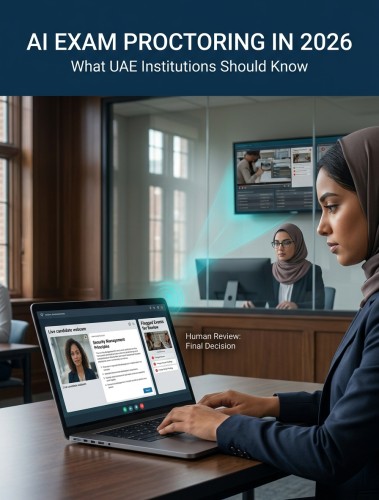
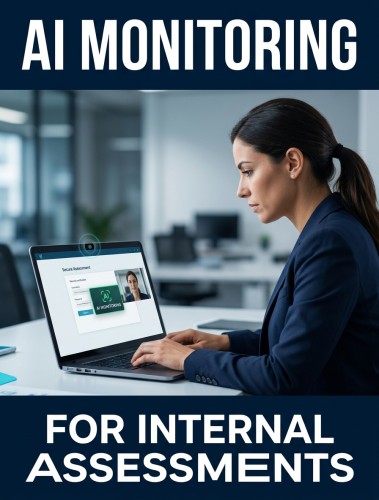
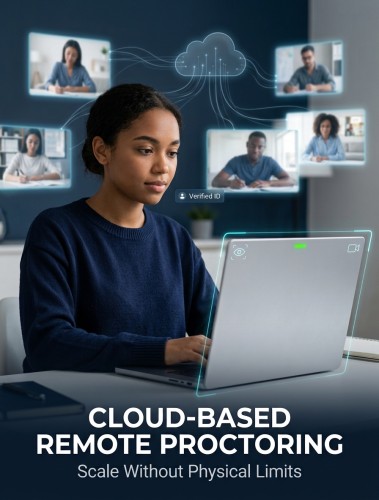
Fully automated monitoring suits high-volume, moderate-stakes assessment: internal university exams, pre-employment screening, recertification. AI auto-proctoring handles automated check-in and ID verification, records screen, camera and audio, flags potential incidents for later review, and runs around the clock without a human watching each candidate live.
Live proctoring earns its cost when a human needs to intervene mid-session, verify something ambiguous, or read the room in real time. Multi-camera setups that use the candidate's own phone as a second angle close the classic blind spot: notes and devices sitting just outside the webcam frame.
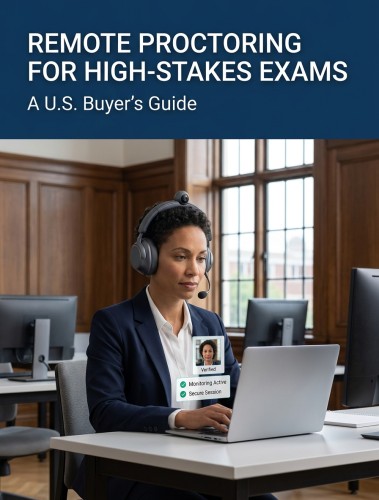
Then there is the top tier, where the exam is worth enough to justify hardware. A 360-degree proctoring headset captures the entire space around the candidate rather than a cone in front of them, and it works for paper exams as well as online ones, which matters for licensing bodies that still run written papers. 360° Total View™ is built for exactly that "test centre grade" requirement.
What a serious proctoring vendor should provide
Strip out the marketing and the evaluation reduces to a short list.
Security tiers, not one product. If a vendor sells you the same configuration for a campus quiz and a national recruitment exam, they have not thought about your programme.
Hardware-level monitoring for the top tier. Software alone cannot see what is taped to the wall behind the laptop.
Demonstrable data governance. Named hosting, documented retention, per-organisation account separation, staff background checks, and regular internal and external security penetration and load testing. Under the DPDP Rules the burden of explanation sits with you, so the vendor has to hand you evidence, not assurances.
Integration that survives your stack. Exam programmes run on an LMS or a test engine. Proctoring that requires candidates to leave that environment adds a failure point at the worst moment. Proctor360 publishes 11 named LMS and test-engine integrations and works with most common platforms and third-party test publishers.
Support that answers during your exam window, in the language your candidates speak. This is the requirement most often discovered too late.
Independent signal on service quality. Proctor360 holds a G2 rating of 4.9 out of 5 across 14 reviews and 5.0 out of 5 on Gartner Peer Insights across 3 ratings, ranked first for service and support among remote proctoring vendors. It has an established partner presence in India, alongside the UK, Brazil, Singapore and Spain.
Frequently Asked Questions
Is AI proctoring legal in India?
Yes. There is no prohibition on remote proctoring, but candidate data collected during a session is personal data under the Digital Personal Data Protection Act, 2023 and the DPDP Rules, 2025. You need a clear, standalone consent notice stating the specific purpose, defined retention, security safeguards, and a breach-notification process.
Can AI proctoring handle exams with lakhs of candidates?
Automated proctoring is the only practical option at that volume, because live human observation does not scale linearly. The design questions are reviewer throughput on flagged sessions, storage and retrieval cost, and whether check-in support can absorb a large simultaneous start.
What happens if a candidate's internet drops mid-exam?
A well-built system resumes the session and preserves the recorded evidence rather than voiding the attempt. Proctor360's platform attempts an automatic reconnect if a student's connection drops, and a pre-exam system check tests bandwidth, camera, microphone, browser extension and operating system before the session starts. Ask any vendor to demonstrate reconnection behaviour on a deliberately throttled connection before you sign, because this is a common source of candidate grievances in India.
Does AI proctoring work for paper-based exams?
Standard webcam proctoring does not, because it watches a screen. Hardware-based 360-degree proctoring does, since it captures the physical space and the candidate's desk. That matters for licensing and certification bodies that still administer written papers remotely.
How is impersonation prevented in remote exams?
Through automated identity verification at check-in, which captures a government-issued ID and confirms face presence on camera, combined with continuous face presence monitoring during the session. For the highest-risk recruitment exams, a live proctor check-in adds a human judgement step that automated checks alone do not provide.
What should we ask a proctoring vendor about data storage?
Ask where session recordings are hosted, how long they are retained and what triggers deletion, whether your organisation gets a separate account, which subprocessors touch the data, and whether the vendor runs external penetration testing. Get the answers in the contract, not the sales deck.
Getting the tier right before the next cycle
The mistake is buying proctoring as a product. It is a capability you tier against risk, and the tiering decision is worth more than the feature comparison. Map your exams by consequence, volume, and adversarial pressure first. Then buy accordingly.
If you are planning a recruitment cycle, a certification calendar, or a semester of remote assessment, schedule a demo and talk to the team about the exam programme you actually run rather than a generic configuration.
Sources
- NTA Declares Result of NEET (UG) 2026, National Testing Agency, Ministry of Education, Government of India
- Rajya Sabha passes 'The Public Examinations (Prevention of Unfair Means) Bill, 2024', Press Information Bureau, Ministry of Personnel, Public Grievances & Pensions
- Government notifies DPDP Rules to empower citizens and protect privacy, Press Information Bureau, Ministry of Electronics & IT
- AI Auto-Proctoring, Proctor360
- 360° Total View™, Proctor360
- Professional Certification Testing, Proctor360
- Integrations, Proctor360
- Book a Demo, Proctor360

Kranthi Bathula is the Co-Founder and CTO of Proctor360 and an online proctoring and assessment-security expert with extensive experience in EdTech, exam integrity, and AI-enabled test monitoring. He writes about remote proctoring, test security, AI in assessments, live and automated proctoring, and best practices for secure online testing. Through his engineering-driven insights, Kranthi helps educational institutions, certification bodies, and employers make informed decisions to protect the integrity of their exams.