AI-Powered Exam Proctoring — What UAE Institutions Should Know in 2026
A dean at a UAE university opens a report the morning after finals. The AI proctoring system flagged 40 sessions as suspicious. Now someone has to decide what those flags actually mean. Were 40 students cheating? Or did the system react to a cough, a glance, a slow internet connection, a candidate rereading a hard question? Get that judgment wrong and you either let cheating slide or you accuse honest students of misconduct. Neither is acceptable.
That decision is the real story of AI proctoring in 2026. The technology has matured. The hype has not entirely faded. And UAE institutions moving to online and hybrid assessment need a clear, honest picture of what AI monitoring does, what it does not do, and where the human still has to stand.
This is that picture. Balanced, specific, and grounded in how these systems actually behave.
What AI Proctoring Actually Does in 2026
Strip away the marketing and AI proctoring does a narrow, useful job. It watches an exam session continuously and surfaces anomalies for review.
It can detect that a second face appeared on camera. That the candidate looked away from the screen repeatedly. That a new voice entered the room. That the browser tried to open another tab. Modern systems run this in the background without interrupting the candidate, which matters, because a system that keeps pausing the exam becomes its own source of stress and disputes.
Proctor360's AI Auto-proctoring is built as a non-disruptive layer. It monitors and flags in the background rather than stopping the candidate to challenge every movement. The exam feels like an exam. The flags accumulate quietly for later review.
That word, "flag," is the whole point. Read the next section carefully.
What AI Proctoring Does Not Do
AI does not decide guilt. This is the single most important thing for a UAE institution to internalize before rolling anything out.
An AI flag is a signal that something happened, not a verdict that cheating occurred. The system saw a pattern. It does not know context. It cannot tell the difference between a student cheating and a student with a nervous habit, a noisy household, a disability, or a bad connection. It flags. A human judges.
AI also does not read minds or prove intent. It cannot confirm a candidate used a hidden phone if the phone stays out of frame, which is exactly why full-environment visibility, and not just AI on a face-cam, matters for high-stakes exams.
And AI is not a substitute for lawful process. A flag does not automatically justify voiding a score. That takes review, evidence, and a fair chance for the candidate to respond.
The False-Flag Problem and Why Human-in-the-Loop Matters
Here is where institutions get burned. They treat the flag count as a cheating count.
Automated systems produce false positives. A candidate who looks down is reading scratch paper, not a phone. A second voice is a family member in the next room, not a collaborator. A dropped connection reads as suspicious behavior when it is just bad bandwidth. If you act on raw flags, you will accuse innocent students, and in a region investing heavily in its academic reputation, that is a serious risk.
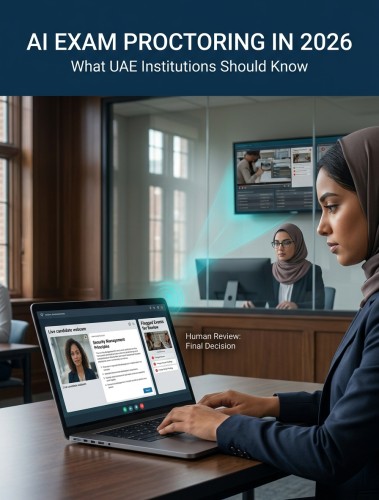
The fix is human-in-the-loop. A trained reviewer looks at the flagged evidence and makes the call. The AI does the tireless watching. The human does the judging. Neither replaces the other.
This is why layered service levels exist. Non-disruptive AI handles the continuous monitoring. Live proctoring adds a human who can watch and intervene in real time. Full-environment tiers give that human enough visual context to judge accurately. Proctor360 runs five proctoring service levels precisely so institutions can put a human where the exam stakes demand one, rather than trusting an algorithm to convict on its own.
The legal record backs this up. According to the brief's case-law research, the Italian Data Protection Authority found a university's use of a proctoring tool violated GDPR, and Bocconi University was fined more than 200,000 euros after a student complaint. But in the Netherlands, the Amsterdam District Court ruled the University of Amsterdam's use of automated proctoring lawful given the specific circumstances, and the Dutch education minister stated that proctoring can comply with GDPR when all legal requirements are met. The lesson is not "AI proctoring is banned." The lesson is that how you deploy it, with what safeguards and what human oversight, decides whether it holds up.
PDPL and GDPR Guardrails for AI Monitoring
AI monitoring is intensive personal data processing. Video of a face, a room, sometimes an ID. UAE institutions have to treat it that way.
According to UAE Federal Decree-Law No. 45 of 2021 (PDPL), effective 2 January 2022, processing must follow lawfulness, fairness, and transparency, with purpose limitation and data minimization built in. The law is consent-first, it grants candidates six rights including access, correction, erasure, restriction, portability, and objection, and controllers must respond within 30 days. The UAE Data Office regulates it. The financial free zones DIFC and ADGM run their own separate regimes, so where your candidates sit changes which rules apply.
GDPR reaches UAE institutions too. It applies to any institution assessing candidates physically located in the EU or EEA, so a UAE university with EU-based online learners is in scope. GDPR's core expectations for high-risk processing are worth stating plainly: a lawful basis, data minimization, transparency with candidates, a data protection impact assessment for high-risk processing, respect for students' rights, and an alternative assessment offered where feasible.
That last point deserves emphasis. Offering a fair alternative to students who cannot or will not consent to invasive monitoring is not just good practice. In the case law above, it is part of what separated a lawful deployment from a fined one.
How UAE Institutions Should Pilot and Roll Out
Do not flip the switch across every exam at once. The institutions that get this right treat it as a phased rollout with checkpoints.
Start with a pilot. Pick one program or a controlled set of exams. Run the AI layer, review the flags, and measure your false-positive rate before you trust it at scale. You are calibrating both the tool and your own review process.
Write the human review process first. Decide who reviews flags, what evidence they see, and how a candidate can respond to an allegation. The process protects your students and your institution equally.
Do the PDPL and GDPR groundwork. Run a DPIA for high-risk processing. Document your lawful basis. Publish clear candidate-facing transparency. Plan an alternative assessment where feasible.
Match the tier to the stakes. Use non-disruptive AI for lower-risk sittings and reserve live human proctoring and full-environment monitoring for the exams where a compromised result carries real consequences.
Then scale. Expand only after the pilot shows your flags are trustworthy and your review process is fair.
For higher education specifically, Proctor360's higher-ed remote testing solution is built around this layered, human-supported model, and the vendor holds SOC2, GDPR, and FERPA compliance. It carries a G2 rating of 4.9 out of 5 across 14 reviews and ranks number one for service and support on Gartner Peer Insights, which matters most in the moments when a flagged session needs a fast, competent answer.
What "Serious" AI Proctoring Looks Like
A credible AI proctoring setup for a UAE institution has a few consistent traits.
- AI that monitors non-disruptively rather than interrupting honest candidates.
- Human-in-the-loop review, so no score is voided on a raw flag.
- Layered tiers, so security matches exam risk instead of one fixed setting.
- Full-environment visibility available for high-stakes exams, not just a face-cam.
- Recognized compliance and a documented process that satisfies PDPL and GDPR.
Proctor360 maps onto that list. Non-disruptive AI Auto-proctoring, live and 360-degree tiers for higher-stakes exams, five service levels to match risk, SOC2, GDPR, and FERPA compliance, and hosting on AWS GovCloud for regulated content. The technology carries the watching. The institution keeps the judgment. That balance is the whole point.
Frequently Asked Questions
Does AI proctoring decide whether a student cheated?
No. AI produces flags, not verdicts. It signals that something anomalous happened during a session, and a trained human then reviews the evidence and decides. Treating raw flag counts as cheating counts is the mistake that leads to false accusations.
How accurate is AI exam proctoring in 2026?
It is useful for continuous monitoring but produces false positives. A candidate looking down, a noise in the room, or a dropped connection can all trigger flags with no cheating involved. That is why human-in-the-loop review is essential rather than optional.
Is AI proctoring legal under UAE PDPL and GDPR?
It can be, when deployed with the right safeguards. UAE PDPL requires lawful, transparent, minimized processing and honors six candidate rights. GDPR applies when you assess candidates in the EU or EEA. Case law shows the outcome depends on deployment: one European university was fined, while another's use was ruled lawful given its safeguards.
Does the UAE PDPL require consent for AI monitoring?
UAE Federal Decree-Law No. 45 of 2021 is consent-first and demands transparency, purpose limitation, and data minimization. Institutions should document their lawful basis, inform candidates clearly, and where feasible offer an alternative assessment for students who do not consent to invasive monitoring.
Should a UAE university roll out AI proctoring across all exams at once?
No. Start with a pilot on a controlled set of exams, measure your false-positive rate, and write your human review process before scaling. Complete a DPIA for high-risk processing and match the proctoring tier to each exam's stakes.
What is the difference between AI proctoring and live proctoring?
AI proctoring watches continuously and flags anomalies automatically without a person present. Live proctoring puts a human proctor in the session to watch and intervene in real time. The strongest setups layer them, using AI for tireless monitoring and humans for judgment and high-stakes oversight.
Put the Judgment Where It Belongs
AI proctoring in 2026 is a strong monitoring layer and a poor judge. Use it for what it does well, keep a human on every consequential decision, and build your PDPL and GDPR groundwork before you scale. That is how a UAE institution gets exam integrity without trading away fairness or compliance.
If your institution is planning or expanding online assessment, talk to the Proctor360 team about a layered, human-supported approach that fits your exam program. Book a demo and see how non-disruptive AI and human review work together.

Kranthi Bathula is the Co-Founder and CTO of Proctor360 and an online proctoring and assessment-security expert with extensive experience in EdTech, exam integrity, and AI-enabled test monitoring. He writes about remote proctoring, test security, AI in assessments, live and automated proctoring, and best practices for secure online testing. Through his engineering-driven insights, Kranthi helps educational institutions, certification bodies, and employers make informed decisions to protect the integrity of their exams.