Key takeaways
- Preventing online cheating starts with understanding the methods, from shared answers to AI tools.
- Layered defenses work better than any single control: identity checks, monitoring, and browser limits together.
- Good exam design plus clear expectations reduces the temptation before monitoring ever comes into play.
The Institutional Guide to Online Exam Cheating Prevention in Digital Education
Is your school or educational institution grappling with the growing challenge of maintaining academic integrity in online exams? With the shift toward digital learning and remote assessments, online exam cheating prevention has become a top priority for educators worldwide. While it is a complex issue, combining targeted strategies with advanced proctoring technology can significantly enhance the security, equity, and fairness of your digital testing environment.
The Online Cheating Epidemic: Understanding the Digital Landscape
The landscape of education has changed dramatically, and so have the methods students use to gain an unfair advantage. Statistics highlight a stark contrast between physical and digital exam environments:
- The Prevalence Gap: Recent academic studies show that 42.3% of students admit to cheating in online courses, compared to just 28.3% in traditional, in-person classrooms.
- The AI Complication: Generative AI tools can instantly write essays, formulate code, or solve complex equations. Roughly 11% of student assignments show at least a 20% mix of AI-generated text, and 3% consist almost entirely of AI output.
- Low Historic Detection Rates: Historically, only about 2% of students who cheat report getting caught. This low visibility creates a dangerous sense of impunity, emphasizing why schools need automated, data-driven approaches to online exam cheating prevention.
Modern Misconduct Methods
Today's students easily bypass simple, single-camera monitoring setups. Common strategies include using hidden secondary smartphones, connecting unauthorized screen-sharing software, running background messaging apps, or using remote-access tools to let an outside party take the test in real time. The emergence of conversational AI chatbots adds a layer of complexity that renders traditional plagiarism tools obsolete, forcing assessment platforms to adapt.
Online Exam Cheating Prevention: A Core Responsibility
Upholding exam integrity is about protecting the fundamental value of your institution's degrees and certifications. Widespread academic dishonesty degrades institutional reputations and devalues hard-earned credentials in the eyes of future employers.
Implementing ironclad online exam cheating prevention guarantees a fair playing field, ensuring that genuine student understanding is accurately measured and rewarded. A resilient framework requires a deliberate blend of modern security technology, intuitive assessment design, and explicit academic policies.
Key Prevention Technologies: What Actually Works
Modern software architectures provide robust, scalable, multi-layered tools to secure digital exams from onboarding to submission.
1. AI-Powered Proctoring Systems
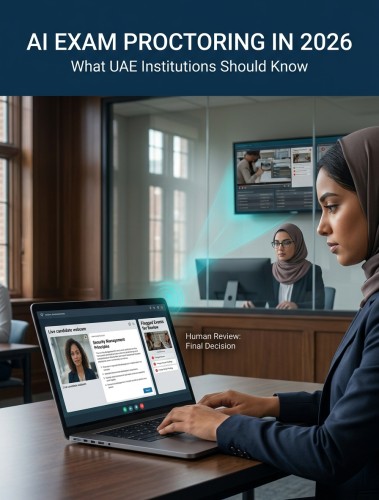
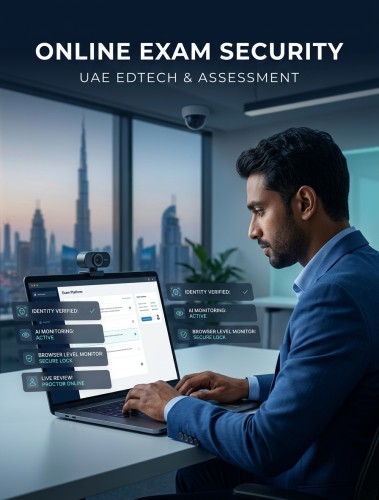
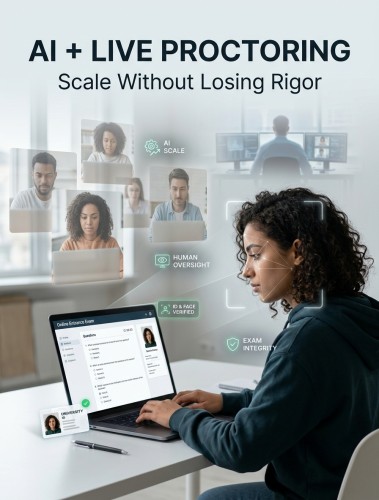
Advanced automated suites achieve a 90% to 95% effectiveness rate in identifying academic misconduct. These systems use machine learning algorithms to verify student identities via automated facial verification, monitor background audio, and flag environmental anomalies like unexpected face departures from the webcam frame.
For high-stakes testing where standard webcams leave physical blind spots, specialized setups use multi-camera ecosystems, such as Proctor360’s patented 360 Total View™ headset or synchronized secondary smartphone streams, to capture a secure, 360-degree view of the student's complete physical environment. Rather than utilizing invasive AI eye-tracking, which often generates high false-positive rates, behavioral anomalies like frequently looking away from the screen are flagged for transparent human auditor review.
2. Browser-Level Security & Extension Controls
Instead of requiring restrictive, heavy standalone application downloads that frustrate students, modern assessment integrity relies on lightweight browser-level security and extension controls. These utilities operate directly within native browsers like Chrome or Edge, tracking user activity and establishing strict navigation constraints.
By securing password entries natively and monitoring active desktop processes, these tools block copy-paste actions, restrict unauthorized browser tabs, and identify dual-monitor configurations. Extension-driven security integrates smoothly into major Learning Management Systems (LMS) like Canvas, Moodle, Blackboard, and D2L Brightspace, providing a frictionless, low-overhead, and cost-effective baseline layer of protection.
3. Continuous Identity Verification Loops
Curious how Proctor360 fits your exam program?
See AI, live, multi-cam, and 360° Total View™ proctoring in a quick 30-minute demo.
To eliminate student impersonation, continuous identity tracking cross-checks the active test-taker's presence throughout the entire assessment window. Rather than capturing permanent, complex biometric data templates or logging typing biometrics, compliant ecosystems run continuous visual matches that compare the live webcam stream directly to the profile verification image captured during check-in. This keeps candidate data secure, protects user privacy, and strictly adheres to local and international data minimization rules.
Strategic Assessment Design for Integrity
Technology alone cannot solve academic dishonesty; how an exam is structured matters just as much. Intelligent test engineering removes the baseline incentives and opportunities to cheat.
Question Randomization & Pools
Drawing variables randomly from an expansive question pool yields a unique exam configuration for every candidate. Shuffling both the question progression and individual multiple-choice answer options cuts collaboration-based cheating by 65% to 70%, making it nearly impossible for students to share answers in real time.
Time Limits & Adaptive Testing
Enforcing strict, per-question or per-section time limits prevents candidates from looking up answers online or referencing external notes. Furthermore, adaptive testing engines dynamically change question difficulty based on prior answers, tailoring the exam layout on the fly to gauge authentic comprehension rather than memorized data.
Engaging & Authentic Assessments
Moving away from simple rote-memorization or fact-recall questions is one of the most effective ways to preserve academic integrity. Designing evaluations built around case studies, complex open-ended problems, presentations, or project-based assignments forces students to provide original, analytical responses that AI tools cannot easily replicate.
Building a Multi-Layered Security Approach
The strongest defense blends security technologies with proactive test design to match the stakes of the exam.
| Exam Stakes | Recommended Security Matrix |
| Low-Stakes Quizzes | Browser extension restriction locks + question randomization. Stops basic digital browsing. |
| Mid-Stakes Midterms | Automated AI behavioral tracking + browser extension locks + strict per-question time constraints. |
| High-Stakes Finals & Certifications | Full suite: Multi-camera hardware validation (Proctor360 headset), continuous identity verification checks, and live or recorded human audits. |
Navigating Regional Compliance and Privacy
Collecting video, audio, and desktop telemetry demands strict adherence to local and international privacy regulations. Organizations cannot afford to compromise student data rights.
- GDPR (Europe): Mandates explicit candidate consent, complete data minimization (only recording variables critical to exam integrity), and verifiable student data erasure pathways.
- FERPA (North America): Regulates the handling of student educational records, ensuring that cloud-hosted telemetry is strictly protected against third-party exposure.
- Privacy-by-Design: Schools should exclusively partner with platforms built on a "privacy-by-design" framework. This architecture safeguards all sensitive user data with end-to-end encryption (both in transit and at rest), explicitly prohibits training AI algorithms on candidate data, and holds verified SOC 2 safety certifications.
Specialized Applications: Beyond Classrooms
Pre-Employment Testing Security
Corporate human resource departments leverage secure remote proctoring to validate applicant skills, protecting recruitment budgets and ensuring candidate verification without adding friction to the hiring pipeline.
High-Stakes Certification Exams
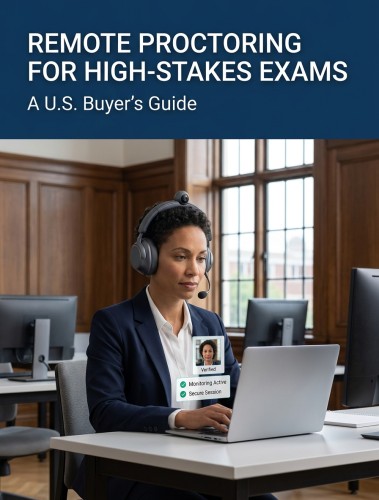
Licensing boards and government organizations combine automated AI screening with certified human reviewers. This hybrid model keeps validation costs manageable while protecting public safety and maintaining international credentialing standards.
Implementation Roadmap for Educational Institutions
- Assess Your Needs: Map your current vulnerabilities, typical concurrent testing volumes, LMS platform configurations, and operational budgets.
- Pilot Program Validation: Run a low-stakes pilot with a focused group of students to test system compatibility and establish internal administrative playbooks.
- Develop Clear Policies: Establish transparent, explicit guidelines regarding candidate expectations, permitted items, and data storage rules. In alignment with strict safety standards, instruct candidates to use institutional IDs or hide highly sensitive personal data (like Social Security Numbers) when completing check-in identity steps.
- Train Staff & Onboard Students: Educate faculty on how to interpret security logs, and provide students with access to low-stakes practice environments to eliminate test-day technical anxiety.
- Review and Optimize: Regularly analyze your proctoring logs and update behavioral parameters to stay ahead of changing compliance rules and emerging digital shortcuts.
Conclusion
Securing digital classrooms does not require overly invasive surveillance. Real success in online exam cheating prevention comes from pairing cutting-edge tools like AI proctoring and browser extension navigation controls with authentic assessment design. This unified approach protects the value of your credentials and fosters a culture of academic honesty, ensuring the long-term validity of online education.
Frequently Asked Questions (FAQs)
What are the most effective methods for preventing online exam cheating?
The most effective approach combines multiple layers: identity verification, 360° camera monitoring or Multi-Cam Live Proctoring, browser extension monitoring, AI behavior detection, and human proctor review. Proctor360 provides all of these in a single integrated platform.
Does online proctoring actually deter cheating?
Yes. Proctor360 clients report a 76% average reduction in confirmed academic dishonesty incidents compared to unproctored online exams. The deterrence effect of monitored exams is well-documented in academic integrity research.
Can students use AI tools like ChatGPT during a proctored exam?
Proctor360's browser extension flags access to external websites including AI tools, monitors clipboard activity, and detects secondary application launches, closing the primary channels through which AI assistance tools are accessed during exams.
How does Proctor360 detect when a student looks at unauthorized notes?
Proctor360's 360° camera captures the full room, including below the desk and to the sides where printed notes are typically placed. AI gaze tracking also detects unusual eye movement patterns consistent with reading off-screen content.
What should schools do when cheating is suspected based on proctoring data?
Schools should initiate their standard academic integrity procedure using Proctor360's incident report, session recording, and AI flag log as supporting evidence. Proctor360 can provide technical documentation to support formal proceedings.
Ready to see Proctor360 in action?
Get a 30-minute demo tailored to your exam type, whether that is AI, live, multi-cam, or 360° Total View™.

Kranthi Bathula is the Co-Founder and CTO of Proctor360 and an online proctoring and assessment-security expert with extensive experience in EdTech, exam integrity, and AI-enabled test monitoring. He writes about remote proctoring, test security, AI in assessments, live and automated proctoring, and best practices for secure online testing. Through his engineering-driven insights, Kranthi helps educational institutions, certification bodies, and employers make informed decisions to protect the integrity of their exams.