How Certification Organizations Prevent Fraud with Remote Proctoring
Picture a psychometrician who flags something odd in the quarterly item analysis. Fourteen candidates, all testing within a six-week window, all in the same metro area, produced near-identical response patterns on a 40-item block. Their scores clustered tightly. Their response times on the hardest items were faster than the cohort average.
That is not a statistical curiosity. That is a live question bank, and the board now has to decide whether to retire 40 items it spent eighteen months developing, whether to invalidate scores, and what it will tell its accreditor at the next review cycle.
Credential fraud in certification does not usually look like someone glancing at a cheat sheet. It looks like proxy testing, systematic item harvesting, and identity substitution. This article covers how those three specifically work, what accreditation standards actually require of your delivery model, and what proctoring software for certification bodies has to do to keep an exam program defensible.
The three fraud patterns that actually threaten a credential
Proxy test-takers. Someone else sits the exam. In a test center this is defeated by a photo ID check at the desk. Remotely, it is defeated only if identity verification is genuinely tied to the person in the chair for the duration of the session, not just at launch.
Item harvesting. Candidates memorize or capture live items and feed them to third-party "practice" sites. This is the expensive one. A leaked bank does not just enable cheating; it destroys the psychometric validity of every score derived from those items and forces a rebuild.
Credential misrepresentation downstream. Someone claims a certification they never earned, or holds one earned fraudulently. Employers absorb the cost. A 2015 First Advantage international survey found that 23 percent of job candidates admitted exaggerating their qualifications to get hired, which gives a sense of how routine credential inflation is even before deliberate fraud enters the picture.
Each pattern needs a different control. Treating them as one problem called "cheating" is how programs end up buying monitoring that stops none of them.
What accreditation actually asks you to prove
Certification bodies do not get to define exam security purely on their own terms. If your program holds NCCA accreditation through the Institute for Credentialing Excellence, or ANAB accreditation under ISO/IEC 17024, the delivery model is part of what gets assessed.
ICE's Security and Confidentiality Checklist, which covers NCCA Standards 10, 11, 12, and 18, is unusually specific about where vendors sit inside the requirement. Standard 18 requires policies and procedures, yours and your vendors', for administering exams under secure and confidential protocols that restrict access to exam content throughout storage, conveyance, administration, and disposal. It requires standardized administration procedures that include verification of candidate identity regardless of the exam delivery or proctoring method. It requires trained proctors, again regardless of delivery method, and proctor training that covers the management and reporting of irregularities. It requires proctor agreements that address conflicts of interest, confidentiality, and confirmation that approved accommodations have been or will be provided.
Note the phrase that keeps recurring: and that of your vendors. Your proctoring provider's policies become part of your accreditation evidence file.
On the international side, ANAB accredits personnel certification bodies against ISO/IEC 17024 and reports more than 200 certifications accredited under the program. ANAB has published a transition timeline for the revised ISO/IEC 17024:2026, with a final transition deadline of March 31, 2029, and it explicitly names AI, competence, and vendor oversight as high-impact areas for programs to assess during that transition.
Vendor oversight. Named as a priority by the accreditor. That is worth planning around now rather than in 2028.
Stopping proxy testing: identity has to persist
Most identity failures in remote testing are not sophisticated. A candidate authenticates with a real ID, then swaps seats. Or a second person sits just outside the camera frame and reads answers aloud. Or the ID presented is real but belongs to a sibling.
A defensible identity chain has four parts:
1. Government ID capture at check-in, compared against the registration record and confirmed against the person on camera
2. Face-presence confirmation rather than a proctor's visual judgment alone, so the check is repeatable and auditable
3. Continuous presence verification through the session, not a single gate at the start
4. Environmental verification that establishes nobody else is in the room and no second device is in use
Point four is where single-webcam proctoring runs out of road. A forward-facing camera sees a face and a slice of wall behind it. It does not see a phone on the candidate's knee, a second monitor angled away, a printed reference sheet taped below the desk edge, or a person seated three feet to the left.
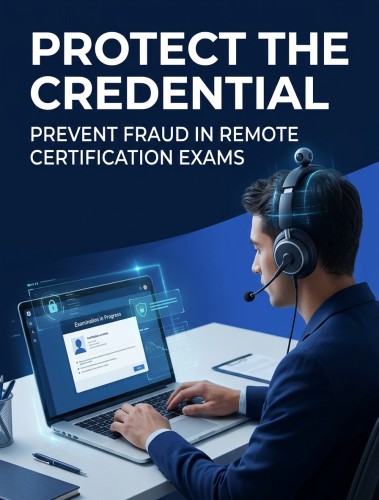
Proctor360's 360° Total View™ addresses that directly with a patent-pending headset carrying a 360-degree camera, a microphone that lets the proctor hear the room, and a speaker that lets the proctor speak to the candidate. The company describes it as test-center-grade security, and the practical point is that it captures the entire space rather than one cone of it. For programs that want a lighter-weight second angle, multi-cam live proctoring uses the candidate's own phone as a second camera and shows the proctor the candidate's desktop.
Stopping item harvesting: detection plus deterrence
You cannot fully prevent memorization. You can make capture hard, make dissemination detectable, and make the consequences credible.
Make capture hard. Screen recording of the full session. Audio capture, which catches a candidate reading items aloud to a recording device or to another person, a method that video alone misses entirely. Room-level monitoring that would show a phone raised toward the screen.
Make dissemination detectable. Run routine item exposure analysis. Watch for response-pattern clustering, unusual speed on high-difficulty items, and score distributions that shift suddenly within a delivery channel or region. Monitor the third-party preparation market for content that mirrors your live bank.
Make consequences credible. Publish your security policy, incident review process, and disciplinary procedures to candidates. ICE Standard 18 asks for exactly that summary as accreditation evidence. Candidates who understand that scores can be invalidated after release behave differently from candidates who assume a pass is permanent.
One honest caveat: rotating item banks aggressively is the most effective structural defense, and it is also the most expensive. Most boards under-invest here and then pay for it in a crisis. Budget item development as a security cost, not just a psychometric one.
Build the audit trail before you need it
The moment you need documentation is the moment you cannot create it retroactively.
For every session, you want the ID document image and check-in result, timestamped check-in evidence, the full recording of screen, camera, and audio, every flag raised with its timestamp and classification, the reviewer's decision and rationale, and the notification and appeal record if action was taken. You also want the proctor's identity, their training record, and their signed confidentiality and conflict-of-interest agreements available on request.
That last set is not optional decoration. It is precisely what an NCCA accreditation reviewer asks for under Standards 10, 11, and 18.
Ask any prospective vendor a blunt question: can you export a complete, timestamped session record for a named candidate, on request, in a format we can hand to an accreditor? If the answer involves a support ticket and a two-week wait, that is your answer.
What a serious proctoring vendor should provide
For a certification body, the requirements narrow to a fairly specific list. Security tiers matched to exam stakes, so a low-stakes practice assessment and a licensure-linked exam are not treated identically. Identity assurance that persists through the session rather than gating only the launch. Monitoring that covers the physical space, not just the candidate's face. Trained, agreement-bound proctors whose training and confidentiality documentation you can produce for an accreditor. Compliance credentials appropriate to candidate data. And session records exportable in a form that survives a review.
Proctor360 is built around that combination. Its professional certification solution spans five service tiers: AI Auto-Proctoring with automated ID verification, AI Auto-Proctoring with Intervention, Single Webcam Live, Multi-Cam Live, and Institutional SaaS Remote Proctoring, which lets you proctor your own candidates. For the highest-stakes exams, the 360° Total View™ headset adds full-room capture. Proctors are background-checked and data-security trained. Each camera in a multi-cam session is recorded as its own view that a reviewer can play back individually, and default retention is six months. The company holds a SOC 2 Type I report and is GDPR and FERPA compliant, keeps each organization's data in a segregated storage account, runs internal and external penetration and load testing, and is a member of ATP and NCTA. For programs delivering regulated content, AWS GovCloud hosting is available with US-citizen proctors.
Frequently Asked Questions
How do certification bodies stop someone else from taking an exam for a candidate?
The controls that work are government ID capture confirmed against the person on camera, face-presence confirmation rather than proctor judgment alone, continuous presence verification through the session, and room-level monitoring that would reveal a second person present. Single-point identity checks at launch are the weakest link, because nothing prevents a swap after the gate.
What does NCCA accreditation require for remote exam delivery?
ICE's Security and Confidentiality Checklist for NCCA Standards 10, 11, 12, and 18 requires secure administration protocols covering storage through disposal, verification of candidate identity regardless of delivery or proctoring method, trained proctors with documented training in managing and reporting irregularities, and signed proctor agreements addressing confidentiality and conflicts of interest. Your vendor's policies count as part of that evidence.
How can we tell if our question bank has leaked?
Watch for response-pattern clustering across unrelated candidates, unusually fast response times on high-difficulty items, sudden score distribution shifts within a delivery channel or region, and pass rate changes that do not track candidate preparation. Pair that statistical monitoring with active surveillance of the third-party preparation market.
Is AI proctoring sufficient for high-stakes certification exams?
Automated proctoring handles volume efficiently and produces a complete reviewable record, which makes it appropriate for lower-stakes assessments. For credential-linked exams, most boards pair it with live intervention or hardware-level room monitoring, because an automated flag reviewed three weeks later is much harder to act on than a proctor intervening in the moment.
Does ISO/IEC 17024 accreditation cover exam delivery vendors?
ANAB accredits personnel certification bodies against ISO/IEC 17024 and has flagged vendor oversight as a high-impact area for programs transitioning to the revised ISO/IEC 17024:2026, with a final transition deadline of March 31, 2029. Certification bodies remain accountable for the practices of the vendors delivering their exams.
What records should we keep from every proctored session?
ID image and check-in result, timestamped check-in evidence, full screen, camera, and audio recording, every flag with timestamp and classification, reviewer decision and rationale, and the candidate notification and appeal record. Keep proctor training records and signed confidentiality agreements accessible alongside them.
Protecting the credential
Credential fraud is a slow-moving threat that becomes an acute one at the worst possible time, usually during an accreditation review or after a leak has already spread. The programs that hold up are the ones that verified identity continuously rather than once, monitored the room rather than the face, and built the audit trail before anyone asked for it.
If your board is reassessing its remote delivery model, schedule a demo and talk to the team about your exam volumes, your accreditation requirements, and where your current identity controls end.
Sources
- Security and Confidentiality Checklist (NCCA Standards 10, 11, 12 & 18), Institute for Credentialing Excellence
- Personnel Certification Accreditation under ISO/IEC 17024, ANSI National Accreditation Board
- International Survey: 23% Exaggerated to Get Hired, First Advantage, 2015
- Professional Certification Testing, Proctor360
- 360° Total View™, Proctor360
- Multi-Cam Live Proctoring, Proctor360
- Book a Demo, Proctor360

Kranthi Bathula is the Co-Founder and CTO of Proctor360 and an online proctoring and assessment-security expert with extensive experience in EdTech, exam integrity, and AI-enabled test monitoring. He writes about remote proctoring, test security, AI in assessments, live and automated proctoring, and best practices for secure online testing. Through his engineering-driven insights, Kranthi helps educational institutions, certification bodies, and employers make informed decisions to protect the integrity of their exams.