Enterprise-Grade Remote Proctoring: Features, Security, and ROI Explained
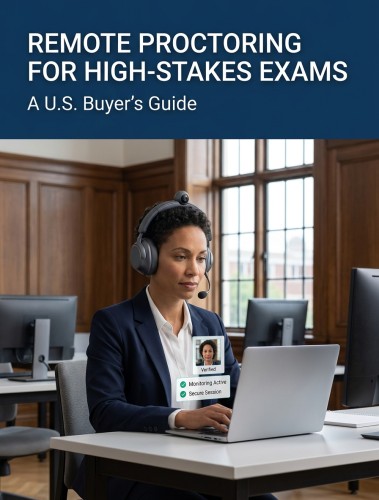
When a procurement team evaluates remote proctoring for an enterprise, the questions look nothing like the ones a single instructor asks. The instructor wants a tool that watches a quiz. The enterprise buyer wants to know whether the platform will pass a security review, integrate with existing systems, scale across business units, and hold up to an audit two years down the line.
That gap is where most proctoring tools fall short. Plenty of products handle a classroom fine. Far fewer are built for enterprise procurement, compliance scrutiny, and the operational load of a certification body or corporate L&D team running thousands of exams a quarter.
Here's what enterprise-grade remote proctoring actually means, and how to think through the return on that investment.
What Separates Enterprise-Grade From Classroom-Grade
The label gets used loosely. In practice, it comes down to four things a procurement team will test before signing anything:
- Security and compliance that survive a formal review. A tool that can't produce a SOC2 report or explain its data handling fails at the first gate.
- Integration depth, since an enterprise isn't going to rip out its LMS or test engine to accommodate a new vendor.
- Scale and reliability under real load, not just a clean demo.
- Support and accountability, because when an exam fails at enterprise scale, the cost shows up as regulatory exposure and brand damage, not a single bad grade.
A platform that nails the demo but can't answer these four questions is a classroom tool wearing an enterprise label.
Security and Compliance: The First Gate, Not the Last
For an enterprise, security is where the evaluation starts, not where it ends up as an afterthought. A proctoring platform captures video, audio, screen activity, and identity documents. That's sensitive data, and any competent security team is going to treat it that way.
Look for SOC2 attestation, GDPR alignment, and FERPA compliance where education data is involved. For government or regulated content, hosting matters just as much. Proctor360 supports AWS GovCloud hosting for regulated content, which is rare among proctoring vendors and matters enormously to buyers handling sensitive material. The right answer to "where does our candidate data live, and who can touch it" should be specific, documented, and ready for an audit on short notice. A vague answer here is a red flag no matter how good the rest of the pitch sounds.
Integration Depth Decides Whether Deployment Actually Succeeds
The fastest way to stall an enterprise rollout is to make the proctoring tool feel like an island. If candidates have to leave the platform they already know, manage a separate login, and reconcile results by hand afterward, adoption falls apart fast.
Enterprise-grade proctoring plugs into the systems already in place. LTI is the standard for LMS connections, and API or SDK options let a platform embed directly into a custom exam environment. Proctor360 integrates with common learning management systems and third-party test publishers, so an enterprise can wire proctoring into its existing exam delivery instead of running a parallel system alongside it. The deployment that works is the one candidates barely notice.
Scale, Reliability, and Matching Monitoring to Risk
An enterprise rarely runs just one type of exam. A certification body might deliver low-stakes practice tests, mid-stakes module assessments, and high-stakes credentialing exams that carry real legal weight. Forcing all of them through a single proctoring mode is either overkill or under-protection there's no middle ground with a one-size-fits-all setup.
The better approach matches monitoring intensity to risk:
- Non-disruptive AI auto-proctoring handles volume on lower-stakes exams.
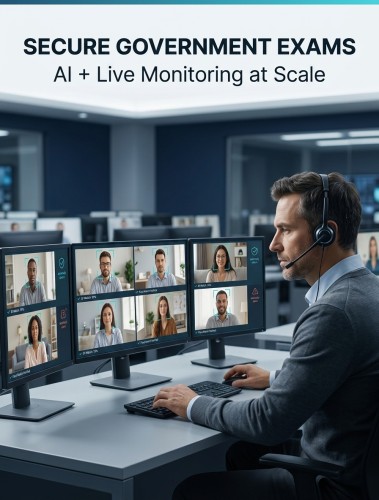
- Live and multi-camera proctoring covers exams where a human in the loop earns its cost.
- 360° Total View™, Proctor360's patent-pending headset, delivers test-center-grade visibility for credentialing exams where the certificate carries real-world consequences.
One platform, several levels, configured per exam. That's what scale actually requires not a single setting cranked up for everyone.
Calculating the ROI of Enterprise Proctoring
The return on proctoring is easiest to see once you price out the alternative. Physical test centers carry facility, staffing, and scheduling costs, and they cap how many candidates an organization can serve at once. Remote proctoring removes both the geographic ceiling and the per-seat facility cost.
Then there's the cost of a breach. The online exam proctoring market reached roughly $1.42 billion in 2025 and is projected near $1.66 billion in 2026, growth driven largely by organizations protecting the value of their own credentials. For a certification body, one compromised exam devalues every certificate it has ever issued. For corporate L&D, a fraudulent assessment means someone gets credited with a skill the company is actually relying on. The ROI math comes down to the platform's cost weighed against the test centers you no longer need and the breaches you avoid. For enterprises running real volume, the platform is usually the cheaper line item by a wide margin.
Why Exam Variety Breaks Single-Mode Tools
A common reason enterprise proctoring deployments disappoint is that the buyer underestimated the variety in their own exam program. A certification body that assumed it needed one proctoring mode often discovers it actually runs practice tests, module assessments, recertification exams, and flagship credentialing exams each with different stakes and different candidate expectations. A single-mode tool forces all of them into the same experience, which means either over-monitoring the low-stakes stuff or under-protecting the high-stakes stuff.
The mismatch shows up as cost and friction. Over-monitoring a practice quiz wastes money and irritates candidates for no reason. Under-protecting a credentialing exam puts the certificate's value on the line. A platform built on several monitoring levels lets an enterprise map each exam to the protection it actually needs. That mapping exercise, done honestly during evaluation, is often what reveals whether a vendor truly fits the enterprise or only fits the simplest exam in its catalog.
Vendor Accountability and the Cost of Downtime
Enterprises aren't just buying a feature set. They're buying a relationship with a vendor that will be accountable when something breaks. A vendor with no real service commitment becomes a liability the moment an exam goes sideways, because the enterprise absorbs the consequence while the vendor shrugs it off.
That's why support quality belongs on the procurement checklist right alongside security and integration. When a credentialing exam goes down, the cost shows up as candidate trust, rescheduling expense, and sometimes regulatory exposure. A vendor that answers fast and owns the problem keeps that cost contained. Proctor360 ranks first for service and support among remote proctoring vendors on Gartner Peer Insights, which for an enterprise isn't a soft metric it's a direct input into how much a failure will actually cost.
Data Retention, Candidate Privacy, and Defensibility
Enterprise proctoring generates sensitive records, and how long they're kept, who can access them, and how they're protected are governance questions a procurement team will dig into. Candidate video and identity documents can't sit in an unmanaged store indefinitely but the records also have to survive long enough to defend a contested result later.
The right platform makes retention and access deliberate instead of accidental: clear policies on how long session data is held, controlled access to recordings, and compliance backing through SOC2, GDPR, and FERPA. That combination gives an enterprise the documentation it needs when its own auditors or a candidate's lawyer come asking. Defensibility and privacy aren't actually in tension here. A well-governed platform delivers both.
Getting Buy-In Across the Organization
An enterprise proctoring decision is rarely made by one person. Security signs off on data handling, IT owns the integration, the exam or training function owns the candidate experience, and procurement owns the contract. A platform that satisfies one of these groups but stumbles with another tends to stall out in committee.
The deployments that succeed give every stakeholder a straight answer to their specific concern: documented compliance and hosting details for security, real integration options through LTI, API, and SDK access for IT, monitoring levels matched to exam stakes for the exam team, and a stability and support record procurement can stand behind for a multi-year contract. When a platform answers all four cleanly, the decision moves instead of circling the table indefinitely.
If your organization is evaluating remote proctoring against a real procurement checklist, the right next step is a conversation grounded in your actual security, integration, and scale requirements. Talk to the Proctor360 team or book a demo to see how the platform fits an enterprise exam program.

Kranthi Bathula is the Co-Founder and CTO of Proctor360 and an online proctoring and assessment-security expert with extensive experience in EdTech, exam integrity, and AI-enabled test monitoring. He writes about remote proctoring, test security, AI in assessments, live and automated proctoring, and best practices for secure online testing. Through his engineering-driven insights, Kranthi helps educational institutions, certification bodies, and employers make informed decisions to protect the integrity of their exams.