Key takeaways
- India’s exam integrity crisis has exposed the limits of single-webcam proctoring. When high-stakes exams serve millions of candidates, blind spots can become major vulnerabilities. Discover how Proctor360’s 360° Total View™ headset captures the full testing environment, helping institutions strengthen security, protect results, and close the gaps.
How Proctor360's 360° Total View™ Headset Solves India's Exam Integrity Crisis
On 19 June 2024, India cancelled a national exam. UGC-NET June 2024 had run the day before. Then inputs from the Indian Cyber Crime Coordination Centre showed the paper had leaked on the darknet, and the whole test was scrapped. Lakhs of candidates lost their sitting through no fault of their own.
That was not an isolated failure. The 2024 NEET-UG cycle drew allegations of question-paper leaks, Bihar police arrested 13 people, some of whom had reportedly paid ₹30 to 50 lakh for leaked papers, the NTA Director General was dismissed, and the case went to the CBI. Two flagship exams. One brutal year.
India does not have a small integrity problem. It has a scale problem, a proxy problem, and a supervision problem, all colliding at once. And most remote proctoring was never built for the room the candidate is actually sitting in.
The Blind Spot in Single-Webcam Proctoring
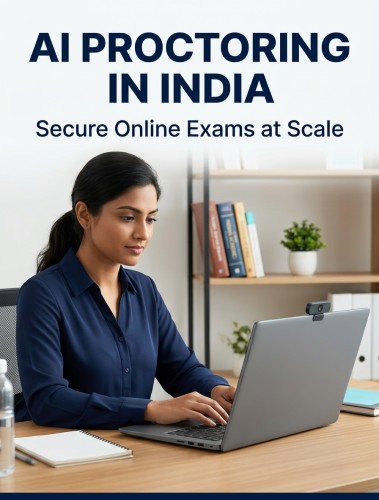
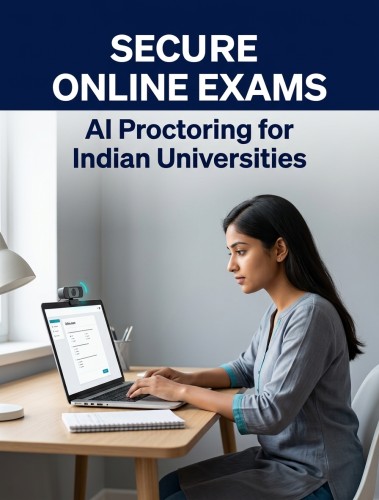
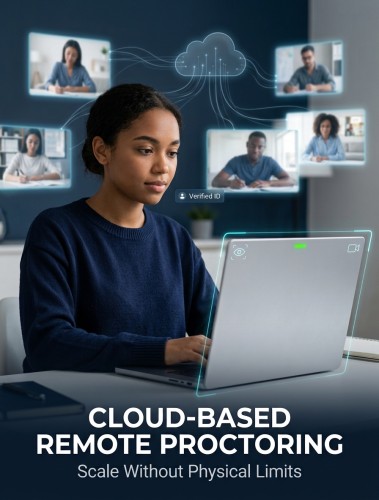
Picture a standard remote proctoring setup. A laptop webcam points at a candidate's face. It sees the face. It sees the shoulders. It sees a slice of wall behind.
It does not see the phone resting on the candidate's lap. It does not see the notes taped under the desk. It does not see the person crouched just out of frame, whispering answers. The webcam captures a face, not an environment, and integrity threats live in the parts of the room the camera cannot reach.
For a low-stakes weekly quiz, that gap is tolerable. For a high-stakes national exam, it is the whole vulnerability. When the score decides a medical seat or a university admission, a blind spot is an invitation.
Why India's Scale Makes This Harder
The numbers are the story here. NEET-UG 2024 drew a record of roughly 24 lakh, about 2.4 million, registrations, with around 23.3 lakh candidates appearing. CUET-UG drew roughly 13 to 14 lakh registrations. These are populations, not classrooms.
The market has moved to match. According to industry market reports for 2024 to 2025, India held about USD 0.88 billion of the online exam proctoring market, a 35.7% regional share, growing at roughly an 18.3% CAGR. More than 900 Indian universities transitioned to online examination models. The demand is permanent.
At that scale, the cost of a single missed cheating vector multiplies fast. One weak proctoring method, applied across a lakh candidates, produces thousands of undetected incidents. The math is unforgiving.
Enter the 360° Total View™ Headset
Proctor360's 360° Total View™ takes a different approach to the room. It is a patent-pending 360-degree proctoring headset that captures the candidate's entire environment, not just the face in front of the screen.
Think about what changes. Instead of one fixed angle, the exam gets a full view of the space around the candidate. The desk. The area behind. The zones a laptop webcam simply cannot reach. No competitor offers this hardware, which is why it is the category-defining differentiator rather than another software tweak.
The idea is almost obvious once you see the blind spot. If the threats hide in the room, watch the room. Not one wall of it.
Why Full-Environment Capture Matters for High-Stakes Exams
High-stakes testing in India carries consequences that most low-stakes assessments never do. A NEET or UGC-scale exam decides careers. It draws organized cheating attempts, not just casual glances at a neighbor's screen.
A face-only webcam cannot answer the questions that matter after the fact. Was there a second person in the room? Was a phone in use below the desk? Was the candidate reading from something off-screen? Full-environment capture gives reviewers the footage to answer those questions instead of guessing.
That is the credibility difference. When a result is challenged, and at this scale results get challenged, you defend it with evidence of the whole room, not a cropped shot of a forehead.
Matching Security to Exam Risk
Here is where exam teams get this wrong. They assume more security is always better and try to apply maximum scrutiny to every assessment. That burns budget and frustrates candidates on exams that never needed it.
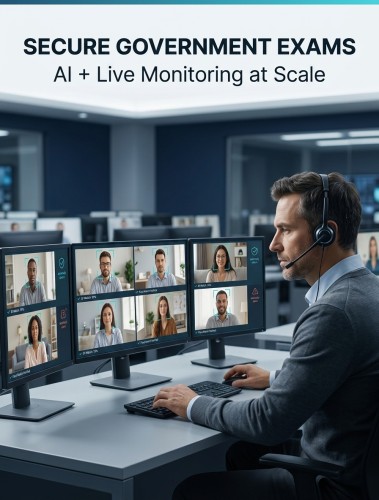
360° Total View™ is not meant for every quiz. It is one of five proctoring service levels Proctor360 offers, alongside non-disruptive AI auto-proctoring, single webcam live, multi-cam live that uses the candidate's phone as a second camera, and remote proctoring software for test centers. The modes let institutions match security to exam risk.
So a practice test can run light. A national-scale certification or entrance exam can run on the headset. Same vendor, different intensity, chosen by the stakes. That flexibility is the point, and it fits Indian institutions that run a wide spread of exam types.
The Legal Backdrop India Now Operates In
Hardware alone does not make an exam defensible. The law has caught up, and proctoring has to sit inside it.
The Public Examinations (Prevention of Unfair Means) Act, 2024 was implemented on 21 June 2024, giving India a national anti-cheating law. On the data side, the Digital Personal Data Protection (DPDP) Act, 2023 governs how candidate data is collected. It is consent-first, with consent that must be free, specific, informed, unambiguous, and withdrawable, and data use limited to the stated purpose. Penalties reach up to ₹250 crore.
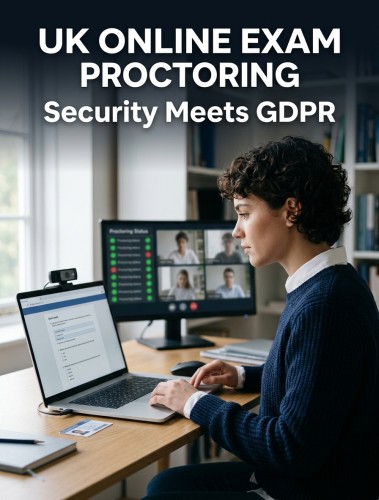
A headset that captures the full environment also captures more personal data, so the vendor behind it has to handle that data lawfully. Proctor360 holds SOC2, GDPR, and FERPA compliance. For Indian institutions assessing students located in the EU or EEA, GDPR applies too, because of its extraterritorial reach.
What a Serious Proctoring Vendor Brings to This Problem
Solving India's integrity crisis takes more than one clever device. It takes a vendor that can prove identity, watch the full room when needed, handle sensitive data lawfully, and stand behind institutions when a result is questioned.
Proctor360 lines up against that standard. 360° Total View™ closes the room-level blind spot that single webcams leave open. Five service levels let institutions match scrutiny to stakes. SOC2, GDPR, and FERPA cover the compliance side, and hosting on AWS GovCloud for sensitive, regulated content is something very few proctoring vendors do. On Gartner Peer Insights the company holds a 5.0 out of 5 rating and ranks number one for service and support, with a 4.9 out of 5 on G2. Its client base includes federal agencies with strict data-residency and security requirements, which is not a reference most proctoring vendors can claim.
For Indian higher education specifically, Proctor360 offers a higher-ed remote testing solution built around exactly these high-stakes scenarios. The headset is the headline. The full stack is what makes it usable at national scale.
Frequently Asked Questions
What is 360° Total View™?
It is Proctor360's patent-pending 360-degree proctoring headset that captures the candidate's entire environment during an exam, not just the face in front of the screen. It is a hardware differentiator, and no competitor currently offers an equivalent device.
Why is single-webcam proctoring not enough for high-stakes exams?
A single webcam captures one angle and misses the rest of the room, including a phone on the lap, notes out of frame, or a second person nearby. For high-stakes exams like NEET or UGC-scale tests, those blind spots are exactly where organized cheating hides.
How does the headset help with India's exam scandals?
India's 2024 cycle saw the UGC-NET June exam cancelled after a darknet paper leak and multiple arrests in the NEET-UG paper-leak case. Full-environment capture gives reviewers evidence of the whole room, which makes results more defensible when integrity is challenged at scale.
Is 360° Total View™ needed for every exam?
No. It is one of five Proctor360 service levels, and institutions match security to exam risk. Low-stakes quizzes can run on AI auto-proctoring or a single webcam, while the headset suits high-stakes national or certification exams.
Does full-environment recording comply with India's DPDP Act?
It can, when handled correctly. The DPDP Act, 2023 is consent-first and limits data use to the stated purpose, with penalties up to ₹250 crore. Proctor360 holds SOC2, GDPR, and FERPA compliance to support lawful handling of the data the headset captures.
Is student data secure with Proctor360?
Proctor360 holds SOC2, GDPR, and FERPA compliance and hosts sensitive, regulated content on AWS GovCloud, which very few proctoring vendors do. For institutions assessing EU-based students, GDPR applies alongside DPDP because of its extraterritorial reach.
Closing the Blind Spot
India's exam integrity crisis is not going to be solved by watching a candidate's face and hoping. The leaks, the proxies, and the sheer scale demand a view of the whole room, applied where the stakes justify it. That is the problem 360° Total View™ was built for.
If your institution runs high-stakes exams and you are tired of defending results with cropped footage, see the headset in action. Book a demo with Proctor360 and walk through your highest-risk exam with the team.
Kranthi Bathula is the Co-Founder and CTO of Proctor360 and an online proctoring and assessment-security expert with extensive experience in EdTech, exam integrity, and AI-enabled test monitoring. He writes about remote proctoring, test security, AI in assessments, live and automated proctoring, and best practices for secure online testing. Through his engineering-driven insights, Kranthi helps educational institutions, certification bodies, and employers make informed decisions to protect the integrity of their exams.