Best Remote Proctoring Software in the USA for High-Stakes Exams
Every remote proctoring vendor in the US market will tell you they use AI, protect student privacy, and integrate with your LMS. Those three claims are close to worthless as a selection criterion, because all of them are technically true of nearly every product on the list.
What separates a platform that survives a FERPA audit and a contested result from one that does not is far more specific: where the recordings physically live, whether monitoring reaches past the webcam frame, what the vendor will put in writing about proctor screening, and whether anyone answers the phone at 11pm on a Sunday when a candidate is locked out mid-exam.
This is a buyer's guide, not a scoreboard. It sets out the evaluation criteria a US institution or certification body should apply, in the order that actually matters, and notes where Proctor360 fits against each one.
Start by Sizing the Market You Are Buying For
The demand side is not a niche. According to the National Center for Education Statistics, in fall 2021 some 9.4 million students, or 61 percent of all US undergraduates, were enrolled in at least one distance education course, and 4.4 million, or 28 percent, took distance courses exclusively. Among students taking distance courses exclusively, roughly 1.0 million were enrolled at an institution in a different state from where they lived.
That last figure is the one procurement teams skip past. Cross-state enrollment means your candidate population is distributed across time zones, network conditions, and state privacy regimes. A proctoring model that assumes a candidate can drive to a testing centre if the software misbehaves does not fit that population.
1. Data Residency and Hosting Environment
Ask where session recordings are stored, processed, and backed up. Get the answer as a region, not as a reassurance.
For most higher education programs, US-based hosting with clear regional boundaries is sufficient. For anything touching federal information, the bar is defined rather than negotiable. FedRAMP is the authoritative standardized approach to security assessment and authorization for cloud services processing unclassified federal information, codified by the FedRAMP Authorization Act in the FY23 National Defense Authorization Act. For Controlled Unclassified Information held in nonfederal systems, the NIST SP 800-171 suite sets the security requirements.
Proctor360 hosts regulated and CUI content on AWS GovCloud, with US-citizen proctors trained in data security. Very few vendors in this category offer that as a standard tier rather than a custom engagement.
2. FERPA Posture, in Detail
Every vendor claims FERPA compliance. Ask them to explain the mechanism.
FERPA permits a school to disclose education records to an outside party performing an institutional service or function, but the US Department of Education's guidance for third-party service providers is specific about what that requires. The provider has to perform a service the institution would otherwise use employees for, be under the direct control of the institution with respect to the use and maintenance of education records, use the personally identifiable information only for the purpose of the disclosure, and meet the criteria set out in the institution's annual FERPA notification for a school official with a legitimate educational interest.
Three questions fall out of that. Does the contract establish direct control over use and maintenance? Does it prohibit redisclosure and secondary use, including model training? Does your annual FERPA notification actually describe this category of vendor?
If a salesperson cannot answer those, they are selling you a logo on a slide.
3. Whether Monitoring Reaches Past the Webcam Frame
This is the criterion that has shifted most since 2023, and most buying checklists have not caught up.
Fabric's analysis of 19,368 technical interviews between July 2025 and January 2026 found cheating signals in 38.5 percent of candidates overall and 48 percent in purely technical roles. Look at the method breakdown. Dedicated overlay tools accounted for 45 percent of detected methods and voice-mode chatbots for 34 percent, while tab switching and second-screen use accounted for only 18 percent.
Legacy proctoring was engineered against that last 18 percent. Browser lockdown, tab-focus detection, and screen recording all assume the cheating happens on the exam device. Most of it no longer does.
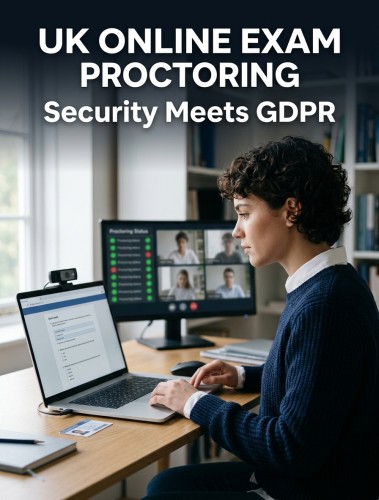
So the practical question for any US buyer is what the platform can see off-device. A single webcam sees a face and a wall. A second camera, typically the candidate's own phone positioned to cover the desk, sees the phone, the notes, and the second person. Hardware-level 360-degree capture sees the room.
Proctor360's tiers map to that spectrum directly: AI auto-proctoring, single webcam live, multi-cam live proctoring using the candidate's phone as a second camera, and 360° Total View™, a patent-pending headset with a 360-degree camera, microphone and speaker that also supports paper exams.
4. Security Tiering, and Whether You Are Forced Into One Level
A single-tier vendor forces a bad trade. You either overspend on low-stakes quizzes or underprotect the licensure exam.
Look for a vendor whose pricing and product structure let you assign different monitoring levels to different exams within the same contract. Five tiers is generous. Two is workable. One is a problem.
5. Integration Reality
Ask for the named list of supported LMS platforms and test engines, not the phrase "integrates with all major platforms."
Then ask a harder follow-up: where do results, flags, and recordings land? If reviewing a flagged session means logging into a separate portal, exporting a CSV, and reconciling it against your gradebook by hand, adoption will decay within two terms. Proctor360 publishes 11 named LMS and test-engine integrations rather than a vague claim.
6. Proctor Workforce Controls
For live proctoring, the humans are part of your security perimeter. Ask three things: are proctors employees or a subcontracted pool, are background checks performed, and where are they located.
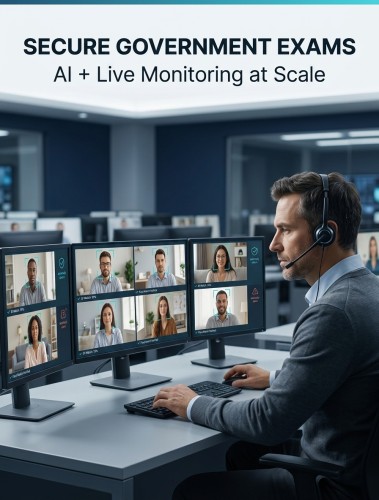
For most academic programs, location is a preference. For government-adjacent, export-controlled, or clearance-related content, it is a requirement. Proctor360 uses US-citizen, data-security-trained proctors and performs background checks on staff, with the alternative of a client's own staff proctoring through the remote proctoring software product.
7. Support During the Exam Window
Exams do not fail during business hours. They fail at 9pm on a Sunday when a candidate's webcam driver updates itself.
Ask for the support model in writing: coverage hours, escalation path, and whether a candidate stuck at check-in can reach a human immediately or files a ticket. Then check third-party review sites for what customers say about support specifically, since that is where the gap between promise and delivery shows up first. Proctor360 holds 4.9 out of 5 on G2 across 14 reviews and 5.0 out of 5 on Gartner Peer Insights from 3 ratings, where it is ranked first for service and support among remote proctoring vendors.
8. Accessibility and Candidate Experience
A proctoring system that produces a 20 percent support-ticket rate on check-in will generate complaints that reach your provost or your board. Run a genuine pilot with real candidates on real hardware, including older laptops and shared home connections, before you commit.
What a Serious Proctoring Vendor Should Provide
Pull the criteria together and the specification is straightforward. Multiple security tiers matched to exam risk. Verifiable compliance attestations, meaning SOC 2 at minimum plus FERPA for education records and GDPR where international candidates sit. Clear data residency, with a federal-grade hosting option for regulated content. Monitoring that extends beyond the webcam frame, because that is where current methods live. Named integrations with the systems you already run. Screened proctors under defined personnel controls. Support available across the full exam window. Regular internal and external penetration and load testing, with separate accounts per organization.
Proctor360 provides all of that, and adds one thing the category does not otherwise have. 360° Total View™ is a patent-pending 360-degree headset with a camera, a microphone the proctor can hear the room through, and a speaker the proctor can speak to the candidate through, delivering test-centre-grade security for both online and paper exams. Founded in May 2018 and headquartered in Chantilly, Virginia, the company counts federal agencies with strict data-residency requirements among its clients and holds memberships with NCTA, ATP, EDUCAUSE, OLC, TIPS and AWS EdStart.
Frequently Asked Questions
What is the best remote proctoring software in the USA?
There is no single answer, because the right platform depends on your exam risk profile, your compliance obligations, and your candidate population. Evaluate on data residency, FERPA contract mechanics, whether monitoring reaches beyond the webcam frame, security tiering, named integrations, proctor screening, and support coverage. Any vendor that scores well on all seven is a credible finalist.
Is remote proctoring FERPA compliant?
It can be, under the school official exception, but compliance is a property of your contract as much as of the software. The Department of Education requires that the provider be under the institution's direct control with respect to use and maintenance of education records, use the data only for the disclosed purpose, and fit the school official criteria in your annual FERPA notification. Review the contract language, not the vendor's compliance page.
Does remote proctoring software store data in the United States?
Some do and some do not, and the answer often varies by tier and by customer. Ask for storage region, processing region, and backup region separately. Institutions handling federal or controlled content should confirm whether a FedRAMP-aligned or GovCloud hosting option exists before shortlisting.
Can AI proctoring alone protect a high-stakes exam?
It handles a lot: automated check-in, automated ID verification, screen, camera and audio recording, and 24/7 incident flagging without scheduling constraints. What it cannot do on its own is see what sits outside the camera frame, which is where most current AI-assisted cheating happens. For licensure, certification, or anything where a compromised result is unrecoverable, pair AI monitoring with a live proctor or hardware-level room capture.
How much does remote proctoring cost in the US?
Pricing is normally per session and varies substantially by security tier, so a fully automated session and a live-proctored session are not comparable line items. Institutions that run their own proctors through a SaaS platform generally reach a lower per-session cost than fully outsourced live proctoring. Ask vendors to quote per tier against your actual exam mix rather than a blended average.
What should we test during a proctoring pilot?
Check-in time on older hardware, behaviour on a shared residential connection, the support path for a candidate who fails check-in, how a flagged session looks to a reviewer, and how results land in your LMS. Those five tell you more than any feature comparison table.
Buy Against Your Exam Risk, Not Against a Feature List
The vendor with the longest feature list is rarely the right choice. The right choice is the one whose security tiers, hosting environment, and contract terms match the specific exams you run and the specific evidence you will need if a result is challenged.
Write your criteria down before you take the first demo. It changes the conversation.
When you are ready to compare against a real delivery plan, schedule a demo and talk to the team about your exam program.
Sources
- Fast Facts: Distance Learning, National Center for Education Statistics, US Department of Education
- Responsibilities of Third-Party Service Providers under FERPA, Student Privacy Policy Office, US Department of Education
- FedRAMP Program Basics, FedRAMP, US General Services Administration
- Protecting Controlled Unclassified Information (NIST SP 800-171 suite), National Institute of Standards and Technology
- State of AI Interview Cheating in 2026: Insights from 19,368 Interviews, Fabric
- Multi-cam Live Proctoring, Proctor360
- Integrations, Proctor360
- Remote Proctoring Software, Proctor360
- 360° Total View™, Proctor360
- Book a Demo, Proctor360

Kranthi Bathula is the Co-Founder and CTO of Proctor360 and an online proctoring and assessment-security expert with extensive experience in EdTech, exam integrity, and AI-enabled test monitoring. He writes about remote proctoring, test security, AI in assessments, live and automated proctoring, and best practices for secure online testing. Through his engineering-driven insights, Kranthi helps educational institutions, certification bodies, and employers make informed decisions to protect the integrity of their exams.