How AI Proctoring Supports Dubai's Vision 2030 Education Goals
Dubai's education ambitions are set out in the Dubai Economic Agenda (D33), the Education 33 strategy, and UAE Centennial 2071. Read those three documents together and a single theme keeps surfacing. Dubai wants to be a place where world-class education happens, at scale, with credentials the world trusts.
That last word does the heavy lifting. Trust. A degree or a certificate is only worth what an employer, a regulator, or a foreign university believes it represents. The moment assessment integrity slips, the credential loses value, and the whole ambition wobbles.
Which is why online assessment is not a side detail here. It sits underneath the goal. If Dubai plans to attract more universities and more international students, it needs exams that hold up whether the candidate is in a lecture hall or a living room. That is the quiet job AI proctoring does.
What Dubai's Real Education Agendas Actually Ask For
Start with the frameworks, because vague ambition is easy and specific targets are not.
The Dubai Economic Agenda, known as D33, aims to double Dubai's economy by 2033 through more than 100 transformative projects. A doubled economy needs a deeper, better-credentialed talent pool. Education is a supply line into that.
The Education 33 strategy, announced by Crown Prince Sheikh Hamdan bin Mohammed, is more direct still. E33 aims to attract world-class universities and international students to Dubai. Growth in international enrollment is the explicit target.
And UAE Centennial 2071, launched in 2017, names "excellent education" as one of its four pillars, setting a long horizon for where the country wants its human capital to be.
Notice what these have in common. Scale and reputation, together. You cannot grow enrollment tenfold and let assessment standards drift. Both have to move at once.
Why Scaling Enrollment Breaks Traditional Exam Security
Here is the tension no strategy slide shows you.
Attract more international students and your candidate pool spreads across time zones and countries. Test centers do not scale that way. A single physical exam hall in Dubai cannot invigilate a cohort logging in from Lagos, Lahore, and London on the same afternoon. Build more halls and costs balloon, and you have tied a global ambition to local concrete.
Online delivery solves the reach problem instantly. It also opens a new one. Remote exams, done carelessly, are easier to cheat. Leaked questions, impersonation, a second device off-camera. If credentials from Dubai institutions get a reputation for weak integrity, the E33 goal of attracting serious universities takes damage that marketing cannot repair.
So the real requirement is reach without integrity loss. That is the gap AI proctoring is built to close.
How AI Proctoring Underpins Credential-Trusted Education
AI proctoring lets an institution watch thousands of remote exams without stationing a human over every candidate. Done well, it does three things that matter to Dubai's agenda.
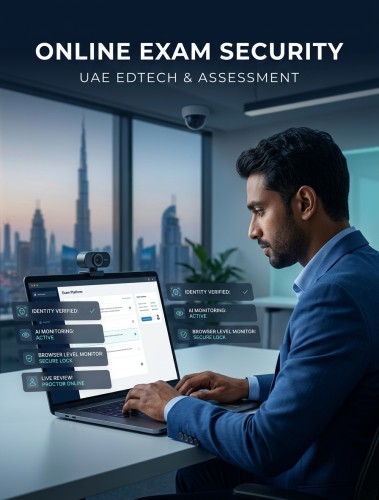
It verifies who is taking the exam, which protects against impersonation, the fastest way to hollow out a credential's meaning.
It flags anomalies during the session so that human reviewers focus their attention where it counts, instead of scrubbing hours of uneventful footage.
And it does both remotely, which means an institution can enroll and assess international students without asking them to fly to a test center. That is E33's growth goal, made operationally possible.
The design choice that separates good from bad here is proportionality. Not every exam needs maximum surveillance. A formative quiz and a final licensing exam sit at different risk levels, and forcing both through the same heavy setup either over-monitors the low-stakes exam or under-protects the high-stakes one.
There is a candidate-experience angle too, and it is easy to overlook. International students weighing a Dubai institution are also weighing how they will be treated. Heavy-handed monitoring on a trivial exam breeds resentment and complaints. A proportionate approach signals that the institution takes both integrity and fairness seriously, which is precisely the reputation E33 is trying to build. Get this balance wrong and the same tool that protects your credential can dent your enrollment goals.
Transparency reinforces the point. When a candidate knows in advance what is recorded and why, the exam feels like a fair process rather than surveillance for its own sake. That clarity is not just good ethics. It is good strategy for an education market competing on trust.
What a Serious Proctoring Vendor Should Provide for This Ambition
If Dubai institutions are going to scale trusted assessment, the vendor underneath has to offer range, credibility, and the ability to match security to risk.
Range first. Proctor360 runs five proctoring service levels. There is AI Auto-proctoring, a non-disruptive layer that reviews a session automatically. There is Single Webcam Live and Multi-cam Live, the latter turning the candidate's own phone into a second camera to close the off-screen blind spot. There is 360° Total View™, the patent-pending headset that captures the candidate's entire environment, which no competitor currently offers as hardware. And there is Remote Proctoring Software for test centers running their own sessions. An institution can dial the security up for a final exam and down for a practice test, matching each exam to its real risk.
Credibility next. For a market chasing world-class reputation, the vendor's own standing matters. Proctor360 was founded in 2018 and is headquartered in Chantilly, Virginia. It holds SOC2, GDPR, and FERPA compliance. It carries a G2 rating of 4.9 out of 5 across 14 reviews and a Gartner Peer Insights score of 5.0 out of 5 from 3 ratings, where it ranks number one for service and support among remote proctoring vendors. It runs regulated content on AWS GovCloud and counts federal agencies with strict data-residency requirements among its clients. Those are not small signals.
For universities specifically, the higher-ed remote testing solution packages this for the academic use case, with 11 named LMS and test-engine integrations so the proctoring layer sits inside the systems institutions already run. That integration point matters more than it sounds. A tool nobody can plug in is a tool nobody uses.
The Practical Payoff for Dubai Institutions
Tie it back to the agenda. E33 wants more international students. D33 wants a bigger economy fed by better talent. Centennial 2071 wants excellent education as a national pillar. All three assume that a credential earned in Dubai means what it says.
AI proctoring is one of the mechanisms that keeps that assumption true at scale. It lets an institution grow its remote cohort without letting integrity, and therefore reputation, slide. That is not a flashy contribution. It is a foundational one.
Think of it as infrastructure. Nobody enrolls in a university because of its proctoring, the same way nobody chooses a city for its water pipes. But let the pipes fail and everything above them suffers. An assessment layer that quietly holds under a growing, international load is what lets the visible parts of Dubai's education ambition, the campuses and the rankings and the partnerships, actually stand up. That is the connection between a proctoring decision and a national agenda, and it is why the choice deserves more attention than it usually gets.
Frequently Asked Questions
Is there really no "Dubai Vision 2030"?
Correct. "Vision 2030" is Saudi Arabia's national framework. Dubai's own education and economic goals are set out in the Dubai Economic Agenda (D33), the Education 33 strategy, and UAE Centennial 2071. When people say "Dubai Vision 2030," they usually mean one of these real agendas.
How does AI proctoring support Dubai's Education 33 goals?
E33 aims to attract world-class universities and international students to Dubai. AI proctoring lets institutions assess a geographically spread, international cohort remotely while protecting exam integrity, so enrollment can grow without credentials losing their credibility.
Does AI proctoring replace human proctors entirely?
Not usually. AI proctoring reviews sessions automatically and flags anomalies, then human reviewers examine the flagged moments. It scales attention rather than removing people from the process, which is why service levels range from fully automated to live-monitored.
Why not just build more physical test centers in Dubai?
Physical centers do not scale with an international cohort. Candidates spread across countries and time zones cannot all reach a Dubai exam hall, and building more halls ties a global ambition to fixed local capacity and cost. Remote proctoring removes that constraint.
What proctoring service level should a university choose for high-stakes exams?
Match the level to the exam's risk. A final or licensing exam may warrant Multi-cam Live or 360° Total View™, while a formative quiz can use non-disruptive AI Auto-proctoring. Proctor360's five service levels exist so institutions can set security per exam.
Building the Trust Layer Under Dubai's Education Goals
Dubai's ambition is scale plus reputation, at the same time. You cannot get there by growing enrollment and hoping assessment integrity keeps up on its own. Trusted credentials need a mechanism, and remote AI proctoring is one of the most practical ones available.
If your institution is planning for that kind of growth, book a demo with Proctor360 and walk through how proportional service levels and higher-ed integrations fit the exams you actually run.
Kranthi Bathula is the Co-Founder and CTO of Proctor360 and an online proctoring and assessment-security expert with extensive experience in EdTech, exam integrity, and AI-enabled test monitoring. He writes about remote proctoring, test security, AI in assessments, live and automated proctoring, and best practices for secure online testing. Through his engineering-driven insights, Kranthi helps educational institutions, certification bodies, and employers make informed decisions to protect the integrity of their exams.