Secure Proctoring for Government Agencies: Ensuring Transparency and Compliance
A government agency administering an exam carries a burden no private organization faces. Every decision has to withstand a public records request, a legislative inquiry, and the expectation that taxpayer-funded processes are fair and documented. When that exam moves online, the proctoring platform inherits all of it. The data handling, the audit trail, and the defensibility of every result become government concerns, not vendor afterthoughts.
This is why most consumer proctoring tools are a poor fit for public-sector testing. They were built for convenience, not for the compliance and transparency standards a government agency answers to. Civil service exams, professional licensing boards, and security-sensitive assessments need a platform that treats data sovereignty, accountability, and equal access as requirements, not features.
This article covers what secure proctoring for government agencies actually demands.
Why Government Exam Security Is a Different Category
A university can absorb a contested exam result with a quiet retake. A government agency cannot. Its exams gate access to jobs, licenses, and in some cases security clearances. The stakes attract more sophisticated fraud, and the process invites more scrutiny.
That combination raises the bar on two fronts at once. The integrity controls have to be strong enough to stop determined cheating, and the entire process has to be transparent enough to defend in public. A flagged result that an agency cannot explain or document is worse than no flag at all. Public-sector proctoring lives or dies on whether it can prove what happened in a session, to anyone who asks.
Data Sovereignty and Where Exam Data Lives
For government content, the question of where data is stored is not a technicality. Sensitive exam material and candidate data may carry handling requirements that rule out standard commercial cloud hosting. An agency that ignores this exposes itself to a serious compliance failure.
This is where most proctoring vendors cannot help. Proctor360 supports hosting on AWS GovCloud for regulated content, which is built specifically for sensitive government workloads. That capability is rare in the proctoring industry. It is also why Proctor360 serves a federal client with strict data-handling and clearance-adjacent requirements, illustrating the standard of demand that public-sector content typically carries. When an agency asks "where does our exam data live and who can access it," GovCloud hosting is a concrete, defensible answer rather than a vague reassurance.
Identity Verification and a Defensible Audit Trail
Government exams demand proof, not impressions. It is not enough to believe the right person took the test. The agency has to be able to demonstrate it, with records that hold up under review.
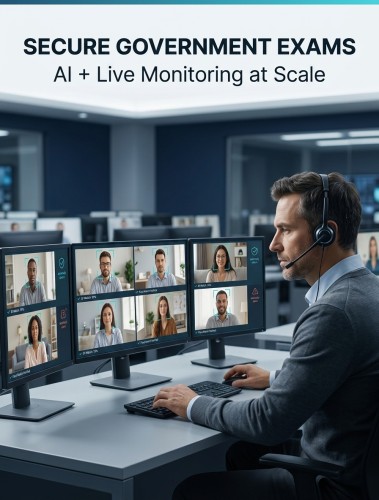
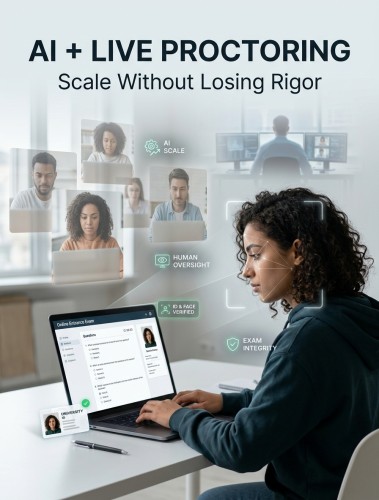
Strong public-sector proctoring verifies identity at check-in by capturing ID and confirming face presence against the candidate on camera, then records the full session as evidence. If a result is later challenged, the recording and the verification log are the defense. For the highest-stakes exams, 360° Total View™ removes the blind spots a single webcam leaves, capturing what a face-only camera would miss. The principle is simple: every flagged decision should be backed by evidence an agency can produce on demand.
Accessibility Is a Legal Obligation, Not a Courtesy
Government agencies operate under accessibility mandates. Section 508 and ADA requirements mean a public-sector exam has to work for candidates using assistive technology, extended time, and alternative formats. A proctoring tool that fights screen readers or cannot accommodate a documented disability is not just inconvenient. It is a legal liability.
Secure government proctoring treats accommodations as a built-in configuration. Extended time, quiet environments, and assistive technology compatibility have to be handled cleanly, because equal access to a government exam is a right, not a favor. Confirm accessibility support explicitly during evaluation, since this is a frequent failure point in tools designed for the commercial market.
What Public-Sector Proctoring Requires, in One List
A government agency evaluating remote proctoring should hold any vendor to the same core standard:
- Data sovereignty through appropriate hosting
- Identity verification with a defensible audit trail
- Monitoring deep enough to support a contested result
- Accessibility that meets federal mandates
- Compliance documentation ready for review
Proctor360 brings these together with GovCloud hosting, SOC2, GDPR, and FERPA compliance, multiple monitoring levels including 360° Total View™, and a track record serving federal clients. For agencies, the GovCloud remote proctoring solution is built around precisely these requirements.
Security Clearance and Sensitive-Content Exams
Some government exams sit in a category of their own: tests tied to security clearances, sensitive roles, or content that is itself classified or controlled. For these, the proctoring platform is handling material where a mishandling is not an embarrassment but a security incident. The bar here exceeds anything a commercial education tool was designed to meet.
This is precisely the gap GovCloud hosting addresses. Hosting regulated content on infrastructure built for sensitive government workloads keeps the material inside an environment designed for its handling requirements. Proctor360's support for AWS GovCloud, and its work with federal clients operating under strict data-handling requirements, show the platform operating at this tier. For an agency running clearance-adjacent or sensitive-content exams, the question is not which tool has the nicest dashboard. It is which one can be trusted with material where the cost of a leak is measured in national, not institutional, terms.
Transparency Requirements That Commercial Tools Overlook
Government accountability runs deeper than passing an audit. Public-sector exam programs may face records requests, oversight reviews, and the standing expectation that any citizen can ask how a taxpayer-funded process worked and get a real answer. A proctoring tool that cannot produce a clear, documented account of a session leaves the agency unable to meet that obligation.
This is a requirement commercial tools rarely design for. Built for institutional convenience, they often treat the session record as an internal artifact rather than a document that might be produced under public scrutiny. Government proctoring has to assume the opposite. Every result should be backed by records the agency can explain and, where appropriate, disclose. The discipline of building for transparency from the start is what separates a platform an agency can defend from one that creates exposure the moment someone asks a hard question.
Procurement, Vendor Stability, and the Long View
Government technology decisions carry long time horizons and strict procurement rules. An agency is not buying a tool for one exam cycle. It is entering a relationship that has to satisfy procurement requirements, survive vendor changes, and remain compliant as regulations evolve. A proctoring vendor that cannot navigate public-sector procurement, or whose stability is uncertain, is a risk no matter how good the technology looks in a demo.
Evaluate a proctoring partner on its track record with government-grade requirements, not just its feature list. A vendor already serving federal clients, with hosting and compliance built for regulated content, has demonstrated it can operate at the standard a public agency needs. Proctor360's work with federal clients and its GovCloud hosting are evidence of that capability, which matters more to a procurement officer than any single feature.
Building Public Trust in Remote Government Exams
Beyond compliance and procurement, a government exam program has to maintain the public's confidence that the process is fair. Citizens taking a civil service exam or a professional licensing test need to believe the remote format has not made the exam easier to cheat or less rigorous than an in-person sitting. If that trust erodes, the legitimacy of the credential erodes with it.
Earning that trust comes down to demonstrable rigor and transparency. When an agency can show that identity was verified, the session was monitored and recorded, and every result is backed by evidence it can produce, the remote format becomes as credible as a proctored test center, or more so. Clear communication with candidates about how the process works, paired with monitoring strong enough to defend, is what lets a government agency move exams online without surrendering the public confidence those exams depend on.
Frequently Asked Questions
Why can't government agencies use standard commercial proctoring tools?
Most commercial tools were built for convenience, not for the data sovereignty, transparency, and accessibility standards governments answer to. Public-sector exams gate jobs, licenses, and clearances, so they require defensible audit trails and compliant hosting that consumer-grade tools generally cannot provide.
What is GovCloud hosting and why does it matter for government exams?
AWS GovCloud is cloud infrastructure built for sensitive government workloads and regulated content. For exams involving sensitive or otherwise regulated material, hosting on GovCloud addresses data sovereignty requirements. Proctor360 supports GovCloud hosting, which is uncommon among proctoring vendors.
How does government proctoring create a defensible audit trail?
By verifying identity at check-in, capturing the ID and confirming face presence against the candidate on camera, and recording the full session. If a result is challenged, the recording and verification log serve as evidence. Deeper monitoring, such as 360° Total View™, strengthens the record for high-stakes exams.
Does remote proctoring meet government accessibility requirements?
It must, because agencies operate under Section 508 and ADA mandates. Secure government proctoring handles extended time, assistive technology, and alternative formats as built-in configurations. Agencies should confirm accessibility support explicitly during evaluation, since it is a common gap in commercial tools.
Which compliance standards should government proctoring carry?
At minimum, look for SOC2 attestation and, where relevant, GDPR and FERPA alignment, plus hosting appropriate to the data's sensitivity. Proctor360 carries SOC2, GDPR, and FERPA compliance and supports GovCloud hosting for regulated content.
Talk Through Your Agency's Exam Security Requirements
Public-sector testing leaves no room for a proctoring tool that cannot prove what it did. If your agency needs proctoring that meets data sovereignty, transparency, and accessibility standards, talk to the Proctor360 team or book a demo to review how the platform supports government exam programs.

Kranthi Bathula is the Co-Founder and CTO of Proctor360 and an online proctoring and assessment-security expert with extensive experience in EdTech, exam integrity, and AI-enabled test monitoring. He writes about remote proctoring, test security, AI in assessments, live and automated proctoring, and best practices for secure online testing. Through his engineering-driven insights, Kranthi helps educational institutions, certification bodies, and employers make informed decisions to protect the integrity of their exams.