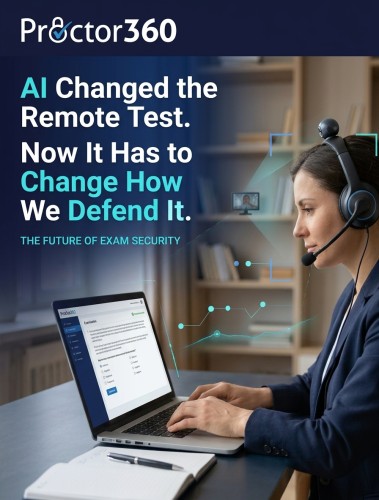
AI changed the remote test. Now it has to change how we defend it.
I attended the virtual Conference on Test Security (COTS) 2026, November 17–19, as a registered attendee. I went to listen, and to test what I heard against what we see every day at Proctor360.
The single clearest message across the three days was this: remote testing has grown beyond imagination due to advanced AI. That growth has changed both sides of the exam at once. AI is now part of how candidates learn, how items are written, and how responses are produced, and it is also part of how programmes must detect, explain, and defend what happened in a session. A programme that treats AI as a cheating problem alone is now answering the wrong question.
Here are the three sessions that stayed with me, and what I would ask any certification programme to check this week.
1. If you cannot explain a flag, you cannot defend it
Session: "Beyond the Black Box: Explainable AI and Test Security in the Age of Generative Assessment." Tuesday, Nov 17, 2:05–3:05 p.m. EST, Kamal Tabine.
This session was about explainable AI (XAI) in assessment: how to spot unusual scoring patterns, evaluate AI-generated responses, and support human review, using interpretable methods such as SHAP- and LIME-based scoring analysis, transparent rubric-driven evaluation, and structured review checkpoints that keep humans in charge.
That matters because the hardest question in proctoring is no longer "did the system flag something?" It is "can you show why, in a way a candidate, an auditor, or a regulator can follow?" A flag without an explanation is a dispute waiting to happen. A score without a traceable reason is difficult to stand behind if it is challenged.
Check this week: pick one recent flagged session in your programme and ask: could we explain, in plain language, what was flagged, what evidence supported it, and who made the final judgement? If the answer lives only inside a model, that is the gap to close first.
2. Can we defend this outcome?
Session: "Building a Proctoring Program that Can Defend Itself: A Framework for Assessment Security." Wednesday, Nov 18, 11:00 a.m.–12:00 p.m. EST, Brandon Smith.
Most programmes choose a proctoring vendor on ease of use, cost, and LMS compatibility. That is the wrong test. The test that matters is the one that arrives after something goes wrong: can we defend this outcome?
Automated flags, unreviewed dismissals, and outcomes issued without documented human judgement are increasingly the source of candidate disputes, regulatory scrutiny, and eroding trust. The framework from this session asks three questions at every stage: Is this decision accurate? Is it fair? Can we document why it was made? I think that is the right discipline. It applies regardless of which platform a programme uses, and it is the standard we should hold our own work to as well.
Check this week: for each stage of your proctoring process (check-in, monitoring, flagging, review, and the final decision), write down who decides, on what evidence, and where that reasoning is recorded. Any stage with no answer is a stage you cannot defend.
3. The new threats are empirical, not hypothetical
Session: "New Threats to Test Security Coming From AI: Empirical Investigations at the Intersection of AI and Assessment Integrity." Thursday, Nov 19, 11:00 a.m.–12:00 p.m. EST, Sergio Araneda (Caveon), Sarah Toton (Caveon), Christopher Foster, Henry Makinde, and Steve Addicott.
This session brought together three empirical studies, covering how large language models respond to test items, the risk of items being exposed in advance across generated item pools, and three kinds of breach: data contamination, item synthesis by test takers, and exposure of vendor-protected content.
What I took from the framing of this session is that AI threats to test security are no longer a matter of speculation. They can be studied: how models respond, how item content can be exposed during development, and how vulnerable items are to systematic manipulation. That changes the conversation for programme leaders. It is not enough to say "we have AI security." The question is: what evidence do we have, and what does it actually show about our items?
Check this week: ask your team what you know about item exposure in your own programme, not in general, but for your items, your pools, and your last administration. If the answer is "we have not looked," that is a finding in itself.
What I would add, and where I disagree
One session that stayed with me was Wednesday afternoon's panel, "The Impact of AI on Education, Assessment, Academic Integrity, and Exam Security" (Nov 18, 3:10–4:10 p.m. EST, with Jarret Dyer, Camille Thompson, Brittany Thornton of the Law School Admission Council, Rachel Schoenig, and Isabelle Gonthier). It covered the risks and the opportunities AI brings, along with the legal, policy, and operational tools programmes need to keep trust.
My own view, and the point I would not soften, is this: a technology problem should be solved by technology solutions. Any organisation that talks about security should think of possible solutions beyond the traditional tools used on their own, like a browser lock or a single webcam.
That is not a dismissal of policy, training, or human review. All three matter, and the sessions above made that clear. It is a warning against treating a new threat with an old toolkit and calling the programme secure. If the threat has moved beyond the webcam's field of view, the solution has to move with it.
At Proctor360, we are very involved in developing and implementing real solutions for the remote testing industry, based on security and validation needs that can be customised and configured to meet client needs. We work with many customers that deliver high-stakes exams. Our aim is to provide the highest possible security in a remote testing environment by converting a candidate's home or office into a proctored environment. I want to be plain about the limit, too: we do not claim that all possible scenarios can be simply solved by our technology. No honest provider should.
What to do next
If you run a certification or licensure programme, do not start with a vendor comparison. Start with the three checks above: can you explain a flag, can you defend an outcome, and do you know what your own item exposure looks like? The answers will tell you more about your security tier than any feature list, and they will tell you whether you need AI auto-proctoring for scale, live proctoring where intervention matters, multi-camera coverage where a single webcam is not enough, or a higher-security option for your highest-stakes exams.
I would like to hear from you: what is your programme's biggest second-device worry right now: the phone, the overlay, the voice tool, or something you have not named yet? Reply to this edition, or book a tiering discussion with us, and tell me what you are seeing. I read the replies, and they shape what I write next.
Ganga Bathula, Founder, Proctor360
Sources
- COTS 2026 virtual portal (Accelevents): https://www.accelevents.com/e/...
- Session 1: "Beyond the Black Box: Explainable AI and Test Security in the Age of Generative Assessment," Tue Nov 17, 2:05–3:05 p.m. EST, Kamal Tabine.
- Session 2: "Building a Proctoring Program that Can Defend Itself: A Framework for Assessment Security," Wed Nov 18, 11:00 a.m.–12:00 p.m. EST, Brandon Smith.
- Session 3: "New Threats to Test Security Coming From AI: Empirical Investigations at the Intersection of AI and Assessment Integrity," Thu Nov 19, 11:00 a.m.–12:00 p.m. EST, Sergio Araneda (Caveon), Sarah Toton (Caveon), Christopher Foster, Henry Makinde, Steve Addicott.
- Panel: "The Impact of AI on Education, Assessment, Academic Integrity, and Exam Security," Wed Nov 18, 3:10–4:10 p.m. EST, Jarret Dyer, Camille Thompson, Brittany Thornton (Law School Admission Council), Rachel Schoenig, Isabelle Gonthier.
- Newsletter: Exam Integrity Insights, Proctor360: https://www.linkedin.com/newsl...

Kranthi Bathula is the Co-Founder and CTO of Proctor360 and an online proctoring and assessment-security expert with extensive experience in EdTech, exam integrity, and AI-enabled test monitoring. He writes about remote proctoring, test security, AI in assessments, live and automated proctoring, and best practices for secure online testing. Through his engineering-driven insights, Kranthi helps educational institutions, certification bodies, and employers make informed decisions to protect the integrity of their exams.