Cloud-Based Remote Proctoring: Benefits for Universities and Enterprises
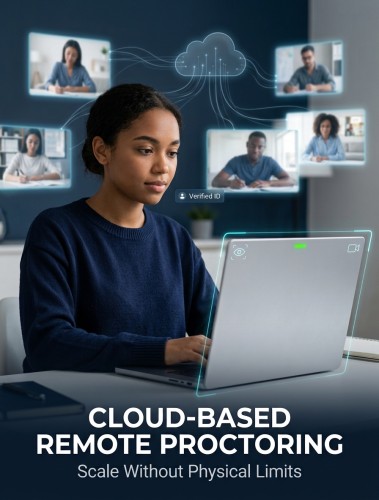
Ten years ago, securing an exam meant booking a room, hiring invigilators, and limiting how many candidates you could test by how many seats you had. Cloud-based remote proctoring removed all three constraints at once. The exam runs from the candidate's own location, the monitoring happens through software, and the only ceiling on volume is how many people you want to test.
For universities and enterprises, the shift is more than a convenience. It changes the economics of testing and the reach of any exam program. But cloud-based does not automatically mean secure or reliable, and the differences between platforms are where institutions get burned.
This article explains what cloud-based remote proctoring delivers, and what separates a platform you can trust from one that buckles when it counts.
What "Cloud-Based" Actually Changes
The core shift is that nothing depends on physical infrastructure anymore. There is no software to install on a lab full of machines, no testing center to staff, and no regional limit on who can sit an exam. A university can test a student in a different time zone as easily as one across campus. An enterprise can certify employees across continents without flying anyone anywhere.
That reach is the headline benefit, and it is why the category is growing fast. The online exam proctoring market reached roughly 1.42 billion dollars in 2025 and is projected near 1.66 billion in 2026. The growth is institutions and companies discovering that the cloud removes the geographic and capacity ceilings that physical testing always imposed.
Benefit One: Scale Without a Facility Cost
A physical testing center has a fixed capacity and a fixed cost. You pay for the room and the staff whether 10 candidates or 200 show up, and you cannot exceed the seat count no matter how much demand there is.
Cloud-based proctoring breaks that link. Capacity scales with the platform, not with real estate. A certification body can run an exam for 50 candidates one week and 5,000 the next without renting more space. A university can expand online programs without building new testing facilities. The cost moves from fixed facility overhead to per-session pricing that tracks actual usage, which for most programs is dramatically cheaper at scale.
Benefit Two: Flexibility for Candidates and Administrators
Candidates gain the obvious flexibility of testing from where they are. A working professional pursuing a certification does not have to take a day off and drive to a test center. A student in a rural area is not blocked by distance from the nearest facility.
Administrators gain a quieter benefit: configuration control. A cloud platform lets an exam team set the security level, the allowed materials, and the monitoring type per exam, then adjust as needed. Proctor360 was built around this idea of not settling for restrictions, supporting multiple proctoring types on one platform so each exam can be configured with the settings that fit it. That flexibility is hard to replicate with physical infrastructure, where the room is the room.
Benefit Three: Security That Travels With the Exam
The fair concern about cloud-based testing is whether it can match the security of a controlled room. The answer depends entirely on the platform, and the strongest ones now exceed what a standard testing room offers.
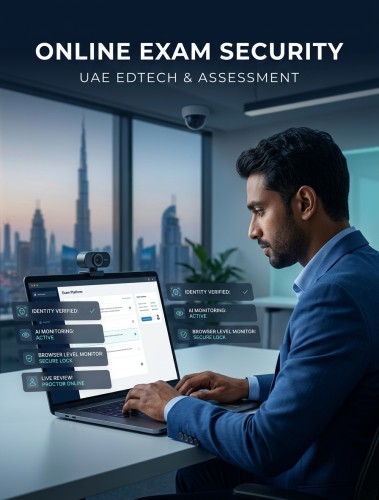
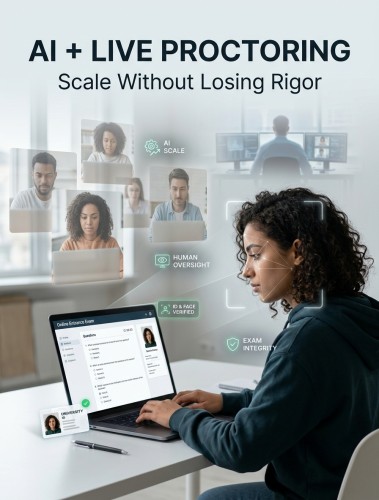
A controlled room has a proctor watching from the front. A cloud platform can verify identity automatically, record the screen and camera and audio, flag anomalies, and for the highest stakes, capture a full 360-degree view of the candidate's environment that no single room proctor could match. 360° Total View™ delivers test-center-grade security from any location. Layered with SOC2, GDPR, and FERPA compliance and the option of AWS GovCloud hosting for sensitive content, cloud-based proctoring can be more rigorous than the physical center it replaced, not less.
Where On-Device and Cloud Monitoring Meet
A point of confusion about cloud-based proctoring is what runs where. The monitoring intelligence, the recording storage, and the review tools live in the cloud, but the capture happens on the candidate's device through a browser or a lightweight application. The quality of that on-device layer matters as much as the cloud platform behind it, because a capture that misses the screen or drops the camera feed leaves the cloud with nothing useful to analyze.
This is why the strongest cloud platforms pair heavy-duty cloud infrastructure with serious on-device capture. Recording the screen alongside the camera and audio closes the on-device cheating avenue, where a candidate switches to another application or browser tab. For the highest stakes, dedicated hardware like 360° Total View™ extends capture beyond what a built-in webcam can see. The cloud is where the analysis lives, but the security of a cloud-based exam is only as good as what the device actually captures and sends.
What to Verify Before You Trust a Cloud Platform
Cloud-based is a foundation, not a guarantee. Before an institution depends on a platform, a few things need confirming: how it performs under peak concurrent load, what happens when a candidate's connection drops mid-exam, which compliance certifications it holds, and how fast support responds during a live exam.
That last point decides more outcomes than buyers expect. When a candidate is locked out of a high-stakes exam, the speed of the response determines whether the score stands. Gartner Peer Insights ranks Proctor360 first for service and support among remote proctoring vendors, and on the cloud-based proctoring software side, that support is what turns a reliable platform into a dependable exam program.
The Hidden Costs of a Cheap Cloud Platform
Not every cloud-based proctoring tool delivers the savings it advertises. A platform priced low but unreliable shifts the cost elsewhere: into staff time spent troubleshooting, into voided exams that have to be rescheduled, and into the reputational damage of a high-stakes test that failed. The cheapest platform on paper is frequently the most expensive once those costs land.
Look past the headline price to the total cost of running a real exam program. A platform that buckles under concurrent load forces you to cap enrollment or split exams across more windows. One with slow support turns every technical hiccup into a drawn-out incident. One with thin monitoring produces results you cannot defend, and a single contested credential can cost more than years of platform fees. The real comparison is not sticker price. It is what each platform costs you across a full year of exams, failures included.
Migrating From Physical Testing Without Breaking Trust
For an institution moving exams from a physical center to the cloud, the transition itself is a risk. Candidates accustomed to a familiar testing room may distrust a remote setup, and a rocky first cycle can sour everyone on the change. Managing the migration carefully is what determines whether the cloud move succeeds.
Phase it. Start with lower-stakes exams to build candidate familiarity and surface platform issues before the high-stakes tests depend on it. Communicate clearly what changes for candidates and what support is available. Run the practice sessions that turn an unfamiliar process into a known one. A cloud platform that supports multiple proctoring levels lets an institution match the migration pace to the stakes, moving routine exams first and reserving the strongest monitoring for the high-stakes tests once the program has proven itself.
Frequently Asked Questions
What is cloud-based remote proctoring?
Cloud-based remote proctoring delivers and monitors exams entirely through software hosted in the cloud, with no physical testing center or on-site invigilators required. Candidates test from their own location while the platform handles identity verification, monitoring, and recording remotely.
How does cloud-based proctoring save money compared with testing centers?
It removes fixed facility and staffing costs and the seat-count ceiling. Capacity scales with the platform rather than with real estate, and pricing typically tracks actual usage per session, which is substantially cheaper than maintaining physical testing centers at scale.
Is cloud-based proctoring as secure as a physical testing center?
With a strong platform, it can be more secure. Cloud proctoring can verify identity automatically, record screen, camera, and audio, flag anomalies, and capture a full 360-degree view of the candidate's environment, which exceeds what a single room proctor can observe. Security depends on the platform, not the cloud itself.
What happens if a candidate's internet drops during a cloud-based exam?
A capable platform provides a clean reconnection path so candidates can resume without losing their exam. Verify the reconnection process during evaluation, since handling dropped sessions well is a key difference between reliable and unreliable platforms.
Can cloud-based proctoring handle large enterprise and university exam volumes?
Yes. Cloud platforms scale capacity with infrastructure rather than physical seats, supporting large numbers of simultaneous candidates. Confirm the platform's peak concurrency and reliability under load with a pilot that mirrors your real exam volume.
See What Cloud-Based Proctoring Can Do for Your Program
If your university or enterprise is moving exams to the cloud and wants a platform that delivers reach without giving up security, talk to the Proctor360 team or book a demo to see how it scales across your exam program.

Kranthi Bathula is the Co-Founder and CTO of Proctor360 and an online proctoring and assessment-security expert with extensive experience in EdTech, exam integrity, and AI-enabled test monitoring. He writes about remote proctoring, test security, AI in assessments, live and automated proctoring, and best practices for secure online testing. Through his engineering-driven insights, Kranthi helps educational institutions, certification bodies, and employers make informed decisions to protect the integrity of their exams.