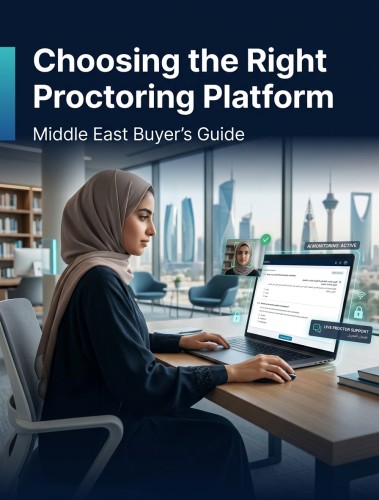
How to Choose the Right Online Proctoring Platform for the Middle East
A procurement team in Abu Dhabi shortlists three proctoring vendors. All three demo well. All three claim compliance. Six months later, one is quietly dropped because it could not support Arabic candidates, could not answer a data-residency question from legal, and had a support desk that went dark during Gulf business hours. The exam program paid for that mistake in voided sittings and candidate complaints.
Choosing a proctoring platform for the Middle East is not the same as choosing one for a single-country program. You are buying for a region with several data-protection regimes, multiple languages, uneven connectivity, and clients who may sit in Dubai, Riyadh, Cairo, or an EU campus all at once. The criteria that matter in one market can be irrelevant in another.
This is a buyer's guide built for that reality. Work through the criteria in order. Weight them for your own exam risk and candidate base, not for a generic feature checklist.
1. Arabic and Multilingual Support
Start here, because it is the criterion vendors most often fake. A translated marketing page is not the same as an Arabic candidate experience.
Ask whether the candidate onboarding, the ID check prompts, and the live proctor communication all work in Arabic. Ask about right-to-left interface handling. Then ask about the other languages your MENA candidates actually use, because a regional program rarely runs in one language.
If a vendor cannot show you a working Arabic candidate flow, treat the rest of the demo with caution.
2. Data-Protection Coverage Across the Region
This is where legal earns its seat at the table. The Middle East is not one regime.
According to UAE Federal Decree-Law No. 45 of 2021 (PDPL), effective 2 January 2022, processing must be lawful, fair, and transparent, with purpose limitation and data minimization, and candidates hold six rights that controllers answer within 30 days. That covers mainland UAE. But the financial free zones, DIFC and ADGM, run their own separate data-protection regimes, so a candidate inside one of those zones may fall under different rules than one on the mainland.
Saudi Arabia has its own data-protection regime that a program serving KSA candidates has to account for. And GDPR reaches further than people expect. It applies to any institution assessing candidates physically located in the EU or EEA, so if your Middle East program includes EU-based learners, GDPR sits on top of everything else.
The buying test is simple. Hand the vendor your candidate map and ask them to walk you through lawful processing for each jurisdiction. Vague answers here are disqualifying.
3. Security Tiers That Match Exam Risk
Not every exam needs the same defense. A low-stakes practice quiz and a national licensing exam should not carry identical proctoring, and paying headset-level security for a formative quiz is waste.
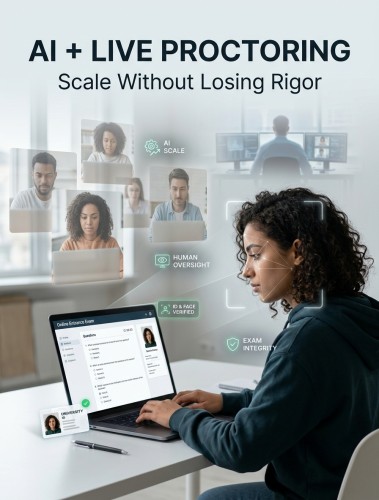
Look for a platform with graduated service levels so you can dial security to the stakes. Non-disruptive AI for low-risk sittings. Live human proctoring for medium stakes. Full-environment or headset-level monitoring for the exams where a leak ends a contract.
Proctor360 is built around this idea. It offers five proctoring service levels, from AI Auto-proctoring that runs in the background to 360° Total View™. The point is control. You match security to risk instead of buying one blunt setting for every exam.
4. Full-Environment Visibility
Related to security tiers, but worth its own criterion, because a face-cam has a blind spot the size of the room.
Collusion and hidden devices do not happen in front of the camera. They happen off to the side, under the desk, on a second phone. A platform that can only see the candidate's face will miss most of it.
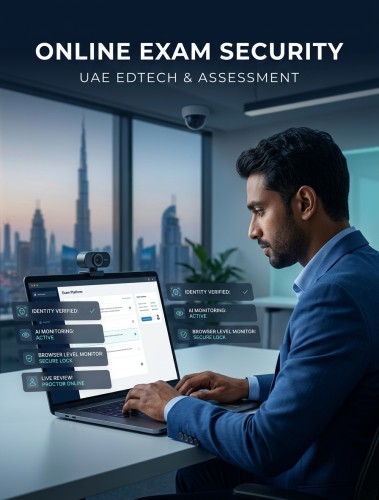
Ask what the top tier actually sees. 360° Total View™ uses a 360-degree headset to capture the candidate's entire environment, and Proctor360's Multi-cam Live option turns the candidate's own phone into a second camera so a proctor can watch the room. That is the difference between watching a head and watching a test.
5. Connectivity Resilience
Bandwidth across the region is uneven. A platform that assumes a fast, stable connection will fail candidates who do not have one, and a candidate dropped mid-exam by the tool becomes a support ticket and a disputed score.
Ask how the platform behaves on a weak connection. How it handles a mid-session drop. Whether recording survives an interruption. Whether a candidate can rejoin without losing their sitting. Resilience is not glamorous. It is what keeps your completion rates honest.
6. LMS and Test-Engine Integrations
A proctoring tool that does not connect cleanly to your learning platform or test engine creates manual work at every sitting, and manual work is where errors and delays live.
Ask for the named integrations, not a vague promise of an API. Proctor360 lists 11 named LMS and test-engine integrations, which tells you the connections are built and supported rather than theoretical. Check that your specific stack is on the list before you sign.
7. Support Hours Across Time Zones
Here is a criterion that quietly decides renewals. When an exam breaks, response time is the product.
A Middle East program may run sittings from early morning Gulf time through to candidates in other time zones. If your vendor's support desk only covers US or European hours, your peak exam windows may land in their dead zone. Ask for support coverage in plain terms. What hours, what channels, what response time.
This is measurable, and third parties measure it. On Gartner Peer Insights, Proctor360 holds 5.0 out of 5 from 3 ratings and ranks number one for service and support among remote proctoring vendors, and it carries a G2 rating of 4.9 out of 5 across 14 reviews. Service reputation is not a soft factor here. It is the thing you feel most at your worst moment.
8. Accessibility
Your candidate base includes people who need accommodations, and in higher education this is often a legal and ethical requirement, not an optional nicety.
Ask how the platform handles extended time, screen readers, and alternative input. Ask whether an accommodated candidate gets an equivalent, dignified experience rather than a broken one. A platform that cannot serve every candidate is not really serving your program.
9. Compliance and Institutional Credibility
The last criterion ties the rest together. Can the vendor prove what they claim?
Look for recognized certifications so your clients' auditors do not have to take anyone's word for it. Proctor360 holds SOC2, GDPR, and FERPA. For regulated content it hosts on AWS GovCloud and serves federal clients with strict data-residency requirements. Its client base spans higher education institutions across the US and internationally, and it holds memberships in bodies including EDUCAUSE, ATP, and OLC. For a higher-education program specifically, its higher-ed remote testing solution is the relevant starting point.
Reading the Region's Direction
One more thing worth factoring in. The Middle East is investing hard in education, and that raises the bar on assessment integrity.
Dubai's economic agenda D33 aims to double Dubai's economy by 2033 through more than 100 projects, and the Education 33 strategy, announced by Crown Prince Sheikh Hamdan bin Mohammed, aims to attract world-class universities and international students to Dubai. The UAE Centennial 2071, launched in 2017, names excellent education as one of its four pillars. A quick fact-check for your own materials: there is no "Dubai Vision 2030." Vision 2030 belongs to Saudi Arabia. Reference the real UAE agendas and you keep your credibility.
The direction is clear. More international students, more world-class institutions, more scrutiny on the credibility of results. The proctoring platform you pick should be able to grow with that.
Frequently Asked Questions
What is the most important criterion when choosing a proctoring platform for the Middle East?
There is no single most important one, but data-protection coverage and genuine Arabic support decide the most shortlists. A platform that cannot lawfully process data across UAE PDPL, the DIFC and ADGM zones, KSA rules, and GDPR where EU learners are involved, or that cannot deliver a working Arabic candidate flow, will fail a regional program regardless of its other features.
Which data-protection laws apply to proctoring in the region?
Mainland UAE falls under Federal Decree-Law No. 45 of 2021, the PDPL. The financial free zones DIFC and ADGM have their own separate regimes. Saudi Arabia has its own data-protection rules, and GDPR reaches any program assessing candidates physically located in the EU or EEA.
How many security levels should a proctoring platform offer?
Enough to match security to exam risk. A single fixed setting forces you to over-secure low-stakes quizzes or under-secure high-stakes exams. Proctor360, for example, offers five service levels from non-disruptive AI up to 360° Total View™, so you can dial protection per exam.
Why does support coverage matter so much for a Middle East program?
Because exams break in real time and response time is the product. If your peak sitting windows in Gulf time fall outside your vendor's support hours, candidates get stuck with no help. Independent ratings help here, and Proctor360 ranks number one for service and support on Gartner Peer Insights.
Does the platform need to integrate with our LMS?
Yes, unless you want manual work at every sitting. Ask for named, supported integrations rather than a generic API claim. Proctor360 lists 11 named LMS and test-engine integrations, so you can confirm your stack is covered before committing.
Is there really no "Dubai Vision 2030"?
Correct. Vision 2030 is Saudi Arabia's national strategy. Dubai and the UAE have their own agendas, including D33, the Education 33 strategy, and UAE Centennial 2071. Use the accurate names in any procurement or marketing document.
Match the Platform to Your Program, Not to a Checklist
The right proctoring platform for the Middle East is the one that fits your candidate map, your languages, your regulators, and your exam risk. Weight these nine criteria for your own program, then test each vendor against them with real questions and real scenarios.
If you run assessments across the UAE and the wider region, talk to the Proctor360 team about which service level, integrations, and deployment model fit your exam program. Book a demo and put the platform against your actual requirements.

Kranthi Bathula is the Co-Founder and CTO of Proctor360 and an online proctoring and assessment-security expert with extensive experience in EdTech, exam integrity, and AI-enabled test monitoring. He writes about remote proctoring, test security, AI in assessments, live and automated proctoring, and best practices for secure online testing. Through his engineering-driven insights, Kranthi helps educational institutions, certification bodies, and employers make informed decisions to protect the integrity of their exams.