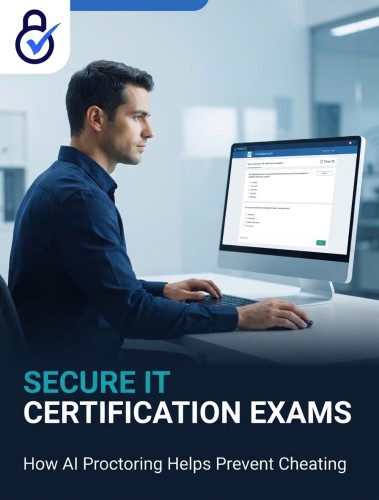
How IT Certification Providers Prevent Cheating with AI Proctoring
A hiring manager checks a new hire's certification number in a verification portal, and it comes back valid. Six weeks later, that same engineer cannot explain what a subnet mask does, and the manager starts to wonder what the credential really proved.
That is exactly the outcome IT certification programs are built to prevent, and preventing it is getting harder. The tools available to a candidate who wants to cheat have changed more in the past two years than in the ten years before that. Controls that only watch the browser assume the threat lives inside the browser, and more and more often, it does not.
This article looks at the main risks facing IT certification exams today: braindump markets, AI help during the session, proxy testing, and practical lab exams. It also covers what the major vendors have already written into policy, and what AI proctoring for IT certification exams needs to do to keep up.
The AI Assistance Problem, by the Numbers
Fabric reviewed 19,368 technical interviews held between July 2025 and January 2026 and found signs of cheating in 38.5 percent of candidates, rising to 48 percent for purely technical roles. The detected methods broke down like this:
- Overlay tools such as Cluely and Interview Coder, which place an invisible answer layer on the candidate's own screen: 45 percent
- Voice mode chatbots: 34 percent
- Tab switching or a second screen: 18 percent
These figures come from technical interviews rather than certification exams. Still, the candidate pool overlaps heavily and the tools are identical, so assuming your exam population is very different would be optimistic.
Overlay tools deserve the most attention. They run on the candidate's own computer, sit on top of the exam window, and do not appear in a recording of the exam application. Browser only controls miss them, and so does a webcam aimed at the candidate's face, because the candidate is looking at the screen exactly as expected.
Braindumps Are an Industry, Not a One Time Event
Under the CompTIA Candidate Agreement, candidates must tell CompTIA promptly if they learn they have been exposed to unauthorized study material, such as braindumps or leaked questions, at any point and whether or not it was deliberate. Staying silent can count as a violation on its own. CompTIA can revoke the certification tied to that exam, revoke every other CompTIA certification the candidate holds, and block new exam registrations for at least six months.
Microsoft's exam and assessment lab security policy is just as firm. Microsoft says it relies on data forensics to cancel scores, revoke certifications, ban candidates, and shut down test centers. The first item on its list of misconduct examples is using AI in any form during an exam or lab, followed by faking score reports, using braindumps, and impersonating someone else.
Cisco has run a formal Exam Security Program since 2001. In a Cisco Blogs post written by that team, they describe oversight of more than 100 exams, eight CCIE labs, about 2,700 Pearson VUE test centers, and all online exam delivery. The team also makes clear that candidates caught using braindump material can be banned for life.
Three of the biggest programs in the industry take essentially the same stance. If your policy is noticeably softer, candidates will figure that out.
Proxy Testing and the Identity Problem
Having someone else sit the exam is the oldest trick in credentialing, and remote delivery made it easier.
Microsoft's policy names proxy testing directly and notes that some companies sell it as a service with a guaranteed pass. CompTIA's conduct rules forbid using false identity documents or asking another person to test on your behalf.
The methods are also getting more advanced. The FBI has issued an alert about North Korean IT worker schemes in which operatives use AI tools, including face swapping, to get through video interviews and technical screens under fake identities. The Bureau's suggested countermeasure is refreshingly simple: ask the person to wave a hand in front of their face, which disrupts real time face rendering.
Two requirements follow. Identity verification has to continue throughout the session instead of happening once at launch, and it needs liveness detection that a rendered face cannot pass.
Location and Testing Environment: The Overlooked Controls
CompTIA's agreement includes two often overlooked rules. The first is location: candidates must register with an address in their country of residence and take the exam from that same country. CompTIA and its delivery partner check location during the exam, and a mismatch can lead to a cancelled score.
The second is the computer. For remotely proctored exams, candidates must use their own personal computer and a personal network connection, and they may not run unauthorized software in the background.
That second rule is exactly what overlay tools break. Enforcing it means watching the machine and the room, not only the face.
Practical Lab Exams Need a Different Approach
Practical, performance based testing is where IT certification earns its credibility, and it is also where remote proctoring is most difficult.
A lab exam runs in a live environment, often for several hours, across many windows and terminals. Candidates may need documentation and will move around. Strict browser restrictions are either impossible here or so limiting that the exam stops working.
What works better is monitoring the environment instead of locking down the application:
- Full desktop visibility, so a second window or an overlay can be seen
- A second camera angle on the workspace, to catch a phone or tablet that a front webcam misses
- Continuous audio, which picks up a candidate speaking to a voice mode assistant, the method behind 34 percent of Fabric's detected cases
- Live proctor intervention during long sessions, because a flag raised hours later does nothing in a four hour lab
- Scheduled identity checks at intervals across a long sitting
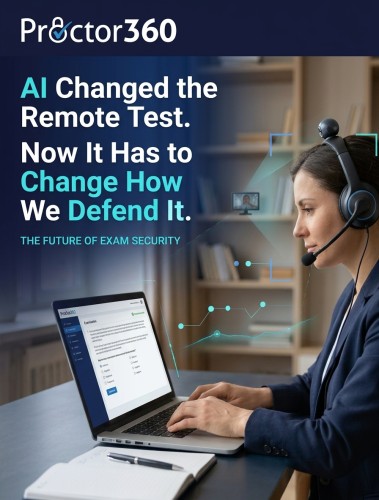
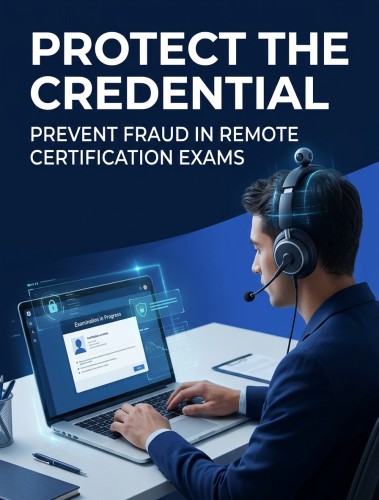
Proctor360's Multi-Cam Live Proctoring covers most of this by using the candidate's own phone as a second camera while the proctor views the candidate's desktop. Alongside the browser extension's browser-level monitoring, a separate System Monitor detects virtual machines, remote control tools, screen mirroring, and extra displays. For programs that want full room coverage, 360° Total View™ uses a patent pending headset with a camera, a microphone so the proctor can hear the room, and a speaker so the proctor can talk to the candidate. It supports paper components as well as online exams.
Score Reports That Cannot Be Faked
Fake score reports are common enough that Microsoft's policy lists a physical mailing address for candidates appealing a ban, who must send an original report rather than a scan or electronic copy.
If your program still issues a PDF as proof of certification, you are trusting the holder to be honest. Stronger options include a verification portal where employers can look up a certification number directly, and digital badges signed cryptographically by the issuer.
Pair that with data forensics on your own results. Statistical anomaly detection is what both CompTIA and Microsoft use as the basis for enforcement, and it is the only control that catches organized fraud after the fact.
What to Expect from AI Proctoring for IT Certification Exams
For an IT certification program in 2026, the checklist is specific:
- Full desktop visibility and a second camera angle
- Continuous audio capture
- Ongoing identity checks with liveness detection
- Live intervention for long practical sessions
- Complete, exportable session records that hold up on appeal
Proctor360 covers this range through five service tiers: AI Auto Proctoring, AI Auto Proctoring with Intervention, Single Webcam Live Proctoring, Multi-Cam Live Proctoring, and Institutional SaaS Remote Proctoring, with the 360° Total View™ headset available for full room coverage. AI Auto Proctoring includes automated check-in, ID verification with face-presence confirmation, and recorded screen, camera, and audio with incident flagging. The professional certification testing solution is built for credentialing bodies. Proctors are background checked and trained in data security, each organization's data is kept in segregated storage, and the platform aligns with SOC 2, FERPA, GDPR, and WCAG.
Frequently Asked Questions
How common is AI assisted cheating on technical exams?
Fabric found cheating signals in 38.5 percent of 19,368 technical interviews, and 48 percent in purely technical roles, with overlay tools the most common method.
Can browser based controls stop AI overlay tools?
Not reliably. Overlay tools run at the operating system level and sit above the exam window,. Full desktop visibility plus a second camera angle is what catches them.
What happens if you use braindumps for a CompTIA or Microsoft exam?
CompTIA can revoke all your CompTIA certifications and block registration for at least six months. Microsoft can cancel scores, revoke certifications, and ban candidates, and Cisco has issued lifetime bans.
How do IT certification bodies detect proxy testing?
Through ID matching, face-presence confirmation with liveness detection, continuous presence checks during the exam, and data forensics afterward.
How do you proctor a practical lab exam remotely?
Monitor the environment rather than locking the application: full desktop, a second camera, continuous audio, a live proctor, and periodic identity checks.
Are AI proctoring flags enough to revoke a certification?
A flag is evidence, not a verdict. Defensible programs pair flags with human review, a documented investigation, a chance for the candidate to respond, and statistical support.
Protecting What the Credential Stands For
An IT certification is only worth something if the person holding it actually earned it. Overlay tools, voice assistants, braindump markets, and AI driven identity fraud all challenge that at the same time, and a single webcam pointed at the candidate's face sees none of them.
If you run a certification program and are reviewing how secure your exam delivery is, schedule a demo to talk with the Proctor360 team about your exam formats, your lab requirements, and where your current monitoring falls short.
Sources
- The State of AI Interview Cheating in 2026: Insights from 19,368 Interviews, Fabric
- North Korean IT Worker Threats to U.S. Businesses, Federal Bureau of Investigation
- CompTIA Candidate Agreement, CompTIA
- Exam and assessment lab security policy, Microsoft Learn
- Behind the Scenes of Cisco Exam Security, Cisco Blogs
- Professional Certification Testing, Proctor360
- AI Auto Proctoring, Proctor360
- Multi-Cam Live Proctoring, Proctor360
- 360° Total View™, Proctor360
- Book a Demo, Proctor360
Kranthi Bathula is the Co-Founder and CTO of Proctor360 and an online proctoring and assessment-security expert with extensive experience in EdTech, exam integrity, and AI-enabled test monitoring. He writes about remote proctoring, test security, AI in assessments, live and automated proctoring, and best practices for secure online testing. Through his engineering-driven insights, Kranthi helps educational institutions, certification bodies, and employers make informed decisions to protect the integrity of their exams.