Key takeaways
- Proxy candidates are the real risk in Indian tech hiring, where someone other than the applicant sits the online round and the gap only shows up after day one.
- Identity verification during the test is what protects score validity, so the person who earned the result is provably the person you hired.
- DPDP consent is not optional for job applicants, and a serious proctoring vendor should give you the consent flow, data controls, and candidate experience to match.
Remote Proctoring for Pre-Employment Assessments in India
A candidate clears your online coding round with a strong score. The interview panel loves the resume. Then the person who shows up on day one cannot write the same code they supposedly submitted. You did not hire a weak engineer. You hired a proxy, and the real test-taker was someone else entirely.
Indian tech hiring runs at a scale that makes this a systemic problem, not a rare one. Employers and staffing firms screen thousands of applicants for a handful of roles, mostly through remote assessments taken from a candidate's home. That format is efficient. It is also wide open to impersonation, and the fraud market around it has professionalized.
Remote proctoring is how you close that gap without dragging every applicant into an office. It verifies who is actually taking the test, protects the validity of the score, and does it in a way that keeps good candidates from walking away in frustration. Getting the balance right is the whole game.
The Proxy Problem in Indian Tech Hiring
Unproctored online assessments assume honesty. At volume, that assumption breaks.
The most common attack is the proxy candidate. Someone more skilled sits the test in place of the applicant, or feeds answers in real time over a call. In competitive tech hiring, where a single offer can attract hundreds of applicants, the incentive to cheat is high and the tools to do it are cheap.
It is worth being specific about the variants, because they need different defenses. A full proxy is one person taking the entire test for another. A partial assist is the real candidate sitting the test while a helper feeds solutions over a screen share or call. A content leak is a candidate who obtained the question set in advance. Each of these fails a different check, which is exactly why a single detection trick rarely holds. You need identity verification, live-session monitoring, and question randomization working together.
The cost is not just a bad hire. It is a corrupted funnel. When you cannot trust the top of your assessment scores, every downstream decision inherits the doubt. Your best genuine candidates get crowded out by inflated ones. Interview panels waste hours on people who cannot do the work. And the assessment itself, the thing you built to save time, starts costing you time instead.
Remote work made this worse by normalizing the never-meet-in-person hire. It also made proctoring the natural fix, because the same remote pipe that carries the test can carry the verification.
Consider what a high-volume screen actually looks like. A staffing firm might push several thousand applicants through an aptitude and coding assessment each month for a shifting set of client roles. At that scale, even a small percentage of proxy submissions translates into dozens of contaminated shortlists. The people reviewing those shortlists have no way to tell a real top scorer from a fabricated one, so they hedge, re-test, and slow down. Verification at the assessment stage is what keeps the whole pipeline moving with confidence.
There is a legal edge to this too. A hire made on a fraudulent assessment is a liability, especially for staffing firms placing candidates into client organizations. If a placed engineer cannot do the work they tested for, the reputational hit lands on the agency, and the client relationship suffers. A verified score is not just a hiring convenience. It is protection for the businesses that depend on your screening.
How Remote Proctoring Verifies Identity and Protects Test Validity
Good pre-employment testing does two jobs at once. It confirms identity, and it defends the integrity of the score. Here is how the pieces fit.
Identity Verification Before the Test Starts
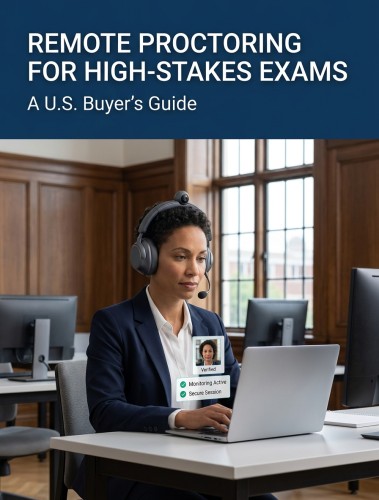
The first defense is the strongest. Before the assessment unlocks, the candidate captures a government ID, the system confirms face presence, and a room scan confirms no one else is present. The applicant who registered has to be the person in the chair. That single gate stops most casual proxy attempts cold.
Continuous Monitoring During the Test
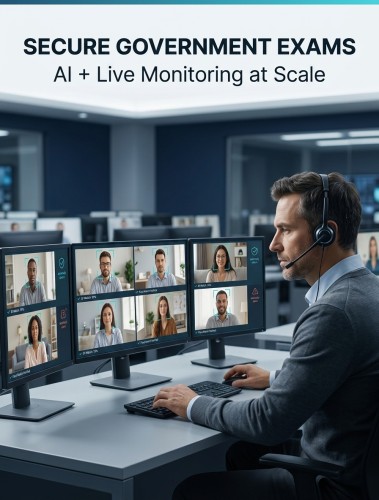
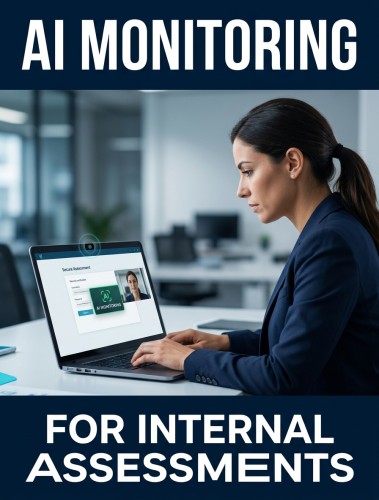
Verification cannot end at the door. AI auto-proctoring watches the session without disrupting it: face presence, gaze patterns, a second face entering frame, tab-switching, unexpected audio. For a coding assessment, that matters, because the classic cheat is a second screen or a whispered assist off-camera.
Matching the Proctoring Tier to the Role
Curious how Proctor360 fits your exam program?
See AI, live, multi-cam, and 360° Total View™ proctoring in a quick 30-minute demo.
Not every assessment needs the same intensity. A first-round aptitude screen for a high-volume role does not warrant the same lockdown as a final technical round for a senior hire. The better platforms let you dial the tier up or down. Proctor360 offers five service levels, from non-disruptive AI auto-proctoring up through live human proctoring, multi-cam using the candidate's phone as a second camera, and 360° Total View™ for full room capture. A staffing firm screening 5,000 applicants a month and a company making a single critical hire can use the same vendor at very different settings.
DPDP Consent Is Not Optional for Job Applicants
Here is where a lot of hiring teams stumble. A job applicant is a data principal under the Digital Personal Data Protection Act, 2023, and proctoring footage is personal data. You cannot record a candidate's face, room, and ID without a lawful basis.
The DPDP Act is consent-first. Consent must be free, specific, informed, unambiguous, and withdrawable. So before an applicant starts a proctored assessment, they need a clear notice explaining what is captured, why, how long it is kept, and how they can withdraw. Data fiduciaries are limited to the stated purpose, and penalties reach up to 250 crore. You cannot quietly reuse hiring footage for anything else.
One more wrinkle for global employers. If you assess a candidate who is physically located in the EU or EEA, GDPR also applies, with its own extraterritorial reach. A serious vendor documents both. Point candidates to a plain-language privacy explanation rather than burying consent in a terms wall.
Retention is the piece hiring teams forget. You captured a candidate's ID and room footage to verify one assessment. Once that hire decision is made, holding the footage indefinitely serves no stated purpose, and the DPDP Act limits you to the stated purpose. Set a clear deletion window, document it, and make sure your vendor honors it. A withdrawn candidate should be able to ask for their data to be removed, and you should have a real answer.
Candidate Experience Decides Whether Your Funnel Survives
Strict proctoring that alienates applicants is a false economy. If your assessment feels like an interrogation, your strongest candidates, the ones with other offers, simply drop out. You end up with a cleaner test taken by a weaker pool.
So the experience has to be smooth. Fast onboarding. Clear instructions. Low-bandwidth tolerance, because a lot of Indian applicants test from home connections that are not fibre. Support that responds when someone cannot launch. And transparency, so the candidate understands they are being recorded and why, which paradoxically increases trust rather than eroding it.
This is the judgment call every talent team has to make. Too little proctoring and your scores are worthless. Too much and your funnel empties. The right vendor gives you the dial to find the middle.
One practical tip. Tell candidates upfront that the assessment is proctored and briefly why. Most applicants accept it readily when the reason is honest, because a fair test protects the honest candidate as much as it deters the cheat. It is the surprise mid-test camera prompt, not the proctoring itself, that generates complaints.
What a Serious Proctoring Vendor Should Provide for Hiring
For pre-employment assessments in India, a credible vendor needs three things. Layered proctoring that scales from mass screening to critical hires. Compliance that satisfies DPDP and, where relevant, GDPR. And infrastructure that stays reliable across uneven connections.
Proctor360 fits that shape. It runs five service levels, so you match security to the role instead of over-proctoring every applicant. It holds SOC2, GDPR, and FERPA compliance, and for the most sensitive content it hosts on AWS GovCloud, an environment few proctoring vendors operate in, with federal clients that carry strict data-residency requirements. On Gartner Peer Insights it holds a 5.0 out of 5 and ranks first for service and support among remote proctoring vendors, which matters most on the day an assessment is live and a candidate needs help.
The goal is not to make hiring harder. It is to make your scores mean something again.
There is a quiet payoff most teams underestimate. When candidates know an assessment is properly proctored, the casual cheats often self-select out before they start, and the ones who stay are competing on a level field. That improves the signal quality of every score you collect, which is the entire reason you run an assessment in the first place. Cleaner data at the top of the funnel saves hours of wasted interviewing at the bottom.
Frequently Asked Questions
How does remote proctoring prevent proxy candidates in hiring assessments?
It gates the test with identity verification: government ID capture, face-presence confirmation, and a room scan before the assessment unlocks. Continuous AI monitoring then watches for a second face, off-screen assistance, or tab-switching during the test. Together these stop the impersonation that unproctored assessments cannot catch.
Do we need candidate consent to proctor a job assessment in India?
Yes. Under the DPDP Act, 2023, a job applicant is a data principal and proctoring footage is personal data. You must give a clear notice and obtain consent that is free, specific, informed, and withdrawable before recording, and you can only use the data for the stated hiring purpose.
Will proctoring hurt our candidate experience and drop-off rate?
It can if done heavily on low-stakes screens. The fix is matching the proctoring tier to the role, keeping onboarding fast, supporting low-bandwidth connections, and being transparent about what is recorded. Applied sensibly, proctoring protects your funnel rather than shrinking it.
Can proctoring scale for high-volume staffing and screening?
Yes. Non-disruptive AI auto-proctoring is built for scale, letting a staffing firm screen thousands of applicants without a human watching each feed. You can reserve live or 360° Total View™ proctoring for the smaller pool of final or high-trust roles.
What proctoring level do we need for a technical or coding test?
For most technical screens, AI auto-proctoring with identity verification is enough to deter proxies and off-screen help. For senior or final-round technical assessments where the hire is critical, adding live or multi-cam proctoring gives you a stronger guarantee that the score reflects the actual candidate.
The Bottom Line
A hiring assessment is only useful if you can trust the person behind the score. In Indian tech hiring, where proxy candidates are a professionalized problem, remote proctoring is what restores that trust, as long as it verifies identity, stays compliant with the DPDP Act, and respects the candidate on the other side of the camera.
If you screen candidates at scale and want to protect the validity of your assessments without losing good applicants, book a demo with Proctor360 and see how the right proctoring tier fits your hiring workflow.
Ready to see Proctor360 in action?
Get a 30-minute demo tailored to your exam type, whether that is AI, live, multi-cam, or 360° Total View™.

Kranthi Bathula is the Co-Founder and CTO of Proctor360 and an online proctoring and assessment-security expert with extensive experience in EdTech, exam integrity, and AI-enabled test monitoring. He writes about remote proctoring, test security, AI in assessments, live and automated proctoring, and best practices for secure online testing. Through his engineering-driven insights, Kranthi helps educational institutions, certification bodies, and employers make informed decisions to protect the integrity of their exams.