Scaling Entrance Exams with AI and Live Remote Proctoring
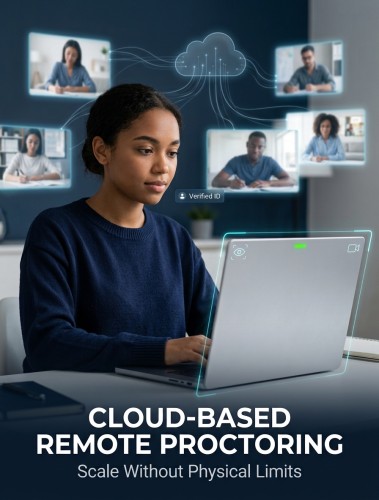
An entrance exam program that worked for 2,000 candidates does not automatically work for 50,000. Scale changes everything. The check-in surge gets sharper, the support load multiplies, the cost of pure live proctoring becomes prohibitive, and the integrity risk grows with every additional candidate who might try to game the test. Scaling an entrance exam is less about adding capacity and more about choosing the right mix of monitoring for the volume.
The smartest entrance exam programs do not pick between AI proctoring and live proctoring. They combine them. AI handles the breadth, live handles the depth, and the program gets both scale and rigor without paying for a human to watch every single candidate.
This article explains how to scale entrance exams with a blended AI and live proctoring model.
Why Pure Live Proctoring Does Not Scale, and Pure AI Is Not Enough
Live proctoring is rigorous. A trained proctor watching a candidate catches things software can miss and can intervene in real time. But it is also staff-intensive and expensive, and at the scale of a major entrance exam, putting a live proctor on every candidate is neither affordable nor necessary.
Pure AI proctoring scales effortlessly and costs far less per candidate, but on its own it leaves judgment calls to an algorithm. An automated flag is a signal, not a verdict, and on a high-stakes entrance exam, a result that affects a candidate's future should not rest on an algorithm alone. The answer is not to choose one. It is to layer them so each does what it does best.
The Blended Model: AI for Breadth, Live for Depth
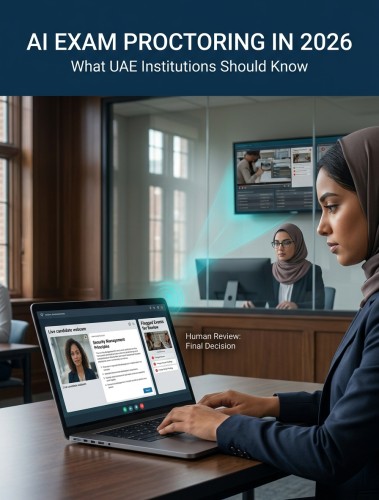
The blended approach uses AI as the baseline across all candidates and brings in live proctoring where it adds the most value. AI monitors every session, verifies identity automatically, records the screen and camera and audio, and flags anomalies. That handles the volume no human team could.
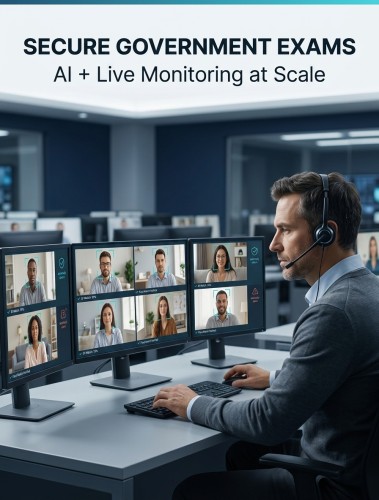
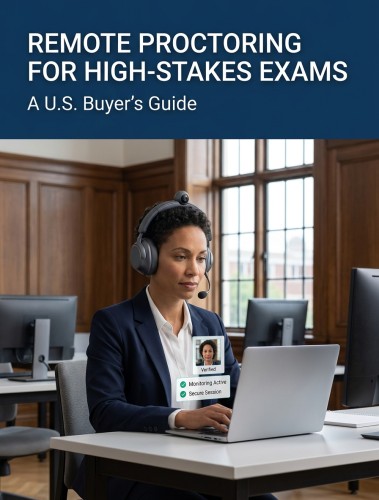
Live proctoring then concentrates on the cases that warrant a human. Some programs use live proctors for the highest-stakes exam tiers. Others use a live review layer where AI-flagged sessions get human verification before any decision is made, so no candidate is penalized on an algorithm's say-so. Proctor360 supports both AI auto-proctoring and live proctoring on one platform, which is what makes the blend practical rather than a two-vendor headache.
Handling the Check-In Surge at Scale
The hardest operational moment in a large entrance exam is the opening. Tens of thousands of candidates trying to verify identity and start within the same window will overwhelm any system that was not built for concurrency.
AI-driven automated check-in is what makes this survivable. Automated ID verification processes candidates in parallel rather than queuing them behind human proctors, so a surge that would stall a live-only model clears quickly. According to a systematic review in the Journal of Academic Ethics, 44.7 percent of students admitted to cheating in online exams, which is exactly why the automated check-in cannot cut corners on identity even under load. The verification has to be both fast and rigorous, and automation is the only way to get both at entrance-exam scale.
Keeping Results Defensible as Volume Grows
Scale multiplies disputes. With 50,000 candidates, even a small percentage of contested results is a large absolute number of challenges the program has to defend. The monitoring record is the defense, so it has to be solid at every tier.
This is where matching monitoring depth to stakes pays off. Higher-stakes exam tiers can use multi-camera or 360-degree monitoring that captures what a single webcam cannot, producing evidence that holds up when a result is challenged. 360° Total View™ gives a complete view of the candidate's environment for the exams that most need it. Combined with SOC2, GDPR, and FERPA compliance and AWS GovCloud hosting for sensitive content, the program can scale its candidate count without weakening the defensibility of any single result.
Designing the Right Mix for Your Program
There is no single correct blend. The right mix depends on candidate volume, the stakes of each exam tier, the dispute risk, and the budget. A program might run automated proctoring across the board with a live review layer on flagged sessions, or reserve full live proctoring for its top tier while AI covers the rest.
The platform decision is what makes any of these workable. A program that has to stitch together a separate AI vendor and a separate live vendor inherits integration pain and inconsistent records. One platform that does both, configured per exam tier, lets the program tune the blend as it grows. Gartner Peer Insights ranks Proctor360 first for service and support among remote proctoring vendors, which at entrance-exam scale is the difference between a smooth program and a support crisis during the busiest window of the year.
Why the False-Positive Rate Matters More at Scale
At small volume, a handful of incorrectly flagged sessions is a manageable review task. At entrance-exam scale, the same flag rate becomes a flood. If an automated system flags even a few percent of fifty thousand candidates, that is thousands of sessions requiring human attention, and a program that has not planned for the review load will either rush decisions or leave candidates waiting. The false-positive rate, easy to overlook in a pilot, becomes a defining operational constraint at scale.
This is another argument for the blended model and for human review of flags. AI handles the volume of monitoring, but a human review layer on flagged sessions prevents algorithmic false positives from turning into unfair decisions. The trick is calibrating the flagging sensitivity so it catches genuine misconduct without burying the review team in noise. A platform that lets a program tune this balance, and a review process staffed for the real flag volume, is what keeps a large entrance exam both fair and operationally sane.
Managing Cost as Candidate Volume Grows
The economics of proctoring change sharply with scale, and a model that was affordable for a small entrance exam can become unsustainable at high volume. Pure live proctoring is the clearest example. The per-candidate cost that was tolerable for a few thousand candidates becomes prohibitive at fifty thousand. Scaling without a cost strategy is how programs blow their budget or quietly weaken their integrity to save money.
The blended model is also a cost-control model. By using automated AI proctoring as the baseline and concentrating live proctoring where it adds the most value, a program keeps per-candidate cost manageable while preserving rigor where it counts. The cost question and the integrity question are answered by the same design. Decide which exam tiers truly require human monitoring, apply AI everywhere else, and the program scales its candidate count without scaling its budget out of control.
Continuous Improvement Across Exam Cycles
A large entrance exam program is not a one-time setup. It runs cycle after cycle, and each cycle generates data that should make the next one better. Flag rates, the share of flags that survive review, support-load patterns, and reconnection incidents all reveal where the process can tighten. Ignoring that data means repeating the same problems every cycle.
Treat each administration as a feedback loop. If the false-positive rate on AI flags is high, the review thresholds or candidate instructions need adjustment. If support clustered at check-in, the preparation process needs work. If a particular exam tier produced most of the disputes, its monitoring level may need to change. A program that reviews and tunes after every cycle gets steadily more reliable, while one that does not stays stuck firefighting the same issues at ever-larger scale.
Frequently Asked Questions
Why combine AI and live proctoring for entrance exams?
AI proctoring scales to huge candidate volumes at low cost but leaves judgment to an algorithm, while live proctoring is rigorous but too staff-intensive to apply to every candidate. Combining them uses AI for breadth across all sessions and live proctoring for depth where human judgment matters most.
How does AI proctoring handle the check-in surge in large entrance exams?
Automated ID verification processes candidates in parallel rather than queuing them behind human proctors, so a surge of tens of thousands of simultaneous check-ins clears quickly. The verification stays rigorous under load, which is essential given how common online exam cheating is.
Should a result ever rest on an AI flag alone?
For high-stakes entrance exams, no. An automated flag is a signal, not a verdict. Many programs add a live review layer where AI-flagged sessions receive human verification before any decision, so no candidate is penalized solely on an algorithm's output.
How do you keep entrance exam results defensible at scale?
Match monitoring depth to each tier's stakes and record everything. Higher-stakes tiers can use multi-camera or 360-degree monitoring that captures what a single webcam misses, producing evidence that holds up when a result is challenged across a large candidate pool.
Can one platform run both AI and live proctoring?
Yes, and using one platform avoids the integration pain and inconsistent records of stitching together separate AI and live vendors. Proctor360 supports AI auto-proctoring, live proctoring, multi-camera, and 360° Total View™ monitoring on a single platform, configured per exam tier.
Scale Your Entrance Exams Without Losing Rigor
If you are growing an entrance exam program and need a proctoring model that combines AI scale with live rigor, the blended approach on one platform is how serious programs do it. Talk to the Proctor360 team or book a demo to design the right mix for your volume.

Kranthi Bathula is the Co-Founder and CTO of Proctor360 and an online proctoring and assessment-security expert with extensive experience in EdTech, exam integrity, and AI-enabled test monitoring. He writes about remote proctoring, test security, AI in assessments, live and automated proctoring, and best practices for secure online testing. Through his engineering-driven insights, Kranthi helps educational institutions, certification bodies, and employers make informed decisions to protect the integrity of their exams.