How to Conduct Secure Online Certification Exams in India
A leaked paper does not just fail one candidate. It voids a whole cohort.
In June 2024, UGC-NET was cancelled a day after it ran, on 19 June, after inputs from the Indian Cyber Crime Coordination Centre showed the paper had surfaced on the darknet. Around the same window, NEET-UG 2024, which drew a record 24 lakh registrations, became a national scandal: Bihar police arrested 13 people, some of whom had paid ₹30 to ₹50 lakh for leaked papers, and the case went to the CBI. If a national testing agency can be blindsided like that, a certification board running a fraction of the volume should assume it is a target too.
More Indian licensing and certification bodies are moving high-stakes exams online, and the reasons are practical. Candidates are spread across states. Physical centres are expensive and slow to scale. But moving online without a real security design just relocates the cheating, it does not stop it. This is a step-by-step guide to doing it properly, from identity to the evidence file you will need when a result gets challenged.
Why Online Certification Exams Are a Different Risk Class
A university mid-term and a professional certification are not the same animal. A certification decides whether someone can practise, get hired, or hold a licence. The incentive to cheat scales with what the credential grants access to, and for licensing exams that can be a career.
That is also why disputes are more likely and more aggressive. A candidate who fails and believes the process was unfair will escalate, sometimes legally. So the security you build has to survive two audiences: the honest majority who deserve a fair, low-stress exam, and the small group actively trying to beat it.
According to industry market reports for 2024 to 2025, India held roughly USD 0.88 billion of the online exam proctoring market, about a 35.7% regional share, growing near 18.3% CAGR. That growth is not abstract. It is boards like yours deciding, this quarter, how to run exams they used to run in a hall.
Step 1: Verify Identity Before the Exam Starts
Impersonation is the oldest trick in the book, and it is the one online exams make easier if you are careless. Before a single question loads, confirm the person on camera is the person who registered.
A workable identity check has three parts. First, a government photo ID captured on camera and confirmed against the candidate's face presence. Second, a live face-presence check at launch. Third, a rule for what happens when the match is uncertain, because it will be sometimes, and "the AI wasn't sure" is not an outcome you can defend to a candidate.
Here is where exam teams get this wrong. They treat identity as a one-time gate at the start and never check again. For a two-hour licensing exam, a mid-session presence check is cheap insurance against a swap after the camera has "seen" the right face.
Step 2: Scan the Room and Monitor the Environment
Identity tells you who is sitting down. An environment scan tells you what is in the room with them. Before the exam, have the candidate pan the space with their camera so you have a record of the desk, the walls, and anything within reach.
Then decide what you are actually worried about. A phone propped behind the laptop. A second monitor. A person off-camera feeding answers. Notes taped below the desk. A single forward-facing webcam cannot see most of that, and pretending it can is how boards end up with contested results.
For exams where the stakes justify it, use a second camera angle. Proctor360's multi-cam live proctoring turns the candidate's own phone into a side camera, so a proctor sees the hands, the desk, and the screen together. For the highest-risk exams, 360° Total View™ captures the candidate's entire environment in one continuous view, which removes the blind spots a fixed webcam leaves wide open.
Step 3: Use Browser Extension Monitoring to Close the Obvious Doors
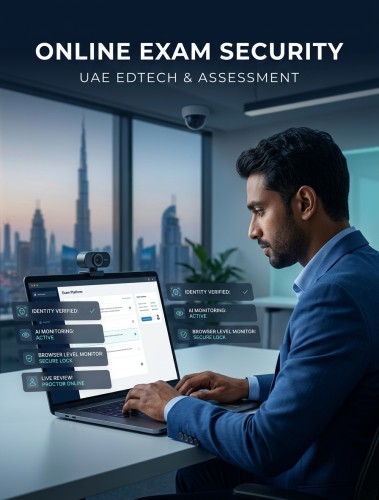
Most cheating online is not sophisticated. It is a candidate opening a new tab, searching an answer, or pasting from a document they had ready. Proctor360's browser extension closes those doors at the browser level: it disables copy-paste within the exam window and monitors for tab switches and access to prohibited browser features during the test.
A note on terminology here, because it matters. Some proctoring products in this space call this feature a "secure browser" or "lockdown mode," language that implies the software takes over the candidate's entire operating system, blocking other applications, disabling virtual machines, or preventing multi-monitor setups at the device level. That is a stronger claim than what a browser extension actually does, and it is not how Proctor360's extension works. It operates within the browser window, the way an extension is designed to. The candidate's operating system, other installed applications, and system-level settings sit outside its reach.
That distinction is not just semantics. Calling browser-level monitoring a "lockdown" overstates what the technology does, and a board repeating that claim to its own candidates, or to a regulator, is repeating something that is not quite accurate. It is also not a silver bullet on its own. A determined cheater can still bring a second device the browser cannot see, which is exactly why the environment scan in Step 2 matters. Browser monitoring handles the exam window; the camera handles the room. You need both.
Make the browser monitoring requirement clear in the candidate instructions well before exam day. People fail the technical check at launch because nobody told them their exam runs through a monitored browser extension, and a panicked candidate at 9 a.m. is a support ticket you could have avoided.
Step 4: Match the Proctoring Mode to the Exam's Risk
Not every exam needs the same level of scrutiny, and over-proctoring a low-stakes quiz just annoys honest candidates and burns your budget. This is where a graded approach beats one-size-fits-all.
A practical way to think about it, from lightest touch to strictest:
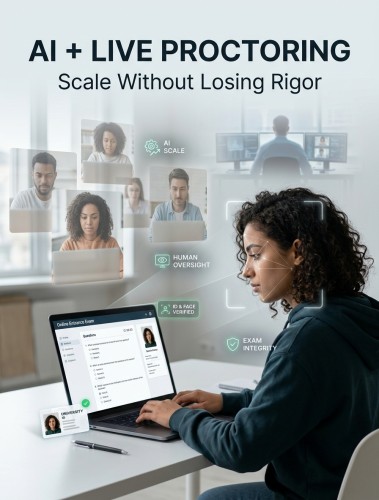
- AI auto-proctoring for lower-stakes or high-volume exams, where software flags anomalies and a human reviews the flags afterward. Non-disruptive and cheap to scale.
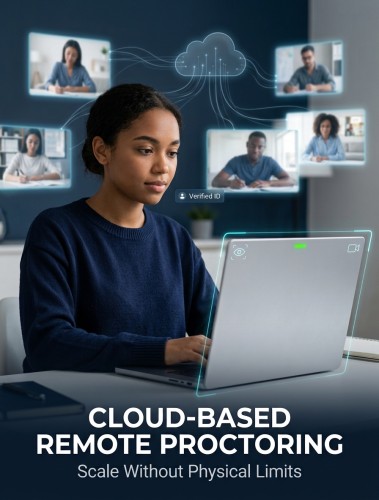
- Single or multi-camera live proctoring for mid- and higher-stakes exams, where a real proctor watches in real time and can intervene.
- 360° Total View™ headset proctoring for the exams where a voided result would be a genuine problem, licensing, high-value certifications, anything with a strong incentive to cheat.
Proctor360 runs five service levels for exactly this reason, so a board can dial security up or down per exam instead of paying top-dollar scrutiny on a practice test. The professional certification testing solution is built around this kind of tiering.
Step 5: Build a Chain of Evidence for Disputes
Assume a result will be challenged. Build for that day now, not after the complaint lands.
A defensible evidence file includes the identity check, the environment scan, the session recording, the timestamped flags, and the reviewer's decision on each flag. When a candidate says "I did nothing wrong," you want a clear record, not a proctor's memory of a session three weeks ago.
The Public Examinations (Prevention of Unfair Means) Act, 2024, which took effect on 21 June 2024, gave India a national anti-cheating law with real teeth. If you ever need to refer a case under it, or defend a decision, that chain of evidence is the difference between an enforceable finding and a "he said, she said." Keep it, secure it, and set a retention period you can point to.
Step 6: Get DPDP Consent Right
Proctoring is intrusive by design. You are recording someone's face, their room, and their screen, so India's Digital Personal Data Protection (DPDP) Act, 2023, is not optional reading.
DPDP is consent-first: the consent you collect must be free, specific, informed, unambiguous, and withdrawable. So tell candidates plainly what you capture, why, how long you keep it, and who can see it, before they agree, not buried in a policy nobody opens. Data fiduciaries are limited to the stated purpose, which means proctoring footage collected for exam integrity cannot quietly become training data for something else. Penalties run up to ₹250 crore, so this is not a corner to cut.
If any of your candidates are minors, DPDP is stricter still: it requires verifiable parental consent and bans behavioural monitoring of children. And if you assess candidates located in the EU, GDPR applies on top of DPDP, so a board with international candidates is running two regimes at once.
What a Serious Proctoring Setup Should Provide
Strip away the marketing and a certification board needs a short list of things from a proctoring vendor. Proctoring modes that scale from light to strict, so security matches exam risk. Real identity verification. Full environment capture, not a single blind webcam. A clean evidence trail for disputes. And compliance posture that holds up to scrutiny.
Proctor360, founded in 2018 and headquartered in Chantilly, Virginia, was built around that list. Its patent-pending 360° Total View™ headset captures a candidate's whole environment, which no competitor offers as hardware. It runs on AWS GovCloud for regulated content, holds SOC2, GDPR, and FERPA compliance, and carries a Gartner Peer Insights rating of 5.0 out of 5 across 3 ratings, ranked number one for service and support among remote proctoring vendors. For an Indian board weighing vendors, that combination, hardware plus compliance plus support, is the part that is genuinely hard to assemble.
Frequently Asked Questions
How do you verify a candidate's identity in an online certification exam?
Capture a government photo ID on camera and confirm it against a live face-presence check at launch. Add a mid-session presence check for longer exams so nobody swaps after the initial match. Have a clear rule for uncertain matches, since automated checks are not always confident and you need a defensible fallback.
Is online proctoring legal for exams in India?
Yes, when done under the DPDP Act, 2023. You must collect free, specific, informed, unambiguous, and withdrawable consent, use the footage only for the stated purpose, and take extra steps for minors, including verifiable parental consent. If you assess EU-based candidates, GDPR applies as well.
Which proctoring mode is right for a high-stakes licensing exam?
For exams where a voided result is a serious problem, use live proctoring with a second camera angle or 360° Total View™, which captures the whole room. Lighter AI auto-proctoring suits high-volume, lower-stakes tests. Match the mode to what the credential grants.
How do you handle a challenge to an exam result?
Keep a chain of evidence: the identity check, environment scan, session recording, timestamped flags, and the reviewer's decision on each. That record lets you defend or overturn a result on facts rather than memory, which matters under the Public Examinations (Prevention of Unfair Means) Act, 2024.
Can a candidate cheat with a second phone or monitor during an online exam?
They can try, which is why a single webcam is not enough. Browser extension monitoring blocks copy-paste and flags tab switches within the exam window, and an environment scan plus a second camera angle catches devices a forward-facing webcam misses. The two layers together close most of the gap.
Running Certification Exams You Can Defend
Securing an online certification exam in India comes down to layers: verify who is there, see the whole room, monitor the browser, match scrutiny to risk, keep the evidence, and get consent right. Skip a layer and you have relocated the cheating, not stopped it.
If your board is moving exams online, or tightening the ones already there, talk to a team that has built for regulated, high-stakes testing. Book a demo with Proctor360 and walk through your exam program with someone who has done this.

Kranthi Bathula is the Co-Founder and CTO of Proctor360 and an online proctoring and assessment-security expert with extensive experience in EdTech, exam integrity, and AI-enabled test monitoring. He writes about remote proctoring, test security, AI in assessments, live and automated proctoring, and best practices for secure online testing. Through his engineering-driven insights, Kranthi helps educational institutions, certification bodies, and employers make informed decisions to protect the integrity of their exams.