Online Exam Security for UAE-Based EdTech and Assessment Companies
A leaked answer key can end a contract in a single afternoon. Picture an assessment company in Dubai that delivers a licensing exam for a client in Riyadh. One candidate screenshots the paper, shares it on a private channel, and by the next testing window the questions are circulating across three countries. The client asks one question. How did this happen on your watch?
That is the pressure UAE-based EdTech and assessment firms live with. You are not just running exams. You are guaranteeing the integrity of someone else's credential across the MENA region, often for regulators, universities, and professional bodies who have zero tolerance for a compromised result. When trust breaks, it rarely comes back.
Exam security here is a business problem before it is a technical one. Get it right and you become the vendor clients renew without a second thought. Get it wrong and you spend the next quarter explaining voided scores.
The Threat Model You Are Actually Defending Against
Cheating is not one thing. It is a cluster of very different attacks, and a control that stops one does nothing against another.
Impersonation. Someone other than the registered candidate sits the exam. A stronger student, a paid proxy, sometimes a whole test-taking service. Without identity verification tied to the live session, you have no way to prove the person on screen is the person on the certificate.
Content theft. The candidate is not trying to pass. They are trying to steal the question bank so it can be sold or reused. This is the attack that keeps assessment owners awake, because a leaked bank compromises every future sitting, not just one score.
Collusion. Two or more candidates coordinate. A second device, a person off-camera feeding answers, a shared screen in another room. Single-webcam setups miss most of this by design, because the camera only sees the face and never the room.
AI-assisted cheating. This is the one that changed the fastest. A candidate runs a generative AI tool on a hidden phone or second monitor, pastes the question, and reads back the answer. The behavior looks calm and natural on camera. Nothing obvious to flag unless you can see the whole environment.
Here is where exam teams get this wrong. They buy a single tool, tick the "proctoring" box, and assume they are covered. They are covered against one attack. The other three walk straight through.
Layered Security Beats Any Single Control
No one controls everything. Serious exam security stacks layers so that what slips past the first is caught by the next. Think of it as defense in depth applied to assessment.
Identity First
Before a single question loads, you confirm who is sitting. ID document check, a live face capture, and confirmation of face presence against the two. If identity fails here, nothing downstream matters, because you could be watching an impostor behave perfectly.
Browser Extension Monitoring
The exam should run through a browser extension that restricts copy-paste and flags access to other tabs during the session. This is your first line against both content theft and casual attempts to search for answers. It operates at the browser level rather than taking control of the candidate's device, so it will not stop a second physical device on its own. It closes most of the easy digital exits inside the exam window itself.
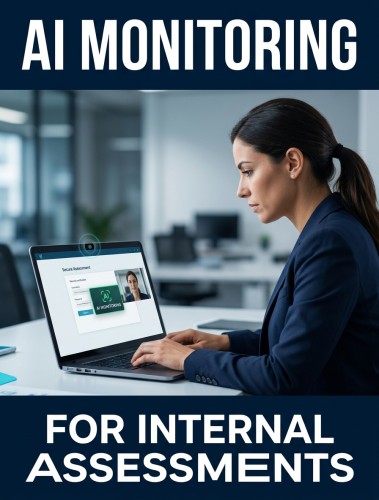
AI Monitoring Plus Live Human Oversight Plus Full Room Capture
This is the layer that separates real security from theater. AI watches continuously and flags anomalies without interrupting the candidate. A live proctor can intervene when a flag warrants it. And a full view of the room, not just the face, is what actually catches the second phone, the person off-camera, and the notes taped below the desk.
Proctor360 built its service tiers around exactly this logic. There is AI Auto-proctoring that runs non-disruptively in the background. There is Single Webcam Live and Multi-cam Live, which turns the candidate's own phone into a second camera so a proctor can see the room, not just the head and shoulders. And there is 360° Total View™, a patent-pending 360-degree proctoring headset that captures the candidate's entire environment. No competitor offers that hardware.
Evidence Review
Every session produces a record. Video, flags, timestamps, identity data. When a client or regulator challenges a result, you need to pull that evidence and defend the decision. A security stack that cannot produce a clean, reviewable audit trail is not really defensible.
Data Residency and Cross-Border Rules Under the PDPL
Security is not only about catching cheats. It is about handling the candidate's personal data lawfully, and in the UAE that means the Personal Data Protection Law.
According to UAE Federal Decree-Law No. 45 of 2021 (PDPL), which took effect on 2 January 2022, processing must follow lawfulness, fairness, and transparency, along with purpose limitation and data minimization. The law is consent-first. It grants candidates six data-subject rights, including access, correction, erasure, restriction, portability, and objection, and controllers must respond within 30 days. The regulator is the UAE Data Office.
Proctoring is heavy data processing. You are capturing video of a person's face, their room, sometimes their ID. Data minimization is not a suggestion here. Collect what the exam risk justifies, and no more.
Cross-border matters too. If you serve clients across MENA, candidate data may move between jurisdictions. The UAE's financial free zones, DIFC and ADGM, run their own separate data-protection regimes, so a candidate sitting inside one of those zones may fall under different rules than one in mainland UAE. And GDPR has extraterritorial reach. It applies to any institution that assesses candidates located in the EU or EEA, which means a UAE firm proctoring EU-based learners is squarely in scope.
The practical takeaway is simple. Map where your candidates physically sit, map where their data lives, and pick a proctoring partner whose hosting and processing can satisfy every regime you touch.
What a Serious Proctoring Vendor Should Provide
Strip away the marketing and a credible proctoring partner for this market should offer a short list of non-negotiables.
Layered service levels so you can match security to exam risk rather than paying for a headset on a low-stakes quiz.
Full-environment visibility, not just a face-cam, because collusion and hidden devices live in the room.
Non-disruptive AI plus human review, so flags get judged by a person before a score is voided.
Recognized compliance so your clients' auditors do not have to take your word for it.
Proven service and support, because when an exam breaks at 2 a.m., response time is the product.
Proctor360 lines up against that list. It runs five proctoring service levels, from non-disruptive AI to 360° Total View™, so institutions can dial security up or down per exam. It holds SOC2, GDPR, and FERPA compliance. It carries a G2 rating of 4.9 out of 5 across 14 reviews, and on Gartner Peer Insights it holds 5.0 out of 5 from 3 ratings and ranks number one for service and support among remote proctoring vendors. For regulated content, it hosts on AWS GovCloud and serves federal agencies with strict data-residency requirements, which is about as demanding a security bar as this industry has.
The White-Label Route for Platforms Proctoring Their Own Candidates
Not every EdTech company wants an outside proctor in the loop. Some run their own testing centers or want their own team watching sessions under their own brand. That is a different product.
For that, there is proctor-your-own software. Proctor360's Remote Proctoring Software lets a platform run proctoring in-house, with its own staff monitoring candidates, while still relying on the underlying security and recording infrastructure. Pair it with the Testing Centers solution and you get a setup built for organizations that deliver exams at scale and want control of the proctoring experience.
The logic is the same either way. Layered controls, full-environment visibility, clean evidence, lawful data handling. Whether an external proctor or your own team clicks the buttons is a business decision, not a security compromise.
Frequently Asked Questions
What is the biggest online exam security risk for UAE assessment companies?
There is no single biggest risk. Impersonation, content theft, collusion, and AI-assisted cheating are four distinct attacks, and each needs a different control. AI-assisted cheating has grown fastest because a hidden phone running a generative tool looks calm on a face-cam, which is why full-environment visibility now matters more than ever.
Does the UAE PDPL apply to online proctoring data?
Yes. Proctoring captures personal data such as video, images, and ID details, so it falls under UAE Federal Decree-Law No. 45 of 2021, effective 2 January 2022. The law is consent-first and requires purpose limitation and data minimization, and it gives candidates six rights that controllers must answer within 30 days.
We proctor candidates in the EU. Which law applies?
Both can apply. UAE PDPL governs your processing in the UAE, and GDPR reaches any institution assessing candidates physically located in the EU or EEA. If your MENA client base includes EU-based learners, plan for GDPR obligations on top of PDPL, and confirm your proctoring partner can support both.
Can we run proctoring under our own brand instead of using an outside proctor?
Yes. Proctor-your-own software lets your platform or testing center monitor candidates with your own staff while using the vendor's security and recording infrastructure. Proctor360's Remote Proctoring Software and Testing Centers solution are built for exactly that model.
How do we handle cross-border data across MENA and the free zones?
Map where candidates physically sit and where their data is stored. Mainland UAE falls under PDPL, while DIFC and ADGM operate separate data-protection regimes, so a candidate inside a financial free zone may be governed by different rules. Choose a proctoring partner whose hosting and processing can satisfy every jurisdiction you serve.
What compliance certifications should a proctoring vendor hold?
Look for SOC2, GDPR, and FERPA at minimum, since these let your clients' auditors verify your controls independently. For regulated or government-adjacent content, hosting on infrastructure like AWS GovCloud is a strong signal, as is a top independent rating for service and support.
Turn Exam Security Into a Selling Point
Your clients do not buy exams. They buy the confidence that a result will hold up. Layered controls, full-environment visibility, lawful data handling under the PDPL, and clean evidence are what let you make that promise and keep it.
If you deliver assessments across the UAE and the wider MENA region, talk to the Proctor360 team about the service level and deployment model that fits your exam program. Book a demo and see how the layers fit together for your specific risk.

Kranthi Bathula is the Co-Founder and CTO of Proctor360 and an online proctoring and assessment-security expert with extensive experience in EdTech, exam integrity, and AI-enabled test monitoring. He writes about remote proctoring, test security, AI in assessments, live and automated proctoring, and best practices for secure online testing. Through his engineering-driven insights, Kranthi helps educational institutions, certification bodies, and employers make informed decisions to protect the integrity of their exams.