Key takeaways
- AI overlay tools like Cluely feed candidates answers live, so flawless, pauseless technical responses now read as a warning sign rather than a strength.
- The cost lands on the employer as bad hires, wasted panel time, and assessment scores that no longer predict on-the-job performance.
- Standard interview recordings will not reveal it, so catching it takes environment-level monitoring plus a clear policy set before the interview starts.
A candidate answers eleven straight technical questions without a single pause, a stumble, or an "let me think about that." Six months ago, that would have impressed a hiring manager. Today it is closer to a red flag. AI overlay tools built to feed candidates answers in real time have moved from a niche trick to a mainstream hiring problem, and Cluely is the name most often behind it.
For HR teams and corporate L&D departments running remote technical screens, pre-employment assessments, or virtual interviews, Cluely is not a hypothetical. It is already showing up in candidate pipelines, and it changes what "passing an interview" actually proves.
What Cluely Does During an Interview
Cluely is a desktop application whose founders, per TechCrunch's reporting, previously built an earlier tool called Interview Coder, designed to help candidates cheat undetected on technical interviews. TechCrunch's reporting also describes the founders' prior project drawing disciplinary scrutiny from their university at the time. Readers evaluating this history should consult the original reporting directly, since the underlying facts involve real individuals and are best verified at the source. Cluely is the commercialized successor, and according to TechCrunch, it raised $15 million from Andreessen Horowitz in June 2025 on top of $5.3 million in earlier seed funding.
During a live interview, the tool listens through the candidate's microphone, transcribes the interviewer's question, runs it through a language model, and displays a written answer the candidate can read back aloud. The full loop from question to on-screen answer takes roughly one to two seconds. It also works as a screen overlay during written or coding assessments, reading on-screen questions and answering silently while staying invisible to whatever recording tool is running.
Two design choices make it a hiring problem specifically. It defeats screen sharing (interviewers see a normal screen while the overlay renders invisibly on top), and it works over audio, so it applies just as easily to a behavioral phone screen as a technical coding round.
How Fast This Has Moved
This is not a fringe concern anymore. According to Fabric, a company that builds AI interview-screening tools, its analysis of 19,368 technical interviews between July 2025 and January 2026 detected cheating signals in 38.5% of candidates overall, rising to 48% in purely technical roles. Per Fabric's reporting, Cluely and Interview Coder together accounted for 45% of the cheating methods it flagged. In an earlier analysis of 50,000 candidates, Fabric reported that adoption had roughly doubled in six months, from 15% in June 2025 to 35% by December.
The consequences go beyond a bad individual hire. The FBI has published a public alert describing operatives using AI tools, including face-swapping technology, to pass video interviews and technical screens under fabricated identities, in connection with North Korean state-linked IT worker schemes. The United Nations has estimated that the scheme generates significant annual revenue for North Korea, with operatives reportedly active across dozens of countries. Readers should consult the FBI and UN sources directly for current figures, since these estimates are periodically updated. The FBI's own recommended check is notably low-tech: ask the candidate to wave a hand in front of their face on camera, since it can break real-time AI face-rendering. A tool built to help one anxious candidate has become infrastructure for organized fraud against employers.
Curious how Proctor360 fits your exam program?
See AI, live, multi-cam, and 360° Total View™ proctoring in a quick 30-minute demo.
There is precedent for candidates misrepresenting themselves before AI made it this easy. A 2015 international survey by First Advantage, a background screening provider, found that 23% of job candidates admitted to exaggerating their qualifications to land a job. Cluely does not create the incentive to misrepresent skill. It just removes the friction that used to catch it.
What This Costs an Employer
Put a Cluely-assisted candidate through a technical screen, and the assessment stops measuring anything real. The hire that follows is not the candidate who answered your questions. It is the candidate whose overlay answered your questions, sitting in a seat that requires those skills every day afterward. That shows up later as missed deliverables, a slower ramp, or, in the security cases the FBI has flagged, as network access nobody vetted properly.
For roles involving sensitive systems, client data, or regulated compliance testing, the exposure is direct. An unqualified or fraudulent hire who cleared a proctored assessment only because the assessment could not see past a screen overlay is a liability the hiring team assumed unknowingly.
What a Pre-Employment Assessment Actually Needs to Catch This
Screen recording alone will not catch Cluely. That is the entire point of the tool. A remote assessment platform needs monitoring that does not depend on the screen feed being trustworthy.
At minimum, that means:
- Identity verification at check-in, so the person answering questions is confirmed against a photo ID before the session starts, not assumed.
- Continuous webcam and audio monitoring, not just screen capture, since Cluely's interview mode operates over audio and a screen recording will not show it.
- Behavior flagging on timing and pattern, because implausibly fast, uniformly confident answers across a technical assessment are a signal, even when nothing looks wrong on the recorded screen.
- A reviewable, timestamped incident log, so a hiring manager can actually see what got flagged instead of trusting a pass or fail score with no evidence behind it.
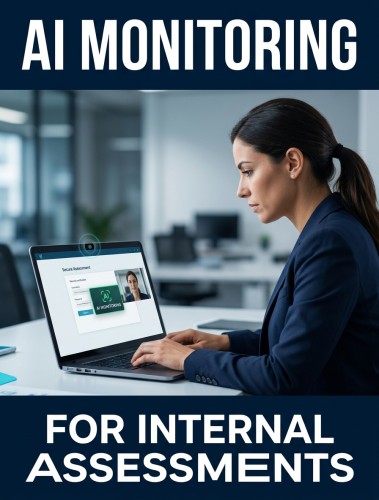
Proctor360's platform builds around exactly this gap. During check-in, the system automatically verifies the candidate's name and photo ID, confirming the person on camera matches who registered for the session. Once the assessment begins, Proctor360 continues to monitor and record webcam, audio, and screen activity together, and every flagged incident is screenshotted and timestamped for your team to review, not buried in an unexplained score.
For technical or coding assessments where the fastest, most confident-looking answer is exactly what an overlay tool produces, that layered visibility (screen, webcam, and audio) catches what a single feed misses. And because Proctor360 is built to verify and monitor your candidates during their pre-employment test sessions rather than just record and hope, your team gets evidence instead of a guess.
Setting the Policy Before the Interview
Technology closes half the gap. The other half is telling candidates plainly, before the assessment starts, that AI-generated assistance during a live interview or proctored test is disqualifying. Ambiguity here favors the candidate using the tool. Clarity favors everyone else who prepared honestly.
Frequently Asked Questions
Can Cluely be used on a phone screen, not just a coding test?
Yes. Its interview mode works entirely through audio, transcribing the interviewer's spoken question and generating a response the candidate reads back, which means it applies to behavioral and phone interviews just as easily as technical assessments.
Would our video interview platform's recording show if a candidate used it?
Not reliably. Cluely is designed specifically to stay invisible to standard screen sharing and recording, which is why detection needs to include behavioral and audio signals, not just a look back at the screen recording.
How fast has this actually become a real hiring risk?
Per Fabric's analysis of 19,368 technical interviews, cheating signals appeared in 38.5% of candidates overall and 48% in purely technical roles, up from a 15%-to-35% doubling the same company measured across 50,000 candidates between June and December 2025.
Is this only a technical-interview problem?
No. The FBI's alert on North Korean IT worker threats describes state-sponsored operatives using AI tools to pass video interviews and gain employment access to corporate networks, which extends the risk well beyond a single bad technical hire.
What is the fastest fix for a company running remote assessments today?
Add identity verification and continuous webcam and audio monitoring to whatever technical or pre-employment test you already run, and require a timestamped incident log your hiring team can actually review before extending an offer.
What share of cheating cases actually involve tools like Cluely, versus something simpler like a second monitor?
Per Fabric's 19,368-interview study, dedicated overlay tools such as Cluely and Interview Coder accounted for 45% of detected cheating methods, ahead of voice-mode use on general chatbots (34%) and traditional methods like tab switching or a second screen (18%).
Verify Every Hire You Extend
If your remote assessment process only records a screen, an overlay tool built to be invisible on that screen was never going to get caught. Schedule a demo to see how Proctor360 verifies identity and monitors webcam, audio, and screen together during every pre-employment test.
Ready to see Proctor360 in action?
Get a 30-minute demo tailored to your exam type, whether that is AI, live, multi-cam, or 360° Total View™.

Kranthi Bathula is the Co-Founder and CTO of Proctor360 and an online proctoring and assessment-security expert with extensive experience in EdTech, exam integrity, and AI-enabled test monitoring. He writes about remote proctoring, test security, AI in assessments, live and automated proctoring, and best practices for secure online testing. Through his engineering-driven insights, Kranthi helps educational institutions, certification bodies, and employers make informed decisions to protect the integrity of their exams.