Peak Admission Season? Here Is How to Run Secure Online Entrance Exams Without Disruptions
An entrance exam has one job: rank thousands of candidates fairly, on the same day, with results no one can credibly dispute. When that exam runs online during peak admission season, a single technical failure or integrity breach does not just affect one candidate. It can force a full retest, trigger legal challenges, and damage the credibility of the entire admissions cycle.
Admission windows compress enormous volume into a few weeks. Tens of thousands of candidates may sit the same exam across different time zones, devices, and connection speeds. The pressure is unforgiving, and the margin for error is close to zero. A score that gets voided because the proctoring platform buckled under load is a score the admissions office cannot defend.
This article covers how to run high-volume online entrance exams that stay secure and stay up, even when everyone shows up at once.
The Two Failures That Sink Admission Exams
Most disruptions trace back to one of two root causes: the platform could not handle the load, or the integrity controls were too weak to defend the result.
Load failures are brutally visible. Candidates get bounced mid-exam, queues stall at check-in, and support lines flood. Integrity failures are quieter but more damaging, because they surface weeks later when a contested result forces a review. According to a systematic review in the Journal of Academic Ethics, 44.7 percent of students admitted to cheating in online exams, so an entrance test without serious controls invites exactly the dispute you most want to avoid.
Plan against both. Capacity and integrity are not competing priorities. A defensible entrance exam needs both at once.
1. Stress-Test Capacity Before the Real Window
Peak load is the part most institutions underestimate. An exam that runs flawlessly for a 200-person pilot can collapse when 20,000 candidates hit check-in within the same 15-minute window.
Confirm with your proctoring vendor how the platform handles concurrency. Ask for specifics: peak concurrent sessions supported, what happens during a check-in surge, and how candidates reconnect if their internet drops mid-exam. Run a scaled pilot that mirrors your real peak, not a quiet Tuesday. The reconnection path matters as much as the entry path, because a dropped session that cannot resume cleanly becomes a retest.
2. Lock Down Identity Verification at Scale
Impersonation is the classic entrance-exam fraud. Someone more capable sits the test in place of the registered candidate, and the institution admits a phantom. At admission scale, automated identity checks are not optional.
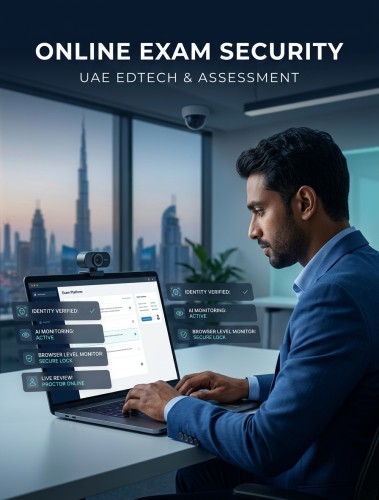
Strong setups verify the candidate at check-in with ID capture and confirm face presence against the camera, then keep monitoring throughout so the verified person is the one who finishes. Automated ID verification handles the volume that manual checks cannot. For the highest-stakes entrance tests, layering a live proctor or a wider camera view over the automated baseline closes the gap a single webcam leaves open.
3. Choose a Monitoring Level the Result Can Survive
An entrance exam result has to withstand scrutiny. If a rejected candidate challenges the process, your monitoring record is the defense. Thin monitoring produces a thin defense.
A single webcam sees the candidate's face and not much else. It misses a phone below the desk, a second person in the room, or notes taped to the wall. For exams where the stakes justify it, a 360-degree view of the testing environment removes those blind spots. The recorded evidence is what lets an admissions board uphold a flagged result with confidence instead of guessing.
4. Prepare Candidates So Disruptions Do Not Become Disputes
A first-time test-taker fumbling the check-in process looks a lot like a candidate in distress, and both flood your support channel. Most peak-season chaos is preventable with preparation.
Publish clear environment requirements, send a mandatory practice exam, and give candidates a real troubleshooting path before exam day. The systems check should happen days ahead, not at the start of the live exam. When candidates arrive knowing what to expect, your support team handles genuine emergencies instead of drowning in avoidable confusion.
Time Zones and a Global Candidate Pool
Admission exams increasingly draw candidates from multiple countries and time zones, which adds a layer of complexity beyond raw volume. A single fixed exam time that suits one region lands in the middle of the night for another, and an exam window that ignores this either disadvantages distant candidates or forces unwieldy multiple sittings that raise their own integrity questions.
Plan the schedule around your actual candidate geography. If sittings have to span time zones, the exam content and security have to hold up across all of them, which means the platform's monitoring and identity verification have to work consistently regardless of where a candidate logs in. A platform already serving international candidates has solved problems a domestic-only tool has never faced. The reach of your admission pool is a real input to the platform decision, not an afterthought.
What a Disruption-Proof Entrance Exam Platform Looks Like
Running secure online entrance exams at peak volume comes down to a platform that stays up under load, verifies identity automatically, monitors deeply enough to defend every result, and supports candidates fast when something goes wrong.
Proctor360 was built for this combination. The platform offers automated ID verification and AI auto-proctoring for volume, plus live and multi-camera options when an exam needs a human in the loop. For maximum-security entrance tests, 360° Total View™ delivers a complete view of the candidate's environment that a standard webcam cannot. Sessions are backed by SOC2, GDPR, and FERPA compliance, with AWS GovCloud hosting available for the most sensitive content. Gartner Peer Insights ranks Proctor360 first for service and support among remote proctoring vendors, which is the difference between a smooth admission window and a flooded support queue.
5. Build Redundancy Into Your Exam-Day Operations
A single point of failure during an admission exam is a single point of catastrophe. If your support team has one channel and it floods, candidates with real problems cannot reach anyone. If your exam runs in one rigid window with no contingency, a regional internet outage can knock out an entire cohort with no recourse.
Plan for the failures you can anticipate. Offer more than one support channel during the live window, staff it for the peak rather than the average, and have a documented contingency for candidates affected by issues outside their control. A clear make-up policy, defined before exam day, turns a potential dispute into a routine accommodation. The institutions that stay calm during admission season are the ones that decided how to handle problems before the problems arrived.
6. Keep Your Integrity Standard Consistent Across the Whole Cohort
Fairness at admission scale means every candidate is held to the same standard. If one group tests under tight monitoring and another slips through with weaker controls, the exam is no longer comparing candidates on equal terms, and a rejected applicant has a legitimate grievance.
Consistency comes from configuration discipline. Set the proctoring level, allowed materials, and identity checks once, apply them uniformly across every session, and document the configuration. When an admissions board reviews a contested decision, a uniform, recorded standard is the difference between a defensible process and one that invites a challenge. Scale does not have to mean uneven enforcement, but only if the standard is locked in before the window opens.
Frequently Asked Questions
How do online entrance exams handle thousands of candidates at once?
A capable platform is built for concurrency, with the infrastructure to support large numbers of simultaneous sessions and a clean reconnection path if a candidate's internet drops. Stress-test the platform with a pilot that mirrors your real peak before the live admission window opens.
How do you stop impersonation in online entrance exams?
Use automated identity verification at check-in that captures ID and confirms face presence against the candidate on camera, then continue monitoring through the exam so the verified person is the one who finishes. For high-stakes exams, add a live proctor or wider camera coverage.
What proctoring level should an entrance exam use?
Match it to the stakes and the dispute risk. Admission decisions affect a candidate's future, so most institutions use automated proctoring with identity verification as a baseline and add multi-camera or 360-degree monitoring for the highest-stakes tests to keep results defensible.
Can remote proctoring prevent retests during admission season?
It reduces the main causes of retests: platform failures under load and integrity breaches that void results. Choosing a platform proven at scale, with strong identity checks and deep monitoring, lowers the chance that a contested or disrupted exam forces a full retest.
How do candidates prepare for a proctored entrance exam?
Institutions should provide environment requirements, a mandatory practice exam, and a systems check several days before exam day. Preparing candidates ahead of time prevents check-in confusion from overwhelming support channels during the live exam.
Run Your Admission Season Without the Firefight
Peak season punishes thin planning. If you are delivering high-volume online entrance exams and need a platform that holds up under load while keeping every result defensible, talk to the Proctor360 team or book a demo to see how it performs at admission scale.

Kranthi Bathula is the Co-Founder and CTO of Proctor360 and an online proctoring and assessment-security expert with extensive experience in EdTech, exam integrity, and AI-enabled test monitoring. He writes about remote proctoring, test security, AI in assessments, live and automated proctoring, and best practices for secure online testing. Through his engineering-driven insights, Kranthi helps educational institutions, certification bodies, and employers make informed decisions to protect the integrity of their exams.